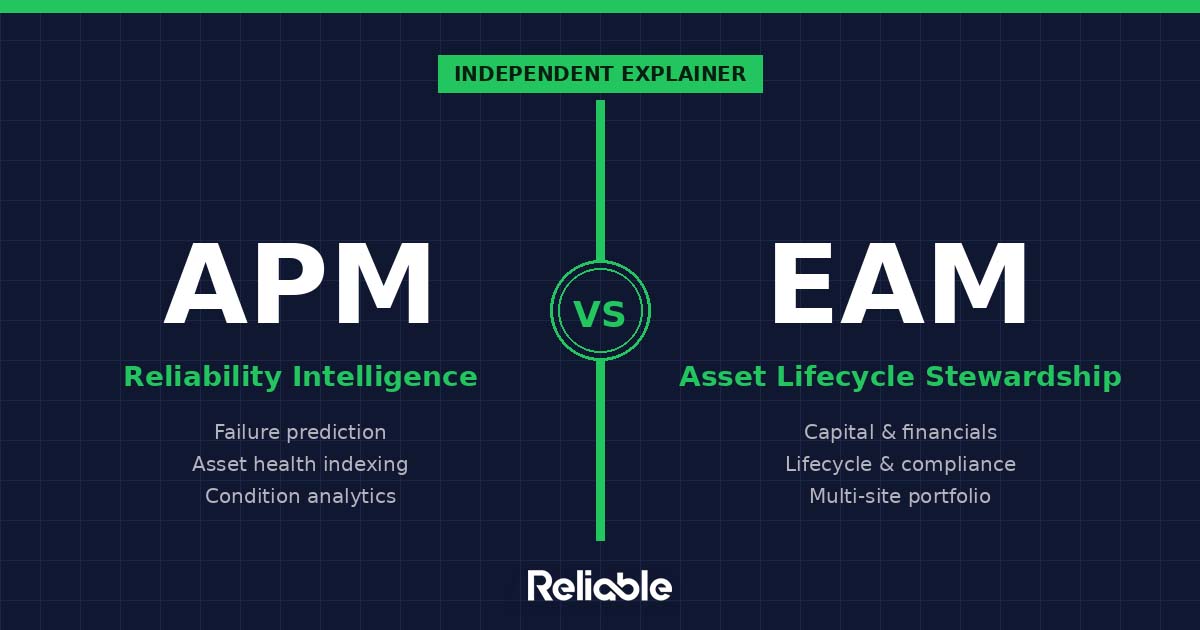

TL;DR: APM and EAM solve different problems at different layers of the asset management stack. EAM (Enterprise Asset Management) is the lifecycle stewardship layer – it manages assets as financial and operational resources from procurement through disposal, including capital planning, depreciation, work management, parts, compliance, and end-of-life decisions. APM (Asset Performance Management) is the reliability intelligence layer – it analyzes condition data, predicts failures, optimizes maintenance strategy, and recommends interventions. EAM manages the asset. APM optimizes how reliably it runs. They integrate bidirectionally: APM recommendations become EAM work orders, EAM execution data feeds back into APM models, and APM reliability intelligence informs EAM capital planning and refurbishment decisions. Most enterprise asset-intensive operations need both, but the right sequencing is EAM first and APM second. Major EAM vendors (IBM Maximo, AVEVA, Hexagon, SAP) now bundle APM modules – the buyer decision is whether bundled APM is analytically deep enough or whether dedicated APM is required alongside.
The Short Answer
EAM manages the asset. APM optimizes how reliably it runs.
If you only remember one thing from this explainer, remember the role distinction. EAM operates at the lifecycle stewardship layer – it owns the asset record from procurement through disposal, including financial accounting, capital planning, work management, compliance documentation, and end-of-life decisions. APM operates at the reliability intelligence layer – it takes condition data from sensors, historians, and IIoT platforms, applies statistical models or AI, and produces predictions and recommendations about asset health and maintenance strategy. EAM is financial and operational; APM is analytical. Both are needed for serious enterprise asset management, but they do fundamentally different things.
Why the Confusion Exists
The categories blur for four reasons. First, the major EAM platforms have absorbed APM functionality into their suites. IBM Maximo Application Suite includes Maximo Reliability Strategies and Maximo Health. AVEVA bundles APM alongside EAM. Hexagon includes APM within HxGN EAM. SAP includes APM capabilities within S/4HANA Asset Management. From the outside, buyers see “EAM with APM” or “APM with EAM” and reasonably conclude the categories are the same thing. They aren’t – the modules have distinct data models and operational purposes – but the marketing makes them look identical.
Second, dedicated APM vendors increasingly include lifecycle management features that look like EAM. GE Vernova APM, AspenTech Mtell, Bentley AssetWise APM, and others have added asset hierarchy management, work order routing, and basic lifecycle tracking. These features handle simple cases but rarely match dedicated EAM platforms on procurement, depreciation, capital planning, or compliance depth. Buyers reading APM vendor marketing sometimes conclude APM replaces EAM, which it generally doesn’t for serious enterprise operations.
Third, the analyst community has not consistently disambiguated the categories. Gartner publishes Magic Quadrants for EAM and Market Guides for APM as separate categories, but the vendor lists overlap heavily and the category definitions blur at the edges. Verdantix and ARC Advisory cover both categories with significant vendor overlap. Buyers reading analyst content sometimes encounter the same vendor described as both EAM and APM in different reports, which deepens the confusion rather than resolving it.
Fourth, EAM and APM serve overlapping buyer populations within the same organizations. The reliability engineer evaluating APM and the asset manager evaluating EAM often report to the same VP of Operations or Plant Manager, and the procurement decision frequently bundles both. Vendors selling into this overlap have strong incentives to position their offerings as one-stop solutions, which compresses the marketing distinction even when the underlying products remain operationally distinct.
What APM Does
APM operates at the reliability intelligence and predictive analytics layer of the asset management stack. The core capabilities are:
- Asset health indexing – aggregating condition data from multiple sources (vibration, temperature, oil analysis, ultrasonic, motor circuit analysis, process data) into composite health scores at the asset and component level
- Failure prediction – applying statistical models, reliability engineering methods, or AI to predict when assets will fail based on current condition and operating context
- Risk-based decision support – quantifying the consequences of failure and the probability of failure to support inspection, maintenance, and replacement decisions, often aligned with risk-based inspection (RBI) methodology
- Reliability-centered maintenance integration – supporting RCM analysis, criticality assessment, failure mode and effects analysis (FMEA), and PM program optimization aligned with SAE JA1011
- Anomaly detection – identifying deviations from normal operating patterns that may indicate developing failures before traditional condition monitoring thresholds are exceeded
- Reliability KPI generation – producing asset health indices, predicted remaining useful life, failure probability, and risk-based prioritization that complement execution KPIs from EAM
- Maintenance strategy optimization – translating analytical outputs into recommended maintenance strategies for specific assets, with priority, urgency, and recommended interventions
APM is the system of record for asset reliability intelligence. It owns the analytical view of asset condition that EAM execution and lifecycle data cannot produce alone. The major APM platforms covered in our APM guide include GE Vernova APM, AVEVA APM, Bentley AssetWise APM, IBM Maximo APM (within the Maximo Application Suite), and emerging AI-driven platforms like Augury, Senseye (Siemens), and AspenTech Mtell.
What EAM Does
EAM operates at the asset lifecycle stewardship layer. The core capabilities are:
- Asset lifecycle management – tracking assets from procurement through commissioning, operation, refurbishment, and disposal, with full financial and operational records at every stage
- Financial asset management – capitalization, depreciation, total cost of ownership tracking, and integration with general ledger for asset accounting
- Capital project management – capital project workflows for asset acquisition, installation, commissioning, and major refurbishment, often integrated with engineering and procurement systems
- Work management – work order workflow, preventive maintenance scheduling, planning and scheduling, technician execution – the CMMS functions that EAM includes as a foundational layer
- Procurement and inventory – spare parts inventory, MRO procurement, supplier management, and inventory optimization across multi-site operations
- Compliance and regulatory documentation – calibration records, inspection logs, mechanical integrity documentation, audit trails for regulated industries (utilities, pharmaceutical, aerospace, oil and gas)
- Multi-site portfolio management – managing asset portfolios across plants, regions, or business units with consolidated reporting, standardized hierarchies, and cross-site analytics
EAM is the system of record for asset stewardship. It owns the lifecycle and financial record of every asset – every capital project, every maintenance event, every compliance audit, every depreciation entry – that drives organizational decisions and feeds enterprise financial reporting. The major EAM platforms covered in our EAM guide include IBM Maximo Application Suite, SAP S/4HANA Asset Management, Oracle Cloud Maintenance, Hexagon HxGN EAM, AVEVA APM (with EAM capabilities), and Infor EAM.
Side-by-Side Comparison
| Dimension | APM | EAM |
|---|---|---|
| Primary Function | Reliability analytics | Asset lifecycle stewardship |
| Primary Question | What will fail and when? | How is the asset managed over its life? |
| Layer | Analytical / intelligence | Lifecycle / financial / operational |
| Primary Outputs | Predictions, recommendations, health indices | Lifecycle records, work orders, financial data |
| Primary Users | Reliability engineers, asset analysts | Asset managers, planners, finance, compliance |
| Data Sources | Sensors, historians, IIoT, condition monitoring | Work orders, financials, procurement, ERP |
| Time Horizon | Days to months (forward-looking) | Asset life (years to decades) |
| Typical Vendors | GE Vernova, AVEVA, Bentley, Augury, AspenTech Mtell | IBM Maximo, SAP, Oracle, Hexagon, Infor |
| Implementation | 6-24 months (data + models) | 6-24 months (enterprise deployment) |
The Overlap Zone (and Where Vendors Confuse Buyers)
Three areas of legitimate overlap between APM and EAM create most of the buyer confusion.
Bundled APM modules in EAM platforms. The major EAM vendors all bundle APM capabilities into their suites. IBM Maximo Application Suite, AVEVA, Hexagon, and SAP all ship APM modules alongside EAM. The bundles are real and operationally useful – for operations already on the EAM platform, the bundled APM module is often the path of least resistance for adding predictive capability. But the bundled modules vary considerably in analytical depth. IBM Maximo APM and AVEVA APM are competitive with dedicated APM platforms for many use cases. Other bundled APM modules handle basic predictive scenarios but rarely match dedicated platforms (AspenTech Mtell, Augury, Senseye) on advanced reliability modeling, multi-source data fusion, or risk-based decision support. The buyer decision is whether bundled APM meets analytical requirements or whether dedicated APM is needed alongside.
Asset hierarchy and master data. Both systems track equipment, both maintain asset hierarchies, and both need consistent IDs across the same physical assets. APM tracks assets for analytical purposes – health, criticality, predicted failure modes. EAM tracks assets for lifecycle purposes – financial records, work history, procurement, compliance. The right architecture aligns the asset master between systems through scheduled sync or API integration, with one system designated as the master (typically EAM, because EAM is the financial and lifecycle system of record). Misalignment between APM and EAM asset masters is one of the most common implementation failures and one of the hardest to fix after deployment.
Reliability KPIs and lifecycle decisions. Both systems produce KPIs but at different levels. EAM produces operational and financial KPIs from work order and financial data – MTBF, MTTR, PM compliance, maintenance cost per asset, total cost of ownership. APM produces predictive and risk-based KPIs from analytical data – asset health indices, predicted remaining useful life, failure probability, risk-based prioritization. The reliability intelligence flowing from APM into EAM lifecycle decisions – when to refurbish versus replace, when to extend versus retire – is one of the most valuable integration points and one of the most underexploited in real operations.
How APM and EAM Integrate
Integration between APM and EAM happens at four primary handshake points. Each one is operationally important and each one is commonly underestimated during procurement.
The asset master handshake. Both systems need to reference the same physical equipment with consistent IDs. The asset master integration aligns the equipment hierarchy so a pump in APM is the same pump in EAM, including the same component breakdown, the same criticality classification, and the same parent-child relationships. Without alignment, APM analytics and EAM work orders cannot be correlated, and lifecycle decisions cannot draw on reliability intelligence. The right architecture typically designates EAM as the asset master and replicates to APM through scheduled sync or API integration. When APM and EAM come from the same vendor, this handshake is native and rarely a problem. Cross-vendor integrations require active master data management.
The recommendation-to-work-order handshake. When APM identifies a developing failure or maintenance need, the recommendation should generate an EAM work order with appropriate priority, estimated parts, and estimated labor. Done well, this means a vibration anomaly detected by APM at 2 a.m. becomes a planned work order in EAM by 6 a.m. – sized, parts-staged, and ready for technician dispatch. Done poorly, the recommendation lives in APM dashboards that nobody acts on. The integration quality at this handshake is the most consequential factor in whether APM produces operational value or remains a reporting layer.
The execution-data feedback handshake. EAM work order completion data should flow back into APM models. When a recommended action is completed – a bearing replaced, an alignment performed, a lubricant changed – APM should update its predictions based on the actual maintenance and observed outcome. Without this feedback, APM models drift from operational reality and predictions degrade over time. The feedback loop is what allows APM models to improve through real operational data rather than remain static at deployment baseline.
The lifecycle-decision handshake. APM reliability intelligence should feed into EAM lifecycle decisions – capital planning, refurbishment versus replacement, end-of-life timing, asset replacement strategy. This is the integration point most often left undeveloped. Operations with mature APM and mature EAM often run them as parallel systems where APM informs daily maintenance but does not inform capital decisions. The opportunity is to feed APM-calculated remaining useful life, failure probability, and risk-weighted cost into EAM capital planning workflows so reliability data drives lifecycle decisions rather than just maintenance decisions. This integration is technically straightforward but organizationally hard because it requires alignment between reliability engineering (APM users) and asset management or finance (EAM users).
Modern integrations use middleware platforms (MuleSoft, Boomi, webMethods) or direct API connections. When APM and EAM ship from the same vendor – IBM Maximo APM with Maximo EAM, AVEVA APM with AVEVA EAM, Hexagon APM with HxGN EAM – these integrations are native and substantially easier. Cross-vendor integrations work but require integration design and ongoing maintenance.
When EAM Alone Is Enough
Many operations need EAM but not dedicated APM. The patterns where EAM alone is adequate:
- Operations without significant condition monitoring – APM analyzes condition data, and operations without sensors, historian data, or condition monitoring programs have nothing for APM to analyze
- Operations where EAM-bundled APM meets analytical needs – IBM Maximo APM, AVEVA APM, or Hexagon APM may handle predictive requirements without a dedicated APM platform alongside
- Asset-intensive operations with simpler predictive needs – utilities and infrastructure operations with extensive asset portfolios but predictable failure modes often get adequate predictive value from EAM-bundled analytics without standalone APM
- Operations early in their reliability journey – typically the first 12 to 24 months after deploying EAM, where the lifecycle and maintenance discipline isn’t yet mature enough to act on advanced predictive recommendations
For these operations, EAM handles asset management adequately on its own, often supplemented by the APM module bundled with the EAM platform. PM programs based on calendar or meter triggers, condition-based PMs from sensor inputs where deployed, and basic predictive scenarios from EAM-bundled APM cover the operational scope. Adding dedicated APM at this stage typically produces dashboards that don’t connect to existing workflows rather than operational improvement.
When You Need Dedicated APM Alongside EAM
Dedicated APM (separate from EAM-bundled APM) becomes valuable when several conditions are met simultaneously:
- Condition monitoring is in place at scale – vibration sensors, oil analysis programs, thermal imaging routes, ultrasonic surveys, motor circuit analysis. APM analyzes data; without data, there’s nothing to analyze
- EAM-bundled APM doesn’t meet analytical depth requirements – operations needing advanced statistical reliability modeling, multi-source data fusion, AI-driven anomaly detection, or specialized predictive analytics often find bundled APM inadequate
- The assets are capital-intensive enough to justify specialized analytics – APM business cases work best when individual asset failures cost six or seven figures in lost production, replacement, or safety consequences
- Reliability engineering is a serious function – APM platforms produce analytical outputs that require reliability engineering interpretation. Operations without dedicated reliability resources rarely extract full APM value
- Mechanical integrity programs require risk-based methodology – oil and gas, chemical, and refining operations with API 580/581 risk-based inspection programs often need dedicated APM that supports the methodology rigorously
Industries where dedicated APM typically delivers strong ROI alongside EAM include power generation (turbine reliability), oil and gas (rotating equipment, mechanical integrity), mining (haul truck and shovel availability), chemical and refining (process equipment with risk-based inspection), and aerospace (engine and component lifecycle). Operations in these industries with mature EAM deployments typically benefit substantially from dedicated APM addition. Operations without these characteristics often find EAM-bundled APM sufficient.
When You Need Both
Most mature enterprise asset-intensive operations need both APM and EAM. The scenarios where both are effectively required:
Capital-intensive operations with reliability maturity. Operations with expensive equipment, established condition monitoring, mature lifecycle management, and reliability engineering function need both systems. The integration between them – APM recommendations flowing into EAM work orders, EAM execution data flowing back into APM models, APM intelligence informing EAM capital decisions – is what makes serious enterprise reliability programs work.
Regulated industries with mechanical integrity programs. Oil and gas, chemical, pharmaceutical, and aerospace operations with mechanical integrity (MI) programs under OSHA PSM, FDA validation, or API standards typically need APM for risk-based inspection methodology and EAM for lifecycle management and compliance documentation. The compliance burden of MI programs is difficult to manage with EAM alone and impossible to satisfy with APM alone.
Multi-site portfolio operations. Operations managing assets across multiple plants, regions, or business units need EAM for portfolio management and standardized lifecycle workflows, and APM for consistent reliability intelligence that supports portfolio-level decisions about where to invest in refurbishment, replacement, or reliability improvement programs.
Utility and infrastructure operations. Investor-owned utilities, transmission operators, water utilities, and major infrastructure operators typically deploy EAM for the lifecycle and regulatory requirements that define utility asset management, and APM for the predictive intelligence that supports grid reliability, transformer health, and substation asset management. The combined deployment is essentially standard at this scale.
The Bundled vs Dedicated APM Decision
When operations need both APM and EAM, the next decision is whether to use the APM module bundled with the chosen EAM platform or to deploy dedicated APM alongside. The decision turns on three factors.
Analytical depth required. If the operation needs advanced statistical reliability modeling, multi-source data fusion across DCS and historian and IIoT, AI-driven anomaly detection on rotating equipment, or specialized risk-based inspection methodology, dedicated APM (AspenTech Mtell, Augury, Senseye, GE Vernova APM) often outperforms bundled APM. If the operation needs basic predictive maintenance, condition-based PM triggering, and asset health monitoring on a modest scale, bundled APM from IBM Maximo, AVEVA, Hexagon, or SAP is often adequate.
EAM vendor and integration overhead. Bundled APM ships with native EAM integration – asset master alignment, work order generation, execution feedback are all handled within the platform. Dedicated APM requires integration design and ongoing maintenance. For operations on IBM Maximo, AVEVA, or Hexagon EAM where the bundled APM is competitive, the integration simplicity often outweighs the analytical depth advantage of dedicated APM. For operations on EAM platforms with weaker bundled APM, dedicated APM is more attractive despite the integration overhead.
Reliability engineering capability. Dedicated APM platforms require reliability engineering interpretation to extract full value. Operations with strong reliability engineering functions can drive value from sophisticated dedicated APM platforms. Operations with thinner reliability engineering benches often get more practical value from bundled APM that requires less specialized expertise to operate.
The Honest Middle Ground
APM and EAM selection is a category where overbuying on dedicated APM is the most common procurement mistake when operations are already on a major EAM platform. A few honest assessments worth flagging.
EAM-bundled APM is often good enough. The major EAM vendors have invested heavily in APM modules over the past decade. IBM Maximo APM, AVEVA APM, and Hexagon APM are competitive with dedicated APM platforms for many use cases. Operations on these EAM platforms should evaluate the bundled APM seriously before assuming dedicated APM is required. The integration simplicity and unified vendor relationship often outweigh modest analytical advantages of dedicated APM.
Dedicated APM without EAM rarely works at enterprise scale. Operations sometimes deploy dedicated APM (Augury, AspenTech Mtell, Senseye) without a serious EAM underneath, then discover the APM recommendations don’t connect to financial decisions, capital planning, or compliance documentation. APM is most valuable when it feeds intelligence into EAM lifecycle workflows. Without that integration, APM becomes a reporting layer that informs maintenance but doesn’t inform asset management.
The AI hype creates premature APM deployments. Vendors selling AI-driven APM emphasize the technology rather than the operational prerequisites, and buyers sometimes deploy APM because the AI capabilities sound compelling. Without EAM discipline underneath, without condition monitoring data feeding the AI, and without reliability engineering capability to act on recommendations, the AI has nothing to drive. Operations that deploy APM in this context typically discover the implementation produces dashboards rather than operational value.
EAM is generally a bigger decision than APM. EAM is the system of record for asset management – it touches finance, procurement, maintenance, operations, and compliance. APM is the analytical layer that informs reliability decisions within that broader system. EAM selection mistakes are harder to recover from than APM selection mistakes because EAM is more deeply embedded in enterprise workflows. Buyers should weight EAM selection carefully and treat APM as a downstream decision that follows the EAM architecture.
Frequently Asked Questions
What is the difference between APM and EAM?
APM is the analytical layer that optimizes reliability strategy – it ingests condition data, applies statistical or AI models, produces health indices, predicts failures, and recommends interventions. EAM is the lifecycle management layer that handles the full financial and operational life of an asset – procurement, capitalization, depreciation, maintenance execution, compliance, refurbishment, and disposal. APM is reliability intelligence. EAM is asset stewardship. They complement each other and most enterprise operations deploy both.
Do I need both APM and EAM?
Most enterprise asset-intensive operations need both, but the right sequencing is EAM first and APM second. EAM is required for any organization managing assets as financial resources across their lifecycle. APM becomes valuable when condition monitoring data is being captured at scale and the organization has reliability engineering capability to act on predictive recommendations. Operations starting out should implement EAM first, build asset hierarchy and maintenance discipline, deploy condition monitoring, then add APM.
Can APM replace EAM?
No. APM and EAM solve fundamentally different problems. APM platforms include some maintenance execution and recommendation features, but they do not handle the financial, procurement, capital planning, depreciation, and compliance workflows that define EAM. Operations managing assets as financial resources require EAM functionality that APM platforms do not provide.
Can EAM replace APM?
Generally no, though major EAM platforms increasingly bundle APM modules. IBM Maximo Application Suite, AVEVA, Hexagon EAM, and SAP all include APM capabilities alongside core EAM. These bundled modules handle many predictive use cases adequately. Organizations requiring deep statistical reliability modeling, advanced failure mode analysis, or specialized predictive analytics often supplement EAM-bundled APM with dedicated platforms.
Should I implement APM or EAM first?
EAM first for almost all operations. EAM establishes the asset master, lifecycle records, work management workflows, and compliance documentation that APM analytics require as a foundation. APM produces predictions and recommendations that need EAM infrastructure to convert into action. The right sequence is EAM first, condition monitoring deployment second, and APM third.
How do APM and EAM integrate?
Integration happens at four primary handshake points. The asset master handshake aligns equipment hierarchy across both systems. The recommendation-to-work-order handshake converts APM predictions into EAM work orders. The execution-data feedback handshake flows EAM completion data back into APM models. The lifecycle-decision handshake feeds APM reliability intelligence into EAM capital planning and refurbishment decisions. When APM and EAM come from the same vendor, these integrations are native.
Is APM a module within EAM, or a separate category?
Both, depending on the vendor. Major EAM platforms bundle APM as a module within the broader suite – IBM Maximo Application Suite includes Maximo APM, AVEVA includes APM alongside EAM, Hexagon includes APM within HxGN EAM. Dedicated APM vendors (GE Vernova, AspenTech Mtell, Augury, Senseye, Bentley AssetWise) sell APM as a standalone category that integrates with whatever EAM the operation already runs. The buyer decision is whether bundled APM from the EAM vendor meets analytical needs or whether dedicated APM is required alongside.
Related Guides
- Best EAM Software 2026: Independent Comparison
- Best Asset Performance Management Software 2026
- APM vs CMMS: What’s the Difference, and Which One Do You Need?
- CMMS vs EAM: What’s the Difference, and Which One Do You Need?
- Best CMMS Software 2026: Independent Comparison
- How to Calculate Asset Criticality
Sources
- IBM Maximo Application Suite documentation – ibm.com/products/maximo
- SAP S/4HANA Asset Management documentation – sap.com
- Oracle Cloud Maintenance documentation – oracle.com
- Hexagon HxGN EAM documentation – hexagon.com
- AVEVA Asset Performance Management documentation – aveva.com
- Infor EAM product documentation – infor.com
- GE Vernova APM product documentation – gevernova.com
- Bentley AssetWise APM documentation – bentley.com
- AspenTech Mtell product documentation – aspentech.com
- Augury product documentation – augury.com
- Senseye (Siemens) product documentation – siemens.com
- SMRP Best Practices – Society for Maintenance and Reliability Professionals
- ISO 55000 Asset Management standard
- SAE JA1011 reliability-centered maintenance standard
- API 580/581 Risk-Based Inspection methodology
- Reliable Magazine independent editorial analysis
Last updated: May 13, 2026. This guide is editorial analysis by Reliable Magazine.