
When production demands climb, bearings tend to be the first component to register the change. Every plant has a story about a line that ran faster than the original design intent for months, then surrendered a string of bearing failures in a single quarter. The common causes of bearing failure on overloaded equipment follow a familiar pattern. They are often predictable, traceable, and preceded by warning signs that may be noticed but not acted on. This article walks through the patterns that show up most often and how reliability teams catch them before the unplanned shutdown.
Why the Common Causes of Bearing Failure Cluster Around Overload
Bearings have rated capacity. That capacity assumes a specific load, a specific speed, a specific temperature range, and a specific lubrication condition. When any one of those variables drifts outside the design envelope, expected service life starts to fall fast. When multiple variables drift at once, service life can fall sharply; the exact reduction depends on load, speed, lubrication, bearing type, and duty cycle.
The deeper problem is that overload conditions usually arrive gradually. They show up across a sequence of small changes that look harmless in isolation. A new product mix that runs slightly hotter. A scheduling change that adds two more hours of operation per day. A cost reduction that switched to a lower-grade grease. Each adjustment looks small on its own. Together they push the asset past its limit.
Asset design margin gets eaten by gradual change more often than by acute events. A line that operated comfortably for ten years can shift into a chronic failure pattern within six months once the design margin gets consumed.
Bearings carry the running total of every overload decision in the plant. The failure event is just the receipt.
Reliability engineers who track design margins on critical assets catch this drift early. A simple log of bearing temperature, vibration, and load over time tells a clearer story than any single inspection.
Excessive Load, Speed, and Heat
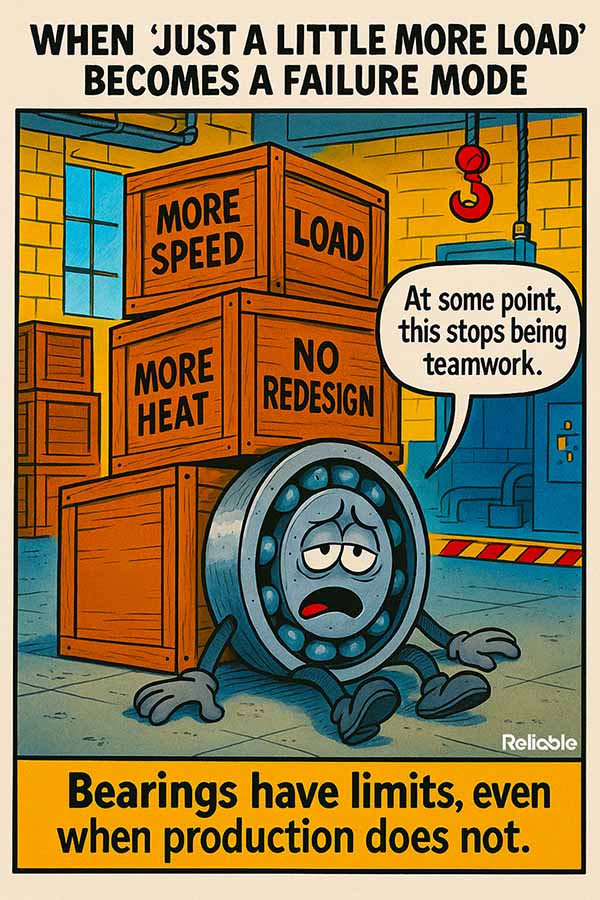
Three common overload conditions appear in many bearing failure investigations and are frequently discussed in bearing reliability guidance.
- Load beyond design rating, often from added belt tension, misalignment, or higher-than-spec product weight
- Speed increases driven by throughput targets that bypass the original gearing or pulley calculations
- Operating temperature climbing past lubricant film limits, often because of ambient changes, motor heat, or process changes
Many of these patterns can leave indicators in vibration data. Spectrum changes at characteristic bearing frequencies can appear before audible symptoms or functional failure. Reliability engineers who run vibration analysis as a routine practice may flag these patterns early enough for planned intervention.
Contamination and Lubrication Failures
Contamination and lubrication problems are among the most common contributors to premature bearing failure. Water ingress, particulate intrusion, incorrect grease quantity, wrong lubricant selection, and grease compatibility errors all qualify.
Two common contamination mistakes stand out. The first is reusing grease guns across incompatible lubricants. The second is open storage of bearings before installation, which can allow dust or moisture contamination before the bearing ever enters service.
Sealing strategy matters as much as the lubricant itself. A bearing with a marginal seal in a clean, dry environment may outlast a well-lubricated bearing exposed to persistent contamination. Plants that win the contamination battle invest in sealing upgrades before they invest in better grease.
Plants that take contamination seriously also invest in lubricant storage discipline. Dedicated grease guns, color-coded fittings, clean handling practices, and controlled bearing storage add up to fewer preventable bearing replacements per year.
How to Spot the Common Causes of Bearing Failure Before They Take Down a Line
Many overload-driven bearing failures develop detectable warning signs before functional failure. The teams that catch them share a few habits.
- Trend vibration data continuously on critical bearings and supplement with periodic spot checks
- Track bearing housing temperature against ambient and against historical baseline
- Log every process change that touches load, speed, heat, or lubrication on monitored assets
- Run a quick design margin check whenever production asks for a sustained rate increase
A 5 percent speed bump on a production line might look like a free win. Plants that do the margin check first may find that the same bump materially changes bearing speed, heat generation, lubricant film conditions, or supported load. That kind of math gets the production conversation back on solid ground.
Bearings tell the truth in vibration data weeks before they fail. Someone has to be reading.
Teams with strong bearing performance often share two habits. They assign someone to review vibration trends on a regular cadence. And they have a working relationship with operations that lets them push back when a process change is about to violate a design margin.
When Bearings Keep Failing in the Same Spot
Repeat failures on the same asset should trigger a review of the operating condition before assuming a bad bearing brand or poor installation. Duty cycle, process changes, load shifts, lubrication practices, and fit/alignment issues can all explain chronic patterns.
A complete bearing failure analysis on a chronically failing asset usually finds that the duty cycle has shifted since the original specification, the upstream or downstream load profile has changed, or process variables (temperature, humidity, ambient dust) have drifted from the original baseline.
The answers point to either a redesign conversation or a process change conversation. Both are harder than a bearing swap. Both are also the only way to break the cycle. Plants that take the harder conversation tend to find that the chronic failure mode disappears for years.
The Bottom Line
The common causes of bearing failure on overloaded equipment cluster around four patterns: load beyond design rating, speed beyond design rating, heat beyond lubricant limits, and contamination ingress. None of these are mysteries. Many of them produce warning signs that a well-designed monitoring program can catch. Each pattern represents a recognized form of component failure with decades of practical and published reliability work behind it.
Plants that treat bearings as honest reporters of equipment condition tend to run longer between failures. Plants that treat bearings as a consumable that fails on its own schedule tend to keep buying bearings.