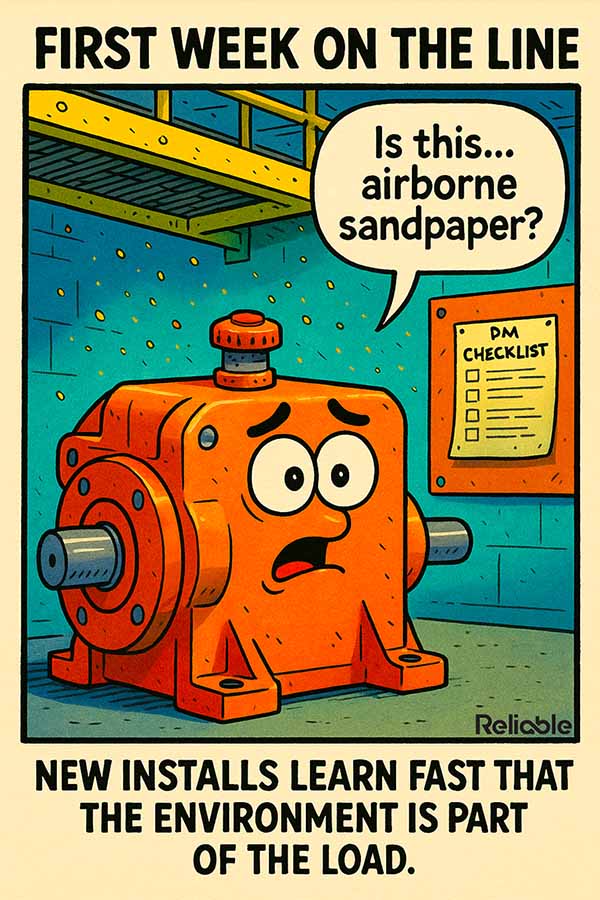

A new gearbox does not get a grace period. The day it goes online, the plant air goes to work on it, and in a dusty environment that air behaves like fine sandpaper. Understanding how to control airborne contamination can make the difference between an asset that reaches its expected service life and one that develops premature wear soon after startup.
Commissioning checklists obsess over alignment, torque, and oil level. The air the machine breathes barely gets a mention, and that gap quietly shortens equipment life across the plant.
Why Airborne Contamination Can Hit New Installs Early
New and existing equipment both rely on tight clearances. Bearings, seals, and gear meshes are manufactured to tolerances measured in microns, and particles within those clearance ranges can disrupt lubricant films and damage contact surfaces.
Cement dust, weld smoke, grinding swarf, and ordinary plant grit all ride the air currents. When they work past a seal, they embed in soft metal, score hardened surfaces, and turn clean lubricant into grinding paste.
Particles too small to see can still be large enough to damage a precision bearing surface.
The damage compounds. One scored surface generates more wear particles, those particles cause more damage, and the failure curve steepens long before anyone has scheduled an inspection.
New equipment can be especially vulnerable during commissioning because fabrication debris, dirty assembly practices, unflushed piping, or incorrect breathers may introduce contamination before a stable cleanliness baseline is established. Existing equipment remains vulnerable whenever seals, filtration, or handling practices allow contamination to enter.
Catching that early depends on watching the right signals, which is why asset condition monitoring belongs on every new install from the first shift, well before the noise ever starts.
How to Control Airborne Contamination at the Source
The cheapest particle to deal with is the one that never reaches the machine. Source control should be the first line of defense, supported by effective sealing and filtration where contamination cannot be eliminated at its source.
- Enclose or capture dust at grinding, cutting, and bagging operations
- Keep doors and bay openings closed near sensitive equipment
- Maintain plant ventilation so clean air pushes dirty air outward
- Schedule housekeeping that removes settled dust before traffic stirs it up again
None of this is exotic. It is discipline, applied in the places where contamination originates rather than where it finally does its damage.
Every plant has its own dust signature too, so how to control airborne contamination on your floor depends on what your air is actually carrying. A foundry, a sawmill, and a cement plant each fight a different particle, and the controls should match the threat.
Seal and Breathe Smarter
Most vented gearboxes and reservoirs exchange air as temperature and fluid level change. An open or poorly filtered vent can admit airborne dust and moisture during these breathing cycles.
Properly selected desiccant or particulate breathers and seals reduce that ingress path. Breather selection should account for airflow, humidity, particle loading, lubricant type, and the equipment manufacturer’s requirements.
A properly selected breather is usually inexpensive compared with the repair and downtime costs associated with a contaminated gearbox.
The fittings are small and unglamorous, which is exactly why they get value-engineered off the install. That is a false saving, and the bearing is the one that pays for it.
- Fit desiccant or filtered breathers on gearboxes and reservoirs
- Specify the right seal type for the dust and moisture you actually have
- Where the equipment design permits, use clean, dry-air pressurization so leakage tends to flow outward
Set a Cleanliness Target
Contamination control works far better with a defined target than with general expectations. Set an ISO 4406 cleanliness target for each critical lubricated system based on component sensitivity, operating conditions, and OEM guidance.
A particle-count target gives the effort a measurable finish line. It helps guide filtration and breather selection, tells technicians what acceptable cleanliness looks like, and lets managers evaluate whether controls are working.
Without a target, how to control airborne contamination becomes a matter of opinion, and opinions drift the moment schedules get tight and someone wants to skip a step.
The reverse is also true. A documented target gives a new technician a clear standard to hit and gives a manager a clean way to confirm the program is doing its job, week after week.
Prove the Contamination Control Is Working
Control without measurement is just hope in a clean shirt. Once you have tightened the system, confirm the contamination is actually dropping.
An oil analysis report can identify evidence of contamination and wear through tests such as particle counting, water analysis, elemental analysis, and wear-debris examination. The appropriate test slate turns the contamination program from guesswork into evidence you can act on.
Track those numbers during commissioning and the first weeks of operation. After proper flushing and filtration, cleanliness should stabilize near the target; watching for contamination ingress through a worsening trend can reveal ineffective breathers, leaking seals, dirty transfer practices, or residual commissioning debris before extensive damage develops.
Treat the environment as part of the load. The spec sheet rates the gearbox for torque and speed, and the plant quietly adds dust, heat, and moisture the catalog never mentioned.
Catching a contamination problem through sampling is relatively inexpensive. Catching it after a bearing has seized or damaged the shaft can require a teardown, a rebuild, and an unplanned production outage.
New equipment learns fast that its surroundings matter as much as its duty cycle. Knowing how to control airborne contamination from day one is how you make sure that lesson does not cost you a rebuild.
Protect the air, seal the openings, and measure the result. The machine you commission clean is the one still running when its neighbors are back in the shop.