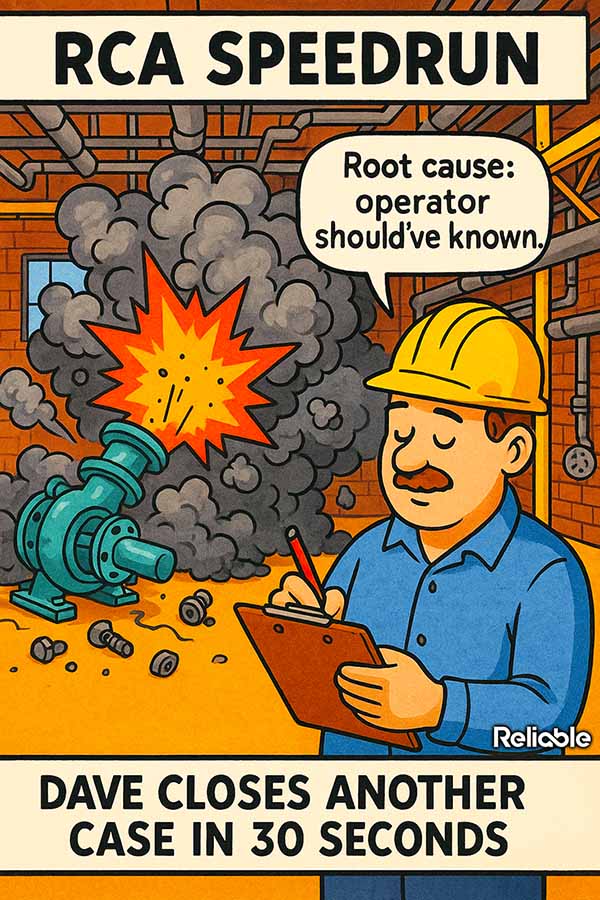

A pump fails. Production stops. Maintenance finds the damage, operations gets questioned and someone writes the conclusion:
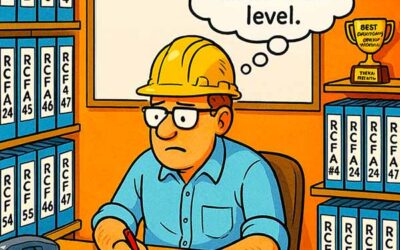
Root cause: operator should’ve known.
Case closed in 30 seconds.
Blaming the operator gives the report a clean ending. It also leaves the conditions that shaped the error sitting there, ready for the next shift.
That’s one of the most common root cause analysis mistakes. The investigation reaches the first human action, calls it the cause and stops digging.
Why “Operator Error” Ends the Investigation Too Early
Human actions often sit closest to a failure.
An operator opens the wrong valve. A mechanic installs a bearing backward. An electrician lands a wire on the wrong terminal.
Human-factors practitioners often call these actions active failures. They occur near the event and produce an immediate effect.
Behind them sit latent conditions: confusing controls, poor procedures, missing safeguards, weak supervision, production pressure, training gaps or equipment designs that make errors easier to commit.
A useful investigation examines both.
Most failures also have several contributing causes. In this article, “root cause” serves as practical shorthand for the controllable conditions an organization can change, rather than a claim that every failure has one tidy cause.
Why Human Error Is a Starting Point
People misread instruments, forget steps, misunderstand instructions and make poor decisions under pressure.
The phrase “human error” identifies the action. The investigation still has to explain why the action occurred and why the system allowed it to produce that consequence.
Compare these two findings:
Finding 1: The operator opened the wrong valve.
Finding 2: Two identical valves were mounted six inches apart, carried faded identification tags and weren’t clearly distinguished in the startup procedure.
The first finding records the action. The second reveals several conditions the organization can correct.
A credible human error root cause analysis asks why the choice made sense, seemed acceptable or became possible at that moment.
Seven Root Cause Analysis Mistakes That Encourage Blame
1. Stopping at the First Human Action
The first person who touched the equipment often becomes the easiest target.
An operator entered the wrong setpoint. A mechanic left a fastener loose. A technician connected the wrong sensor lead.
Those actions belong in the event timeline. The investigation should keep moving:
- Were the correct values clearly marked?
- Could the components be assembled incorrectly?
- Did the drawing match the installed equipment?
- Was the work performed under unusual time pressure?
- Did the job require independent verification?
- Had similar confusion occurred before?
The goal is to follow the cause-and-effect chain until the team reaches conditions it can control.
2. Using Retraining as the Default Corrective Action
“Retrain the operator” appears on RCA reports with suspicious frequency.
Training is appropriate when someone never received the necessary knowledge, couldn’t demonstrate the required skill or faced an unfamiliar task without adequate preparation.
Other conditions require different controls. A poorly designed panel needs redesign. An ambiguous procedure needs clarification. An overloaded operator may need fewer alarms, better automation or additional support.
Before assigning retraining, ask:
- Was the person originally trained?
- Had the person previously demonstrated the task?
- Which knowledge or skill gap contributed to this event?
- How will the organization verify that the new training addresses that gap?
Vague retraining actions usually produce vague results.
3. Treating a Procedure Violation as the Final Cause
An investigator discovers that an employee deviated from the written procedure. The investigation quickly becomes a compliance review.
The procedure deserves equal scrutiny.
Was it available at the job site? Did it match the current equipment? Could the task realistically be completed as written? Were experienced employees routinely using a different method?
A procedure that everyone works around contains useful evidence about the work system.
Evidence may also show reckless behavior, sabotage or deliberate disregard for a known critical risk. Handle that conduct through the appropriate accountability process while continuing to examine the conditions that allowed one person’s action to cause the failure.
4. Investigating From a Conference Room
A conference-room RCA often begins with a maintenance history report and ends with whoever speaks most confidently.
Physical evidence disappears quickly. Parts are discarded, controls are reset, debris is cleaned up and people begin blending their memories with what they’ve heard from others.
Visit the location. Photograph the scene. Record switch positions, alarm histories, process values and component conditions. Preserve failed parts when practical.
The work area may reveal details nobody mentioned: poor lighting, hidden indicators, nearly identical controls, awkward access, missing labels or a blocked line of sight.
5. Asking Questions That Contain the Answer
“Why didn’t you follow the procedure?”
That question assumes the procedure was correct, available, understood and usable. It also puts the employee on defense immediately.
Use neutral prompts:
- Walk me through what you saw.
- What did you expect to happen?
- What information were you using?
- What happened immediately before the decision?
- What made that choice seem appropriate?
- What was different from a normal shift?
Good interviews reconstruct the event. Accusatory interviews produce short, guarded answers.
6. Choosing Causes Before Collecting Evidence
Every investigation team develops theories. Trouble starts when a theory becomes the conclusion before the evidence arrives.
Suppose a gearbox fails after an operator reports unusual noise. The initial theory blames continued operation.
Oil analysis later shows severe water contamination. Maintenance records reveal that a saturated desiccant breather went unreplaced for three months, allowing humid air to enter the gearbox.
The decision to keep running may have increased the final damage. The degradation process had already been developing.
List possible causes early and label them as hypotheses. Then gather evidence that supports, weakens or eliminates each one.
7. Closing the RCA When the Report Is Approved
An investigation creates value when its corrective actions change the conditions that produced the event.
Assign every action an owner, due date and verification method. Then check whether it worked.
A new label was installed. Can employees read it from the normal operating position?
A procedure was revised. Have affected employees used it successfully during an actual job?
A recurring failure was addressed. Did its frequency decline over the next 30, 60 or 90 days?
Report approval closes the paperwork. Effectiveness verification completes the investigation.
Warning Signs That an RCA Has Become a Blame Exercise
Poor investigations tend to reveal themselves early.
Watch for these warning signs:
- The first question is, “Who caused this?”
- The cause statement contains an employee’s name.
- Interviews focus on rule compliance before the timeline is established.
- The report uses words such as “carelessness,” “inattention” or “complacency” without supporting analysis.
- Retraining is selected before training adequacy is evaluated.
- The team never visits the equipment.
- Failed parts, alarm records or process data aren’t preserved.
- Corrective actions apply only to the person involved.
- Opinions appear in the report as established facts.
- A similar event has occurred under another employee.
- The action plan depends on everyone remembering to be more careful.
That next-to-last warning sign matters. When several competent people make the same mistake, the workplace may be creating the same trap repeatedly.
Three Examples of Better Human Error Root Cause Analysis
Example 1: The Wrong Pump Was Started
Weak conclusion: Operator failed to identify the correct pump.
Investigation findings: Pumps P-201A and P-201B had identical local controls. Selector labels were partly obscured. The control room display used different equipment names, and the startup procedure referred only to the “standby pump.”
Stronger corrective actions:
- Standardize equipment names across the field, HMI and procedure.
- Replace damaged identification labels.
- Add positive equipment verification before startup.
- Review similar paired equipment across the facility.
The incorrect selection remains part of the event record. The corrective actions address the conditions that made the selection likely.
Example 2: A Bearing Was Installed Backward
Weak conclusion: Mechanic lacked attention to detail.
Investigation findings: The bearing could physically fit in either orientation. Its manufacturer marking became hidden during installation. The work instruction contained a low-resolution photograph from another machine model.
Stronger corrective actions:
- Update the instruction with the correct model and clear orientation photographs.
- Mark the bearing and housing before installation.
- Add an inspection hold point before reassembly.
- Evaluate a design change that prevents reverse installation.
“Pay closer attention” is difficult to verify. Orientation marks, inspection points and error-proofed designs can be checked.
Example 3: A High-Temperature Alarm Was Missed
Weak conclusion: Operator failed to respond promptly.
Investigation findings: The control system generated 180 alarms during the first 20 minutes after startup. The temperature alarm used the same priority and sound as dozens of lower-consequence alerts.
ISA alarm-management guidance uses more than 10 alarms in 10 minutes per operator as an alarm-flood metric. This event averaged 90 alarms per 10 minutes, nine times that rate.
Stronger corrective actions:
- Rationalize the startup alarms.
- Assign alarm priority according to consequence and required response time.
- Remove duplicate and non-actionable alarms.
- Create a clear response procedure for the critical temperature alarm.
- Test operator workload during startup.
An alarm system that demands attention everywhere makes timely response less reliable.
A Better Root Cause Investigation Process
A disciplined investigation doesn’t need to become a six-week academic exercise. It does need enough structure to keep assumptions from outrunning evidence.
Step 1: Stabilize the Situation
Protect people, control hazards and prevent additional damage.
Document relevant equipment positions and conditions before resetting controls, cleaning the area or disposing of parts.
Step 2: Define the Event Precisely
Describe what failed, where it occurred, when it happened and what consequences followed.
“Pump failure” is too broad.
“The drive-end bearing on cooling-water pump P-204 seized 47 minutes after startup” gives the team a workable starting point.
Step 3: Preserve and Collect Evidence
Gather physical, electronic, documentary and testimonial evidence.
That may include:
- Failed components
- Photographs and measurements
- Alarm and historian data
- Work orders
- Procedures and drawings
- Training records
- Shift logs
- Inspection results
- Interview notes
- Previous similar events
Record where each item came from and when it was collected.
Step 4: Build a Factual Timeline
Arrange equipment conditions, alarms, actions, process changes and communications in time order.
Separate confirmed facts, reasonable inferences and unanswered questions. Three visible gaps are more useful than a smooth story built from assumptions.
Step 5: Examine the Conditions Around the Action
Review the factors that influenced performance:
- Equipment and control design
- Procedure quality
- Labeling and identification
- Training and qualification
- Staffing and workload
- Fatigue and shift patterns
- Supervision
- Communication
- Tools and spare parts
- Environmental conditions
- Production pressure
- Previous warnings or failures
Ask the substitution question:
Would another competent person, facing the same situation with the same information, have been likely to make the same choice?
A “yes” points strongly toward conditions in the system.
Step 6: Classify the Human Action
James Reason’s human-error framework separates slips, lapses, mistakes and violations.
- Slip: The person intended the correct action but performed the wrong one, such as pressing an adjacent button.
- Lapse: The person forgot or lost track of a step.
- Mistake: The person followed an incorrect plan or made a decision based on incomplete knowledge.
- Violation: The person deliberately departed from a rule or procedure.
Slips and lapses are generally skill-based errors. Mistakes are often rule-based or knowledge-based.
The classification should follow the evidence. Surrounding conditions may change how an action is understood, and some events involve more than one category.
Step 7: Develop and Test the Causal Factors
Build a cause-and-effect chain for each credible factor.
Ask:
- Did this condition exist before the event?
- How did it influence the outcome?
- What evidence supports the connection?
- Would changing it probably have prevented the event or reduced its consequences?
- Does the same condition exist elsewhere?
A single equipment failure may involve a physical failure mechanism, a missed detection opportunity and an organizational weakness.
Step 8: Choose Corrective Actions That Change the Work
Favor controls that reduce dependence on perfect memory and constant vigilance.
Depending on the event, effective controls may include:
- Equipment redesign
- Interlocks or permissives
- Error-proofed components
- Improved access
- Standardized labels
- Alarm rationalization
- Clearer procedures
- Automated condition monitoring
- Independent verification for critical steps
- Better planning, scheduling or supervision
Training can support these changes when a defined knowledge or skill gap exists.
Step 9: Verify Effectiveness
Define how the organization will know the risk has been reduced.
Track repeat failures, procedure deviations, alarm response, inspection findings or another relevant measure. Set a review date and reopen the investigation when results show that the controls fell short.
The Question That Improves Every RCA
When an employee makes an error, ask:
What conditions allowed this action to produce this consequence?
That question keeps personal responsibility in view while opening the investigation to equipment, procedures, supervision, workload and organizational decisions.
A strong RCA addresses the full causal chain.
A speedrun RCA circles the operator’s name, schedules another training session and waits for the next failure.