
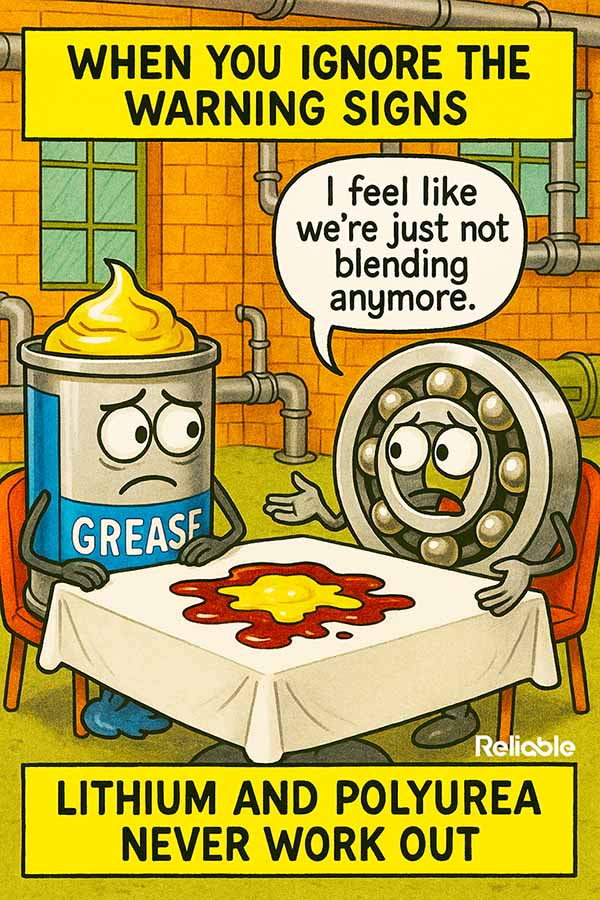

Two greases can each perform well on their own and still perform poorly when mixed. Thickener chemistry is an important part of grease compatibility, but it is not the only part. Base-oil viscosity, additive systems, and the exact formulations also matter, which is why compatibility cannot be predicted reliably from thickener names alone. A mismatch may go unnoticed until grease consistency changes, leakage increases, or a bearing begins running differently after a product change or top-up.
Why Greases Become Incompatible
Lubricating grease is a semi-solid system made from base oil, thickener, and additives. The thickener gives the grease structure and helps retain and distribute the oil. Common thickener families include lithium, lithium complex, polyurea, calcium sulfonate complex, and others. When two incompatible greases are mixed, the mixture can soften, harden, or separate enough that its properties become markedly worse than those of the original products.
Thickener interaction is only part of the picture. ASTM D6185 notes that substantially different base-oil viscosities or additive concentrations can also dilute performance, and even greases with similar thickeners can occasionally be incompatible because of additive interactions. The practical rule is simple: judge compatibility for the actual product pair, not from a thickener chart alone.
The Warning Signs of Grease Incompatibility
Grease incompatibility can produce visible or operating changes, but none of these symptoms proves incompatibility by itself. Watch for changes that appear after a grease change, cross-contamination event, or top-up with a different product:
- Softening or thinning: the mixture becomes noticeably softer or begins leaking from a location where the original grease stayed in place.
- Hardening: the mixture becomes significantly stiffer, which can impair flow or grease distribution.
- Excessive oil separation: liquid oil separates from the thickener structure beyond what is normal for the products involved.
- Unexpected texture or separation: the grease becomes grainy, lumpy, or visibly nonuniform. A color change may show that two products were mixed, but color alone does not establish incompatibility.
- Higher temperature or noise after relubrication: investigate the grease change, but also check for overgreasing, the wrong grease quantity or viscosity, contamination, and mechanical causes.
The important distinction is that these are warning signs, not a field compatibility test. If the symptoms follow a product change, verify what was added before assuming the bearing itself is the root cause.
Lithium and Polyurea: A Pair That Requires Verification
Lithium or lithium-complex grease and polyurea grease should not be assumed compatible simply because both products are suitable bearing greases. They also should not be assumed universally incompatible. ASTM D6185 states that compatibility cannot be predicted with certainty from grease composition, and polyurea itself covers multiple formulations. Some specific polyurea products have passed ASTM D6185 compatibility testing with specific lithium-complex greases.
That is why the product pair matters more than the generic thickener labels. Different thickener systems can interact, but base oils and additives can change the result as well. Use supplier data for the exact products involved, and treat general compatibility charts as screening guidance rather than proof that a particular pair will perform acceptably in service.
Why Compatibility Testing Matters
When a plant is changing grease products, start with the equipment manufacturer and lubricant suppliers. If the actual pair is not supported by reliable compatibility data, request testing. ASTM D6185-24 evaluates defined binary mixtures and uses dropping point, 100,000-stroke worked penetration, and elevated-temperature storage stability in its primary protocol. A simple jar mix or hot-plate check may expose an obvious problem, but it is not equivalent to the ASTM practice.
Formal testing costs and turnaround vary, but the decision should reflect the consequence of getting the change wrong. On a critical bearing, motor, or production asset, verifying the actual pair before conversion is usually more defensible than relying on a generic thickener chart or an informal bench check.
Documentation is one of the simplest controls. Label grease guns, storage containers, and lubrication points by product, and maintain the specified grease in the lubrication route or CMMS. Those controls reduce the chance that a technician unknowingly introduces a different product and make it easier to reconstruct what happened if an operating change follows relubrication.
Compatibility is not a quality contest. Two good greases can still be a poor pair, and two different thickener types are not automatically incompatible.
How to Prevent Grease Incompatibility
Prevention starts with knowing what is actually in the bearing and what the equipment and lubricant suppliers recommend. Keep grease identification clear, control dispensing equipment by product, and document conversions. When changing products, follow the OEM and lubricant supplier’s conversion procedure. Where practical, remove the old grease before introducing a different product; where a purge-through conversion is approved, use the specified procedure and monitor the bearing during the transition.
If a bearing runs hot, leaks, or becomes noisy after relubrication, include grease incompatibility in the investigation, but do not stop there. Overgreasing, contamination, an unsuitable viscosity or grease type, and mechanical problems can produce similar symptoms. Review the lubrication history, identify the exact products involved, and use supplier data or compatibility testing when needed. Many grease-mixing problems are preventable when product identification, change control, and verification are treated as part of the lubrication program.
Sources
ASTM International, ASTM D6185-24, Standard Practice for Evaluating Compatibility of Binary Mixtures of Lubricating Greases. https://store.astm.org/standards/d6185
ExxonMobil, Mobil SHC Polyrex EM product data, including ASTM D6185 compatibility statements for selected lithium-complex greases. https://www.exxonmobil.com/en/apps/pds/mobil/grease/2019/09/29/14/46/glxxmobil-shc-polyrex-em
NTN Americas, Frequently Asked Questions, grease selection and relubrication guidance. https://ntnamericas.com/technical-resources/faqs/
Timken, Thrust Bearing Catalog, grease-use guidance on quantity, temperature, leakage, and relubrication. https://catalog.timken.com/Thrust-Bearing-Catalog/62/63/