How to Build and Keep a Strong Maintenance Team

Maintenance and engineering managers face a host of personnel challenges these days, including the basic question of how and where to find qualified technicians to replace older technicians who are retiring. But once an employee is on the job, the challenges do not end.
Managers also need a strategy for leading people across the full range of performance and personalities, from stars they cannot afford to lose to the hire they cannot afford to keep.
The demographics of every facilities department are similar. Twenty percent are superstars, or high performers. Forty percent are older and more reliable. Thirty percent are new hires. Ten percent are poor performers.
The concept is simple: Before deciding how to manage an employee, managers need to diagnose the individual. A people problem generally is a clarity problem, a conditions problem or a fit problem.
Start at the top
Top performers are high-output, low-maintenance personnel with high internal standards who are self-directed and often impatient with friction. The mistake managers make is assuming that because they need less, they need nothing.
The outstanding tech makes the building run so smoothly that leadership forgets the amount of work that takes. They're technically broad, comfortable across differing HVAC systems, electrical, plumbing, controls and general repairs, but their real edge is judgment. They know which problems are cosmetic and which are the early signal of a failure that will flood a mechanical room at 2 a.m. They diagnose the root cause instead of just clearing the symptom, so the same call doesn't come back three weeks later.
These folks catch failure before failure occurs. For example, during a routine preventive maintenance (PM), notices amp draw on a supply fan motor trending high and a faint vibration that wasn't there last quarter. Instead of closing the PM, pulls the trend from the CMMS, confirms it's climbing, and schedules a motor/bearing replacement for the weekend shutdown. Avoids an unplanned loss of conditioning to a production area during peak hours.
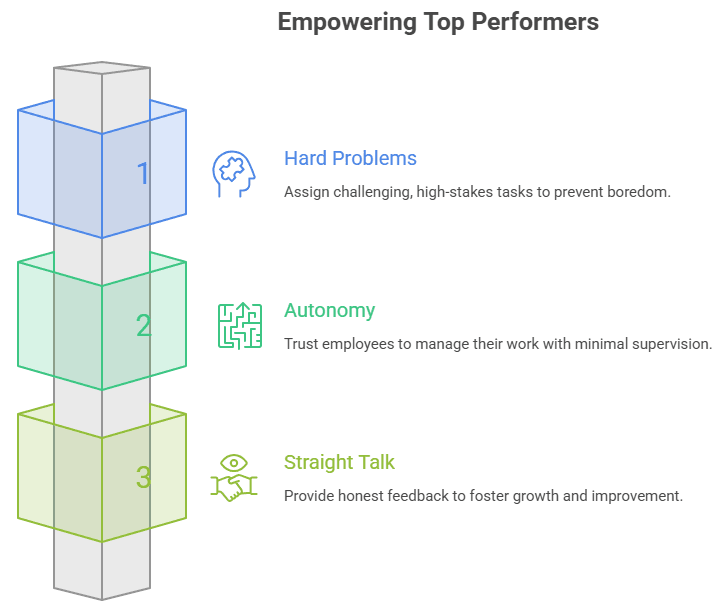
What do these workers actually need from managers?
Hard problems. Boredom is their number one exit reason. Give them the ambiguous, high-stakes work nobody else can do.
Trust first, and verify lightly. Prescribe the outcome, not every step.
Straight talk. They want real feedback, not applause. Tell them where they're actually weak.
Managers also need to protect a top performer’s time. Do not let the best worker become the dump for everyone else's slack. They also need to put the top performer’s name on their work. Visibility to leadership is currency they value more than another compliment.
Workers known as the reliable core show up, do solid work and hold the operation together. They are easy to overlook precisely because they never create problems. They are the backbone of the crew. Give them a work order, and they will complete it correctly and safely. They know the building, they know the equipment they are responsible for, and they follow the preventive maintenance schedule.
Where they differ from the outstanding tech is scope and initiative. They tend to fix what is in front of them rather than scanning for what is coming. They will do excellent work on the tasks assigned but might not connect dots across systems or push improvements on their own.
To successfully manage them:
Recognize specifically. Saying, “The chillers performed well in the heat wave because you finished the PMs last month” beats, “Good job” every time.
Give them a stake in improvements. Their hands are in the process, and they see what you do not. Ask.
Offer growth sized to them. Provide ownership of one area. Not everyone wants a promotion. Most people want to matter.
Be consistent and fair. This group is motivated by stability and even-handedness far more than by adrenaline.
Inspiring above-average employees
Above-average workers are better than solid, though not top performers. But they could be. These are the people worth deliberately investing in because a small push can turn a good employee into a great one. To manage them effectively:
Tell them you see it. “I think you’ve got another gear, and I want to help you find it” is a genuinely motivating sentence.
Stretch them past comfortable. Growth happens at the edge of ability with a safety net, not a cliff.
Pair them with strong performers. Proximity to excellence teaches faster than any course.
Grow scope in steps. Add responsibility in increments, and give real feedback on each one.
Give them a reason. A goal bigger than the task pulls harder than any incentive.
The growth path for these people is usually about broadening technical range and building the anticipation and ownership habits that define the top tier, and a good supervisor actively coaches toward that rather than letting them plateau.
Coaching new hires
Coaching is not training. Training gives workers skills. Coaching builds their judgment, confidence and relationship. One makes them capable at a task, while the other makes them a thinker who can handle the task you did not foresee.
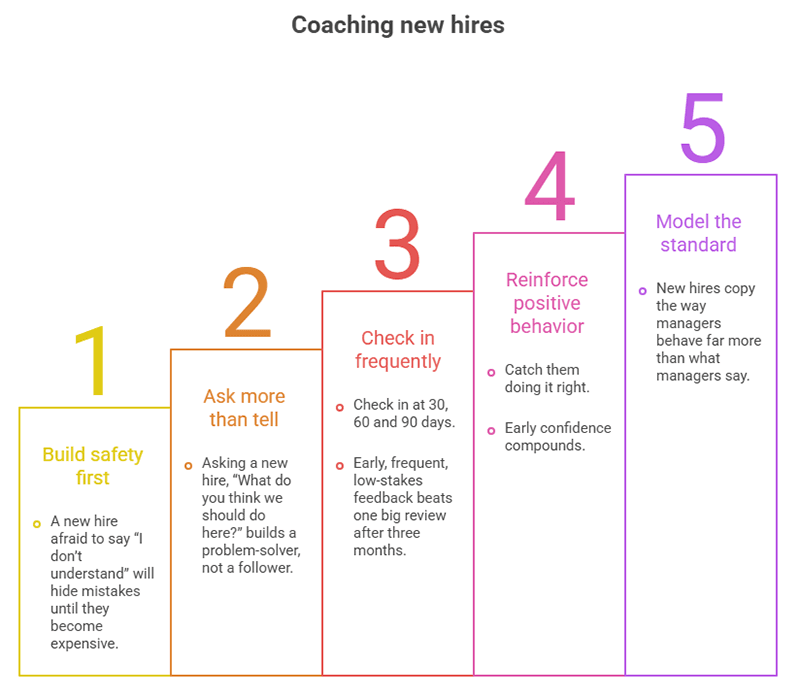
New hires can change a pump seal or wire a receptacle, but they do not know where the shutoffs are, which panel feeds what or whom to call for a permit. They lean heavily on the CMMS and other technicians for acquiring specific knowledge. Their work is sound but slower because every task includes a layer of, “Where is this? How do we do it here?”
In these cases, managers need to:
Build safety first. A new hire afraid to say “I don’t understand” will hide mistakes until they become expensive.
Ask more than tell. Asking a new hire, “What do you think we should do here?” builds a problem-solver, not a follower.
Check in at 30, 60 and 90 days. Early, frequent, low-stakes feedback beats one big review after three months.
Catch them doing it right. Early confidence compounds.
Model the standard. New hires copy the way managers behave far more than what managers say.
The goal in training new hires is to get them to competency safely. Ambiguity on day one reads as chaos and predicts turnover. A clear plan says, “We’re organized, and you matter.”
Managers should expect a lot of questions and treat them as the right behavior, not a red flag. The good ones ask before acting, especially around lockout/tagout and anything they have not verified. They're still learning the safety culture, escalation paths and unwritten norms, such as who signs off on what and how thorough notes need to be. This is normal and temporary. The signal to watch for is not speed. It is adoption and consistent improvement.
Underperformance has a number of common root causes, and each needs a different response. A poor performer gets a work order for a leaking valve, tightens a packing nut, closes the order as complete and moves on. Two weeks later, the valve fails and floods the room. The actual problem was a corroded stem they did not inspect. When asked about the problem, the poor performer says, “It wasn’t leaking when I left.”
First, managers need to run a diagnostic:
Skill or will? A skills gap can be remedied. A will gap is a different conversation entirely.
Did the worker ever actually know what good looks like? A lot of poor performance is related to undefined expectations.
Bad tools, unclear priorities, a broken process or no feedback can make a capable person look weak.
The second step is to act:
Act early, and be specific. Avoid vague dissatisfaction that festers.
Set measurable goals with a timeline and support attached. A target with no help is a setup, not a plan.
Document, for their fairness and the manager’s.
Follow up on schedule. A plan a manager does not follow through on is a plan a manager does not mean.
Attack the problem, not the person. Separate the performance from their character.
Give people a real, supported chance to recover. Many do, and a recovered performer is often the most loyal person on your team.
When someone should be let go
Managers cannot fix some situations, and dragging them out hurts the team, the operation and the poor performer. Knowing when to make the call is part of the job. Managers will know it is time when these events occur:
Repeated failures after a real chance. Clear expectations, genuine support and enough time all have been given, and nothing has changed.
Values or safety violations. These are non-negotiable problems, even from a skilled person.
A toxic presence. A worker is corroding the team, regardless of individual output.
Every day a manager keeps the wrong person, they pay for it with the morale and trust of the rest of the staff.
Manage the person in question, not the label on them. The same individual can be a star in the right seat and a poor performer in the wrong one. A manager’s job is not to sort people into permanent categories. It is to read the situation accurately, be honest early and match the response to the situation.
The best people will stay because they are growing, the core stays because they are seen, new hires ramp up quickly and the few who truly do not fit are handled with clarity instead of dread.