The Mill Kept Running After the Budget Cut. That Was Part of the Problem

In this short story, the controller of Bell Cut Mill looks back on an $8 million maintenance cut she entered in the books as “recurring savings.”
“If the machines are running this well, why are we spending $35 million a year on maintenance?” Grant Ferris asked.
It was July 2005, Grant’s first budget meeting as manager of Bell Cut. I was the controller at the kraft paperboard mill. We made the brown board that goes into the backs of writing pads and the cores that other people wind paper around. Our oldest customer’s purchasing manager could tell which of our machines had made a roll by looking at the end of it.
That morning I’d walked Grant past a framed photograph of Number Two’s crew holding a banner for a hundred days without an unplanned stop. He knew three of the men from his time as a shift superintendent.
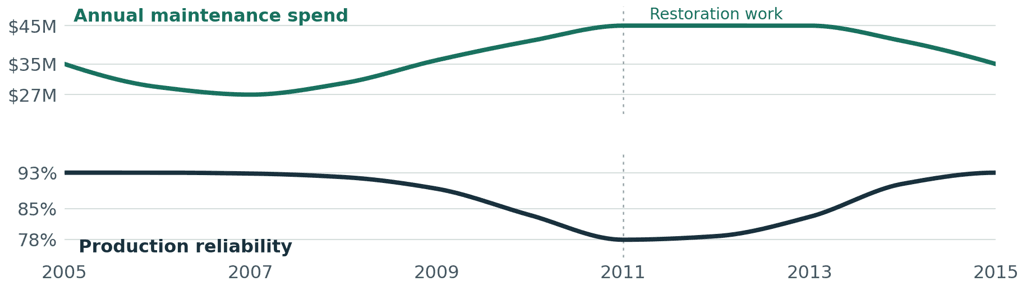
Now he slid my report back to me. He’d circled the figure for machine reliability, 93 percent, and penciled in a maintenance budget of $27 million for the coming year.
It was a fair question. Three pumps had come back from scheduled overhauls with nothing wrong. We stocked parts for a line we had sold to Brazil. I could find him money. He needed eight million.
Our maintenance superintendent, Walt Kearns, brought two sheets to the next meeting. On the first were jobs we could eliminate or redesign. On the second were jobs we could postpone, with the consequence of postponement written beside each. Grant liked the first sheet. It came to less than two million dollars. He went back to the top of the second.
One entry would leave the oil-analysis route on the paper machines running at half its frequency. Another would carry an aging drive through a second winter. Grant asked Walt which item would stop the machine before Christmas.
“Probably none of them,” Walt said. “Which Christmas should I be planning for?”
It got a laugh. In the forecast I called all eight million recurring savings. Walt kept his two sheets stapled together.
The bonus
For nearly two years the crew gave Grant every reason to believe he had been right. Number Two ran through a hard winter. A customer sent a tin of butter cookies to the shipping office because we had covered an order after another supplier went down. By the second June, the annual maintenance account had fallen to twenty-seven million. I’ve put all the mill figures in 2025 dollars.
Grant spent some of it well. He put heat in the shipping shack, where a bowl of water for the stray cat had frozen solid on somebody’s desk. Two operators he put on the capital committee redesigned a conveyor and spared the finishing crew a miserable cleanup. Years later I still remembered why we liked him.
At the corporate dinner the CEO asked three hundred people to stand and applaud Grant for taking eight million dollars out of a reliable mill. Grant’s special cash bonus was $640,000. Afterward Grant put his glass beside mine. Had we approved his head count for the shipping shack?
“They did,” I said.
“Good. Would you tell second shift? They think I forgot.”
By September he had accepted the chief operating officer’s job at a larger manufacturer. A trade magazine photographed him beside its new headquarters. Walt clipped the picture from the magazine and used the blank side to write down a bearing number.
Inez Calder came from the converting end of the business. In her second week she asked to attend the morning planning meeting. Thursday’s crew had been assigned twelve jobs and had finished four. The planner turned his monitor around to show her the other eight, rescheduled for next Thursday. Two had already made that trip eleven times.
There was still plenty of good board coming off Number Two. We had also started carrying an extra week of finished rolls for our oldest customer. Our customer’s delivery score stayed green. Its buffer stock occupied an aisle in our warehouse.
The hearing
Inez asked the board for an outage to replace the drive. Its vibration readings had begun to climb. Sales could sell every ton we made that month. The board approved closer monitoring and asked Inez to find a better date.
She tried to buy herself room on nights. Twice she arranged for a contractor to do the work that our own people kept getting pulled away from. Twice production needed the machine. On the second cancellation, the contractor charged us for the crew. That charge went into her monthly variance. The eight million in Grant’s column remained intact.
Four years into the cycle, downtime started coming in bunches. The distinction mattered on the floor. A two-hour stop on Tuesday left enough time to reset the week. A second stop on Wednesday took the same electrician away from the job that might have prevented Friday’s stop. We began paying premium freight on parts we had once received by ordinary truck.
During an emergency repair on a roll stand, a mechanic named Emmett Shaw sustained a crush injury to his left hand. I knew his wife, Pat, better than I knew him. We played cribbage at the fire hall, where I also kept the books for the widows’ Christmas fund. While he was off, she came alone and dealt his hand to an empty chair the first night, out of habit. She gathered up the cards and asked me whose turn it was.
The CEO called Inez to headquarters for the September board meeting. My exhibit showed her spending and machine reliability. Martin Hale, one of the directors, had asked me to add Grant’s best year in blue. Hale rested the tip of his pencil on the twenty-seven.
“Your predecessor ran this same mill for that. You’ve had three years. When do we get his performance back?”
Inez looked at me. “Mara, when did the drive replacement first come into the forecast?”
I had the date in my folder. Beside me sat the CFO who had rehearsed this meeting with me. “I’ll get you the original authorization,” I said.
They fired her before lunch. That cost her the last installment of her incentive award. I drove her home because the company kept the car. We talked about whether she should keep paying into the fire hall Christmas fund. I had the whole ride to tell her I had known the date.
Four years to pay it back
At the six-year mark Number Two was delivering seventy-eight of every hundred scheduled production hours. Maintenance spending had reached forty-five million dollars. Emergency callouts, rental equipment and overtime accounted for much of the increase. Paying three people to come in on a Sunday could get us to Monday morning. It did very little for the following Sunday.
The man who followed Inez inherited an unusual privilege. The board had run out of people who believed the machine could be talked into another good quarter. It gave him the outage windows and the money Inez had requested. Walt and the planners discarded duplicate work orders, inspected the equipment and estimated a hundred thousand labor-hours to put it right.
They put the hours on a board by the time clock. For the first few months the list got longer. We were looking inside equipment we had run unopened for years. One inspector kept two lists so his boss could see how much they had finished as well as what they had found.
One Friday the planner came into my office and set Thursday’s schedule on my desk. Every job under the two electricians’ names had a check mark. “I kept waiting for the radio to go,” he said. He’d left their names on the same jobs all shift. When repeat failures eased enough to let whole crews work that way, production came back faster. The bills stayed near forty-five million while they worked down the debt.
Ten years after Grant’s first budget meeting, reliability was back near ninety-three percent. The overdue restoration list was clear. Annual spending had settled near thirty-five million, enough for the condition monitoring, planned repairs and renewal work that kept it there. Our oldest customer had moved one grade to a second supplier. We got the machine back in full. We got half that order back.
The blue cell
In July 2015, corporate finance sent the mill a workbook for the next round of savings. Under “internal best demonstrated performance” somebody had entered twenty-seven million. I recognized the blue fill. I’d made the number easy to find. The new group president had never met Grant or Inez. He quite reasonably assumed that our own finance people had checked the number.
This time I attached Walt’s original second sheet to my response. The business units were being consolidated, and the upload form accepted one spreadsheet. My attachment went into a correspondence folder. The number went into the budget. I saw the approved budget and let it go.
Six years later the mill hit its lowest point in living memory. On a restart, fiber-laden water escaped the treatment system and reached the river. Our oldest customer took its remaining core-board volume elsewhere. When the town held a hearing, Pat Shaw came straight from work in her pharmacy smock. She wanted to know why the town’s downstream sampling station had been the first place her neighbors could get a straight account of the release.
The audit committee hired Ruth Ansel, an independent asset-management adviser who had run a mill and later chaired an audit committee herself. Her first request was for the unedited maintenance schedules. Her second was for my bonus calculations. I asked how many years she wanted.
“How far back can you tell me who got paid?”
Payroll went back thirty years. The oldest records were on microfilm. To open one archive we had to call a retiree in Arizona. Ruth sat beside me in the records room. We lined up work requests, machine stops, invoices, bonuses and changes of command. For each loss Ruth entered the date of the decision that had contributed to it. Some dates she left blank.
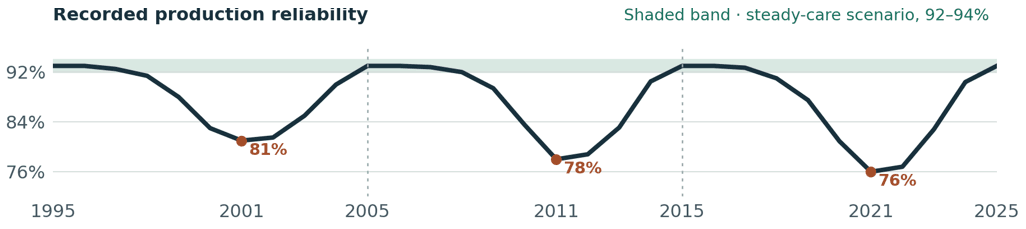
Late one afternoon she found a 1995 schedule headed “temporary extension of inspection intervals.” The blue handwriting in the margin belonged to Walt’s predecessor. The restoration invoices peaked six years later. By 2005 the mill was running beautifully again, just in time for Grant to inherit it. We had found the first of three turns through the same cycle of despair.
I showed her the exhibit from Inez’s dismissal. “I could have answered her,” I said.
“Put that in your presentation,” Ruth said. “If I’m the one who tells them, they can thank me for my independence and go to lunch.”
Thirty years in two columns
At rock bottom Ruth had shown the board how much work was overdue. Hale had asked if the outages she wanted would cost just as much. By June 2025 the mill had recovered. With Hale back in the same seat, Ruth asked me to start with the eight million.
“Before we go any further,” he said, “some of that eight million was real. Did you put the pump overhauls back in?”
“We kept $1.8 million a year in changes Walt could verify,” Ruth said. “We put it into inspections and outage work the old budget left out. Both cases start with the same equipment condition in 1995. We held loads and market conditions constant and checked the plan against comparable machines and Bell Cut’s own good years. The plan averaged thirty-five million in 2025 dollars, with more in major outage years.”
I put up the totals. We’d spent $1.132 billion maintaining the mill. Ruth’s estimate for steady care was $1.050 billion. On orders we could document, we’d have earned another $64 million after variable costs. That took cumulative operating profit from $614 million to an estimated $760 million.
“Those first cuts put cash in our hands years before your repairs,” the director said. “Did you discount either stream?”
“At six percent after inflation, the annual operating cash differences come to about forty-seven million in present value,” Ruth said.
He tapped the sales figure. “What if we never sold another ton?”
“At our central estimate, eighty-two million,” Ruth said. “That’s the difference in maintenance spending alone.”
Ruth handed around a second sheet. The safety row used emergency repair hours. She had struck out my first draft, which said that a certain number of injuries would have been prevented. “You know when Emmett was hurt,” she told me. “You don’t know what would have happened to him on a different Thursday.”
Table 1 - Recorded performance versus steady state asset performance comparison.
Measure | Recorded | Steady care estimate |
|---|---|---|
Operating profit, 2025 dollars | $614 million | $730–790 million |
Safety exposure, emergency repair hours | 306,000 | 160,000–200,000 |
Reportable releases during trips and restarts | 12 | 5–8 |
Customer orders delivered on time | 89% | 95–97% |
Quarters triggering independent permit review | 14 | 4–7 |
Fictional figures. Ranges reflect model uncertainty. The 6% real sensitivity discounts annual maintenance cash and recovered contribution to June 1995, in 2025 dollars.
The vote
The chair stopped at the permit row. We could count the quarters that triggered outside review. It was harder to say what they’d cost us in town. People still stopped Pat at the pharmacy to ask what the mill had put in the river.
“What about our management decisions?” a director asked. “Would you have kept Calder?”
I opened the authorization I’d had in my folder at Inez’s hearing. “She asked me when this work first came into the forecast. I had the answer. July 2005. More than two years before she took the job.”
He asked who had signed the deferral. “You gave the board the figures it asked for,” the CFO said. I laid my signed forecast next to the authorization. “Hale signed the deferral. Recurring savings is mine. All eight million. It went into my incentive calculation, too.”
The chair proposed accepting the findings and asking management for an action plan in ninety days. Ruth closed her folder. “Your next budget goes out on Friday. Which number would you like Mara to send downstairs?”
“If I need a week to finish an order, I’m supposed to call a committee?” Hale asked. Ruth looked to the chief engineer, who’d helped draft the policy. He opened the work list. “Inside the approved window, go ahead. Beyond it, somebody has to sign.” Hale turned the old authorization around. “Put the risk committee’s approval in the minutes,” he said. “I’ll move that.”
The board adopted the asset-management policy and funded the treasurer’s three-year plan. Annual budgets had to fund care and renewal for the planned load. Every deferral had to name the equipment, the risk, who accepted it and the funded date for the work. Anything below the approved care plan went to the risk committee. Each quarter, the audit committee would see overdue critical work alongside reliability and spending, with independent checks on work completed.
Part of each mill leader’s award would vest over five years, subject to a review of asset condition and unfinished work even after departure. The board corrected Inez’s record and restored her forfeited installment. At my next review the compensation committee cut my annual award. The chair sent me the decision with my forecast attached.
Eight months later a large order fell through. The CFO brought two ways to conserve four million dollars of cash. One moved scheduled mill work into the following year. The other reduced a planned share repurchase. I recognized the work-order numbers. This time the names of any directors accepting the deferral would go on the same page as the savings.
The board reduced the repurchase. The mill kept its outage. At the next earnings call the chair took the question about the smaller buyback himself.
I mailed Inez the amended minutes. I put a note in with them. “I had the date when you asked me. I had it all the way home.” A week later an envelope arrived with a check for the Christmas fund and a note in her handwriting.
“Mara, I appreciate having it in writing. Please put the check down for the years I missed.”
Bell Cut, its people, the events and the operating figures are fictional.