How to Involve Maintenance in Capital Projects From the Start
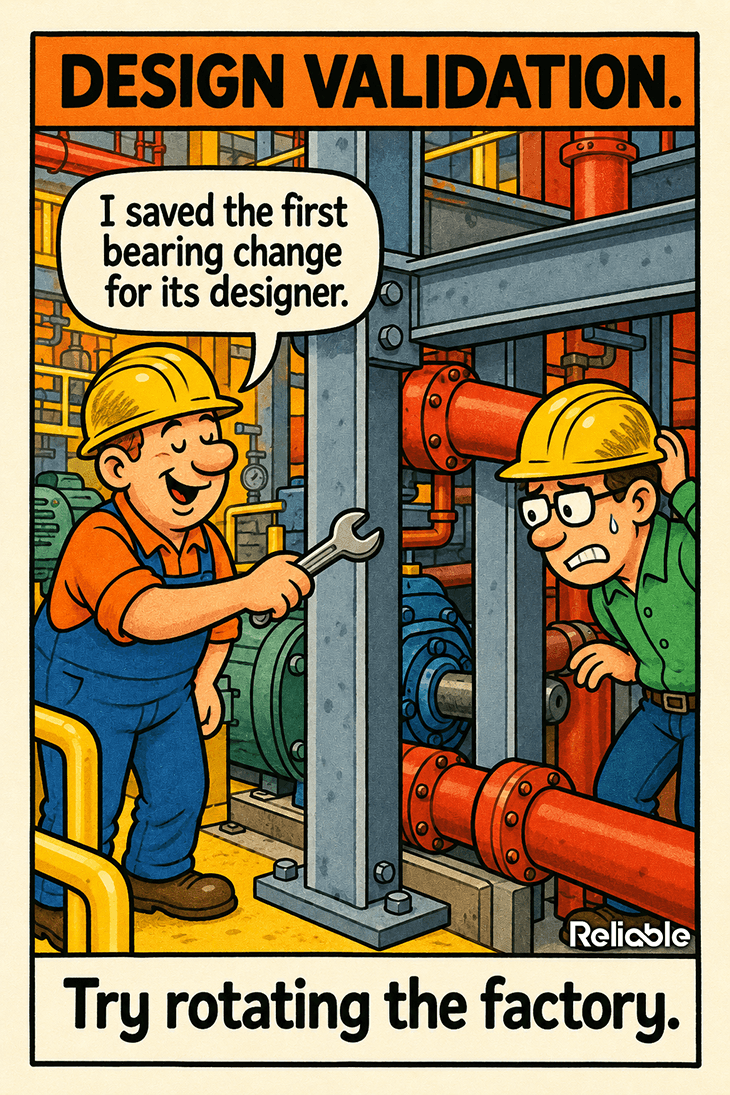
A new pump skid can pass its factory acceptance test, start up on schedule, and still cost a technician six hours the first time a bearing needs changing. Those six hours go to removing a handrail, unbolting a pipe spool, and borrowing a chain hoist from another building.
That's a design problem, and the fix lives upstream. Learning how to involve maintenance in capital projects is one of the cheapest reliability improvements a plant can make, and it rarely shows up as a line item in a project budget.
The project team gets measured on cost, schedule, and a clean startup. Maintenance gets measured on the next 30 years. Those incentives only line up when somebody deliberately lines them up.
Why New Equipment Arrives Hard to Maintain
Project engineers work against a capital budget and a startup date. Layout decisions get made to fit the building, shorten pipe runs, and shrink the footprint. Room for a mechanic with a puller and a torque wrench tends to fall off the priority list, because nobody on the project team will be the one holding the wrench.
Vendors add to it. A packaged unit gets optimized for shipping dimensions and purchase price. Clearance for pulling a motor or swapping a mechanical seal becomes the installer's problem, and then the plant's.
Then comes handover. The project team closes out, celebrates the startup, and moves to the next job. Maintenance inherits whatever got built, along with a box of manuals and a spare parts list that may or may not match the nameplate.
The project closes out in months. The maintenance department lives with the layout for decades.
Early design decisions commit a large share of an asset's total cost of ownership. Purchase price is only one slice. Labor, downtime, parts, and energy over the asset's life make up the rest, and early design choices drive a big share of each.
Once concrete is poured and steel is erected, relocating a pump costs real money and a shutdown. During design review, the same move costs a revision to the 3D model and maybe an afternoon of a designer's time.
How to Involve Maintenance in Capital Projects at Each Stage Gate
Capital projects usually move through a series of gates: concept, front-end engineering, detailed design, construction, commissioning, and handover. Maintenance involvement in capital projects matters at each gate, and the questions shift as the project matures.
Concept: confirm the maintenance strategy for the new asset, including criticality, likely failure modes, and whether the site has the skills to support the technology.
Front-end engineering: write maintainability requirements into the design basis, such as minimum clearances, lifting provisions, and standardized components.
Detailed design: review layouts and 3D models for access, isolation points, and removal paths for heavy components.
Construction and commissioning: witness installation quality, check alignment and lubrication, and capture baseline readings.
Handover: verify spares, documentation, PM routines, and CMMS asset records before the project team leaves site.
The earliest gates offer the most leverage and usually get the least maintenance attention. A requirement written into the design basis is usually cheaper to meet than one added later. The same requirement raised after equipment is ordered becomes a change order, and change orders get fought.
If you're working out how to involve maintenance in capital projects for the first time, start with the design basis. It's the document the project engineers work from, and a maintainability requirement written there carries far more weight than a comment raised in a late review.
Concept-stage input sounds abstract, but it shapes everything downstream. Choosing a gear-driven agitator over a direct-drive unit, or one large compressor over two smaller ones, sets the maintenance workload for the asset's whole life. Maintenance should weigh in on those choices with failure history and labor hours from similar equipment already on site.
Commissioning deserves its own attention. Baseline vibration readings, thermal images, and oil samples taken during commissioning under stable, representative operating conditions give the reliability team a reference point for future comparisons. Skip them, and the first reading becomes the baseline, whatever condition the machine is in by then.
What a Maintainability Review Should Check
A maintainability review puts experienced technicians in front of the layout and asks them to perform the work on paper. Walk through a bearing change, a seal replacement, a motor swap. If any of those steps requires removing something unrelated, the layout needs another look.
The principles of design for maintainability are well documented. Applying them takes someone who has actually pulled a coupling in a cramped pump room and remembers which bolts needed a stubby wrench and a lot of patience.
Technicians who will own the asset for the next ten years make the sharpest maintainability reviewers.
Removal paths deserve special attention. A 900-pound motor needs a lifting point above it and a clear route to a laydown area. If the only route runs over a live process line, someone will eventually improvise, and improvised lifts are how people get hurt.
Give the review team a checklist so the review stays focused and repeatable from one project to the next. A useful starting list covers:
Clearance around bearings, seals, and couplings for pullers and alignment tools
Lifting points, monorails, or davit sockets above heavy components
Isolation valves and lockout points reachable without a ladder
Grease fittings, sight glasses, and sample ports reachable from a walkway
Mounting pads or permanent sensor studs for condition monitoring routes
Standard motors, bearings, and seals that match what the storeroom already stocks
That last item feeds straight into spare parts management. A project that introduces three new bearing sizes and an oddball seal cartridge adds inventory the storeroom will carry, count, and insure for decades.
Who Should Sit at the Design Review Table
A maintenance planner, a senior mechanical technician, an electrician or instrument tech, and a reliability engineer cover most of the ground. Operations belongs there too, since operators tend to catch sampling, cleaning, and changeover problems that maintenance might miss.
Name the reviewers early and put their hours in the project budget. Reviewers borrowed from the daily schedule get pulled back the first time a line goes down, and the review quietly slides off the calendar.
One person should own maintenance involvement for the whole capital project. On larger jobs, that's usually a dedicated maintenance or reliability representative who attends each gate review and signs the handover checklist.
Bring past pain to the meeting. Work order history on similar equipment shows where the hours go: the pump that needs scaffolding for each seal job, the conveyor drive that takes two shifts to realign. Those records turn opinions into evidence the project team will have a hard time waving off.
That representative also needs authority. A reviewer who can only make suggestions gets heard politely and overruled on schedule grounds. A reviewer whose sign-off gates the handover gets answers.
How to Make Maintenance Input Stick
Involving maintenance in capital projects pays off only when the comments survive. Comments that live in an email thread disappear. Log each maintainability comment in the same action tracker the project uses for safety and process comments, with an owner, a due date, and a required response.
Some comments will be rejected for cost or schedule reasons. That's fine, as long as the rejection is documented and the project manager signs it. A documented decision lets the plant plan around the compromise instead of discovering it during the first outage.
A signed rejection gives the plant something to plan around.
Tie maintainability to the handover criteria too. A project that can't close out until PM routines are loaded, spares are on the shelf, and asset records exist in the CMMS has a strong reason to take those items seriously.
This is where maintenance and asset management meet. The asset's life starts at the design basis, so the maintenance plan should start there as well, with failure modes and PM tasks drafted before the first purchase order goes out.
Where to Start on the Next Project
The practical answer to how to involve maintenance in capital projects is to start small. Pick one upcoming project, even a small one, and run a single maintainability review on the layout before equipment is ordered. Track the comments raised, the ones accepted, and the estimated labor hours each accepted change saves over the asset's first five years.
That number makes the case for the next project. Once leadership sees a few hours of review time traded for hundreds of hours of avoided labor, maintenance gets invited earlier and more often, and involving maintenance in capital projects becomes standard procedure.
Keep the review short and specific. Two hours with the layout, a checklist, and the right four people will catch the big problems. A week-long review that tries to perfect each valve handle tends to burn goodwill with the project team before the important comments land.
The test for success is simple. The first major repair on a new asset should take the hours in the planner's estimate, with standard tools, and with the handrails left exactly where the installer bolted them.