
A condition monitoring program can detect a developing machine problem and still fail to prevent an unplanned event, which is why how to respond to condition monitoring alarms matters as much as collecting the data in the first place. The sensors detect a change, the trend climbs, an alarm fires, and someone acknowledges it. If the finding is valid but no disposition follows, the plant can still absorb a failure or a forced outage that the warning might have helped avoid or manage.
Detection creates decision lead time; the value comes from validating the signal, diagnosing the likely condition, evaluating risk, and taking an appropriate response. An acknowledged alarm without a disposition leaves the underlying condition unmanaged. The plant paid for the information but has not yet converted it into a maintenance decision.
Why Acknowledged Alarms Sometimes Fail to Become Action
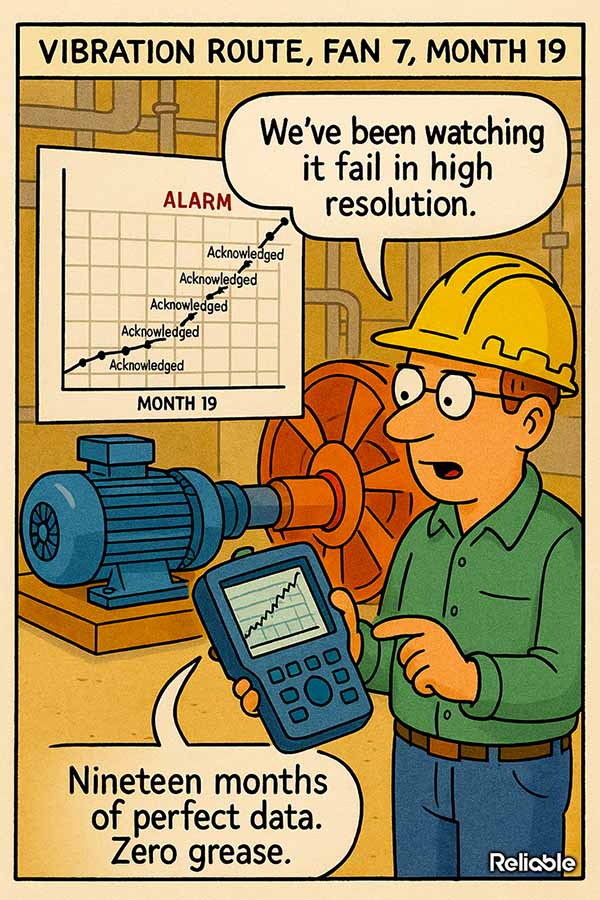
Acknowledgment can feel like action, and that is part of the problem. Clicking to accept an alarm clears or changes its status on many systems and can create a sense that the issue is handled, when all that has really happened is the warning was noticed. Noticing and resolving are separated by every step that a response process is supposed to supply.
Without a required next step, acknowledgment can become the end of the process rather than the start of one. The alarm list gets tidied up while unresolved conditions remain. A screen with no open alarms is not proof that the monitored assets are healthy if alarms can be acknowledged or closed without a documented disposition.
Acknowledging an alarm records that someone saw it; it does nothing to record that anyone acted on it.
Ownership is often the missing piece. When an alarm belongs to everyone and no one, each person may assume another will validate the finding, raise the work request, or set the next review date. Wiring ownership into the plan, the groundwork covered in guidance on how to start a condition monitoring program, keeps that gap from forming. Naming the owner is a small step that changes the trajectory of an alarm.
The result can be a program that looks active but runs quietly passive. Data flows in, alarms are cleared, and developing conditions can continue because no mechanism converts awareness into a documented decision. The next step may be a work order, additional diagnostics, an operating change, a planned shutdown, or a watch interval with a defined review date.
The Cost of Watching a Failure Develop
There is a particular waste in detecting a developing failure and then doing nothing with a validated, actionable warning. The plant pays for the sensors, software, and analyst time, yet may still experience a breakdown that earlier intervention could have mitigated, scheduled, or prevented. Condition monitoring cannot prevent every failure, but it should create information early enough to support better risk decisions.
The main operational value of early detection is the lead time it creates for diagnosis, risk evaluation, parts, labor, and outage planning. A fault identified early may offer weeks or months of runway, but the available lead time depends on the failure mode and how fast the condition is changing. Letting a validated, actionable condition drift without a decision can turn that advantage into a surprise.
- The lead time that early detection created, spent watching instead of diagnosing, planning, or deciding.
- The chance to correct a condition during a planned window rather than after a breakdown, when the failure mode and risk justify intervention.
- The possibility of secondary damage if a developing fault progresses into neighboring components.
- Credibility for the whole program, as leaders question why monitoring did not help.
The frustration compounds when the eventual corrective task is simple. If analysis confirms inadequate lubrication or misalignment, early action can sometimes prevent a developing condition from becoming a bearing, coupling, or machine-level repair. The lesson is to diagnose the cause and use the available lead time, not to assume every trend has an obvious fix.
How to Respond to Condition Monitoring Alarms Consistently
Knowing how to respond to condition monitoring alarms consistently comes down to building a defined path that every alarm follows. When an alarm crosses a threshold, the sequence should begin with validation and assessment rather than automatic repair. The process should define who reviews the signal, what evidence is required, how priority is assigned, and what dispositions are allowed.
That path starts with assessment and ends with a recorded decision. Someone qualified validates the signal, evaluates the probable condition and diagnostic confidence, considers severity, rate of change, operating context, and asset consequence, and then raises a work order or request, sets a watch with a review date, calls for additional diagnostics, or documents why no action is needed. Every alarm should end in a traceable disposition so nothing simply disappears from the list unexplained.
A response process turns a rising trend from a topic of conversation into a task with an owner and a due date.
Consistency is what makes the process trustworthy. Alarms in the same class should follow the same decision logic, while asset criticality, rate of change, operating state, failure mode, and diagnostic confidence influence the actual response. The goal is a repeatable process, not identical action for every alarm with the same severity label.
Documentation holds the whole thing together. Recording the decision behind each alarm, including the deliberate choice to wait, creates a trail that supports learning and keeps a deferred item from vanishing into the noise. A watched alarm with a review date stays alive; an unwatched one fades from view.
From Alarm to Work Order
One useful change, when the condition monitoring and work-management systems support it, is to connect validated, actionable alarms to the work process. A high-priority alarm can generate a notification or draft work request after defined validation and priority criteria are met, reducing the chance that a finding dies between the analyst and the planner.
That connection removes some of the friction where response can die. Instead of relying on someone to re-enter the finding later, the work request can carry the alarm, diagnosis, priority rationale, and evidence into the planning process. It still needs the same screening, planning, scheduling, and authorization required for other maintenance work.
- Automatic creation of a notification or draft work request only after defined validation and priority criteria are met.
- The alarm data and trend attached, so the technician sees the evidence directly.
- A required disposition, so no alarm is closed without a recorded decision.
- A link back to the asset history, so recurring alarms are visible at a glance.
Prioritization keeps the workload manageable once alarms start generating work. Sound rules for ranking these jobs, the same discipline behind how teams prioritize maintenance work orders, help ensure the highest-risk conditions reach the schedule first.
Deciding What Each Alarm Deserves
Some alarms can wait, and treating them all as emergencies is its own failure mode. A workable response process considers alarm validity, fault severity, rate of change, diagnostic confidence, asset criticality, operating context, and the consequences of delay. Those factors together determine how urgently a finding needs a response.
Severity tiers give the sorting structure, but they are only one input. A minor deviation on a redundant or spare asset may reasonably wait for a planned window, while a fast-rising, credible fault on a critical unspared machine may require prompt action. Matching urgency to consequence and evidence keeps the team from drowning in low-value alerts while a real threat waits.
The first question is whether the alarm represents a credible condition; the next is how urgently the plant should respond.
Asset criticality sharpens those choices further. The same vibration signature can represent different business risk on a redundant unit than on the single machine a production line depends upon, and the response should reflect that difference. The measured condition, diagnostic confidence, failure mode, and consequence all belong in the decision.
Some condition-monitoring findings trace back to basic maintenance issues, but the signal alone does not prove the cause. Indications associated with lubrication can reflect lubricant quantity or condition, contamination, over-lubrication, load, installation, or another fault. If lubrication is confirmed as a contributor, sound bearing lubrication best practices can guide the corrective task.
Closing the Loop on Every Alarm
A response process is only as good as its ending. An alarm that generated a work order, and a repair intended to resolve the fault, should feed back into the monitoring process so post-repair data can confirm that the condition returned to an acceptable baseline or expected state. A loop that ends at the work order and skips verification leaves the plant guessing.
Verification prevents false closure. Confirming that vibration or another monitored parameter returned to an acceptable baseline under comparable operating conditions, rather than assuming it did, can catch jobs that treated a symptom while the underlying fault remained. When operating conditions change, the analyst should compare against an appropriate reference rather than force the data back to an old number.
- A repair tied back to the alarm that triggered it, so the history stays connected.
- A post-repair check that the monitored value returned to an acceptable baseline or expected state under comparable operating conditions.
- A short note on the confirmed cause or diagnosis, when known, so the same alarm is easier to handle next time.
- A review of alarms that recur, to catch problems the first fix did not solve.
Closing the loop also builds the knowledge base over time. The record of which responses resolved which alarms turns a stream of warnings into a practical guide for handling the next ones faster and with more confidence. Each closed alarm teaches the plant something about the next one.
Making Alarm Response a Habit Instead of a Heroic Act
The strongest alarm response does not depend on a dedicated analyst chasing every trend by force of will. It depends on a process embedded in the daily routine, so the right review and escalation happen even on a busy week when attention is scarce. A defined process is more resilient to turnover and workload spikes than individual diligence alone.
Habits form when the process is simple and the tools support it. A clear owner, a defined disposition path, easy transfer of validated findings into work management, and a standing review of open alarms ask less of any one individual while making consistent response more likely.
A condition monitoring program should be judged by the quality and timeliness of the decisions its findings produce, not by alarm count alone.
Measurement keeps the habit honest. Tracking time from alarm to review and disposition, the share of alarms with a documented decision, overdue watch items, and the outcome of corrective work shows whether the response process is working. Alarm-to-work-order time can be useful for actionable findings, but not every legitimate alarm should become a work order.
Handled this way, condition monitoring delivers its real value. A rising trend becomes a prompt for a documented technical and risk decision, with repair when warranted, additional diagnosis when uncertainty remains, or a controlled watch when continued operation is justified. That shift, from watching to managing the condition, is the point of monitoring.