Bearing Lubrication Best Practices That Stop Failures Before They Start
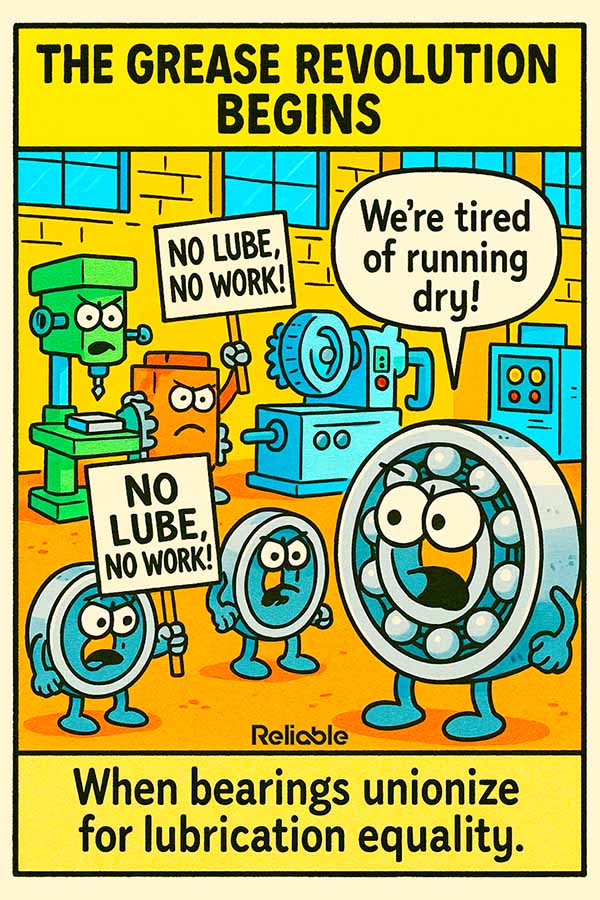
The cartoon’s humor lands because it exposes an uncomfortable truth: bearings often get attention only after they fail. “No lube, no work!” might be funny, but it’s precisely what happens in plants where lubrication is treated as an afterthought. When bearings “run dry,” failure is inevitable, downtime follows, and production goals crumble.
Lubrication isn’t just grease. It’s the thin, engineered film separating reliability from ruin. Bearing lubrication best practices turn that film into a strategic advantage. Properly lubricated bearings run cooler, quieter, and far longer than those managed by habit or calendar. Yet too many facilities still rely on inconsistent methods, generic lubricants, or incompatible mixtures.
When lubrication becomes intentional, reliability stops being accidental.
Why Bearing Lubrication Best Practices Matter
Studies suggest that 40–50% of premature bearing failures are lubrication-related, including inadequate lubrication, contamination, and improper lubricant selection. When contamination within the lubrication system is included, the figure can approach 70–80%. The takeaway is simple—lubrication is a primary reliability driver, not a background task.
The Four Pillars of Precision Lubrication
Right lubricant type: Choose grease or oil based on bearing speed, load, temperature, and environment. High-speed electric motor bearings often benefit from synthetic base oils with lithium-complex thickeners; slow, heavily loaded rollers may favor mineral base stocks or calcium sulfonate complexes.
Correct quantity: Over-lubrication causes churning: excess grease shears, generates heat, blocks relief ports, and increases seal drag. Under-lubrication allows boundary contact where the protective film collapses.
Proper frequency: Set intervals by condition and criticality, not the calendar. Dust, moisture, and vibration shorten grease life and demand tighter control.
Delivery method: Manual greasing can work for accessible points; remote or critical assets often need automated or centralized systems.
Without these fundamentals, even excellent condition monitoring can’t compensate for poor lubrication discipline.
Recognizing the Signs of Poor Lubrication
Bearings usually “complain” before they quit, but only if you know what to listen for. Misalignment, contamination, and over-greasing each leave distinct clues. Detecting them early prevents cascading damage.
Common Warning Signs
Gradual temperature increases while load, speed, and ambient conditions remain steady
Ultrasonic signal rise (>20 kHz) indicating friction and thinning of the lubricant film
Audible squeal or chatter as boundary contact begins
Grease leakage/purging at seals, suggesting overfill or blocked relief
Discoloration or rust on housings from moisture or oxidation
Each signal demands investigation. A steady temperature rise, for example, may indicate oxidation, contamination, or blocked relief—not just a lack of grease. Root-cause analysis, not assumptions, drives reliable decisions.
Using Technology to Improve Bearing Lubrication Best Practices
Modern tools turn lubrication from guesswork into science. Condition-based approaches combine ultrasound, vibration, and thermography to determine the optimal timing and amount of grease application.
Ultrasonic lubrication devices optimize re-greasing by tracking frictional noise during application, well-suited to accessible, grease-lubricated bearings operating below ~3,600 RPM.
Infrared thermography spots hotspots and insulation breakdown well before mechanical damage.
Vibration analysis in the 100 Hz–10 kHz range detects bearing defects such as spalling and race damage, while ultrasonic frequencies (>20 kHz) indicate early lubrication deficiency.
A bearing operating 10–15°C above its design temperature can see lubricant oxidation life roughly halved (Arrhenius rule-of-thumb). Elevated heat accelerates viscosity loss and oxidation, degrading film strength and shortening grease life.
Building a Program Around Bearing Lubrication Best Practices
A sustainable lubrication program aligns people, data, and standards to manage every aspect of lubrication quality.
Lubrication Mapping
Document every bearing’s type, location, lubricant, quantity, interval, and last service. Use a CMMS or digital platform to standardize routes, eliminate guesswork, and create auditability.
Condition-Based Lubrication
Ultrasonic and connected lubrication solutions enable precision greasing—only when required. For **sealed, high-speed, or oil-lubricated bearings—now increasingly common in modern OEM equipment—**adapt using oil analysis, temperature trending, or manufacturer-specified intervals instead.
Contamination Control
Cleanliness defines life expectancy. Particles abrade; water corrodes.
Adopt:
Color-coded grease guns and tagged fittings
Sealed storage and transfer containers
Desiccant breathers and proper seals
Clean handling practices at lube points
For oil-lubricated systems, monitor ISO 4406 cleanliness codes; for grease-lubricated bearings, focus on contamination exclusion and disciplined handling.
Technician Training + Standards
Lubrication precision depends on understanding viscosity, base-oil compatibility, NLGI grade, and re-lubrication calculation methods (based on bearing size, speed factor/DN, environment). Technicians should be fluent with manufacturer data and standards, such as:
ISO 15243 (damage classification and failure modes relevant to lubrication)
ISO 281 (bearing life calculation)
ASTM D217 (worked penetration / NLGI consistency)
ASTM D566 (grease dropping point)
ISO 12925-1 (industrial gear and related lubricants; context for oil selection) (Include ASTM D4950 only when discussing automotive gear applications.)
Turning Best Practices Into Measurable Reliability Gains
Metrics convert lubrication from ritual to reliability science.
Key Performance Indicators
MTBF (Mean Time Between Failures): Longer intervals indicate improved control
Lubricant consumption rate: Stabilized usage reflects efficiency and reduced over-greasing
Bearing replacement frequency: Declines signal successful contamination and film-thickness control
Downtime attributed to bearings: A leading indicator of program maturity
Data Integration
Correlate oil analysis, vibration trends, ultrasound, and thermal data. For example, rising particle counts often precede increased vibration—linking contamination to degradation before it becomes mechanical failure.
Cost and ROI
Plants adopting structured bearing lubrication best practices routinely cut bearing-related failures by 30–50%, while reducing energy draw and lubricant waste. Those gains compound into meaningful annual savings.
Final Reflection: From Protest to Precision
The cartoon’s message stands: ignoring lubrication is ignoring reliability. Bearings may not carry picket signs, but they send clear warnings—heat, noise, and ultrasonic friction signatures—when neglected.
Implementing bearing lubrication best practices doesn’t require significant capital investment. It requires structure, measurement, and follow-through. Start by:
1) Mapping every lube point, 2) Training personnel, 3) Standardizing procedures, and 4) Measuring outcomes.
Every bearing deserves proper care, and every maintenance leader can prevent “the next Grease Revolution.” Precision lubrication isn’t trivia; it’s the foundation of mechanical reliability.