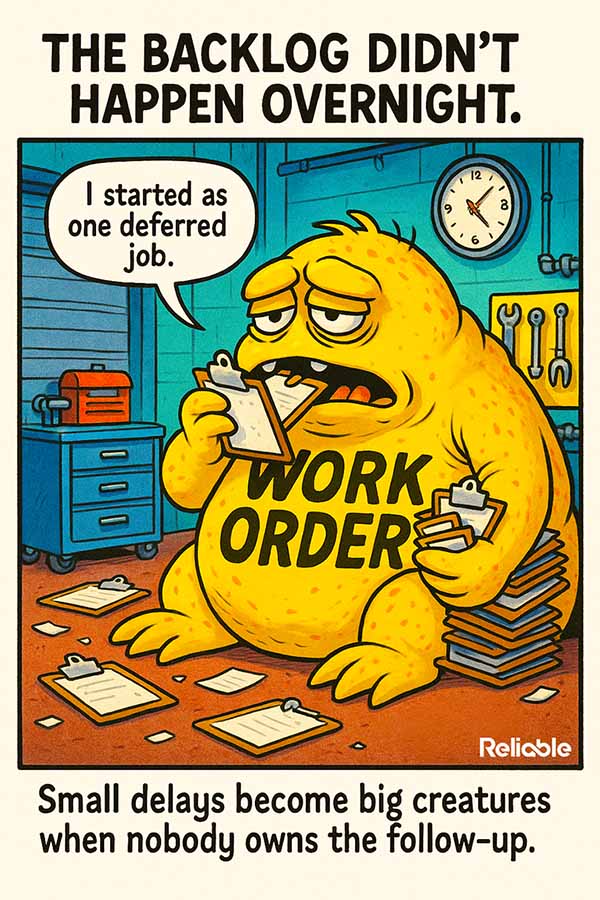

Every backlog starts the same way. A single work order gets deferred for what feels like a defensible reason: parts are out, the operator says it can wait, the technician is pulled to a higher priority.
Then another. Then a dozen more. By Friday the backlog has its own gravity, and nobody can quite say when it formed.
Plant leaders who want to learn how to reduce maintenance backlog have to start by accepting an uncomfortable truth. The backlog is a symptom of dozens of smaller process failures that nobody is owning end-to-end.
Most sites already know their backlog is too big. They just measure it the wrong way.
The count of open work orders is a poor number to manage by, because it rewards closing trivial jobs and can quietly punish anyone who logs real ones. The better number is total backlog hours, broken down by craft, and tracked weekly against ready-to-schedule capacity.
That single shift in measurement, from count to hours, exposes the real story.
Sites that ask how to reduce maintenance backlog without first changing the measure usually end up demoralized inside a quarter. The dashboard says the backlog is shrinking. The team in the field knows the work is still piling up.
Why Backlogs Grow Faster Than Teams Can Shrink Them
A growing backlog almost always traces back to broken flow inside planning, parts, or operations handoffs. Work comes in faster than it can be planned, kitted, scheduled, and executed.
Each handoff has friction. Each piece of missing information can add time. The work piles up at the slowest stage in the chain, and that stage is often planning, parts readiness, or work approval.
Walk a typical maintenance planning and scheduling cycle and you will see why. The planner receives a work request with no failure code, no asset criticality, and a one-sentence description.
They spend twenty minutes chasing the originator. The originator is on vacation. The planner moves to the next request, and the first one sits.
A growing backlog is a flow problem dressed up as a labor problem, and no amount of overtime fixes a broken flow.
Multiply that pattern across dozens or hundreds of requests and the backlog can grow every week even when the craft team is fully staffed and working at a healthy pace.
The fix starts upstream. Standardize the work request form. Require failure code, asset, observed condition, and a photo.
Reject requests that lack any of these fields, kindly but consistently. Over time, the planning queue stops drowning in clarification work.
That single upstream fix is one of the cheapest ways to reduce maintenance backlog inside any plant with a CMMS and a planner who is willing to enforce the rule.
Triage With Honest Risk Scoring
The second compounding factor is dishonest prioritization. Every open work order is somebody’s priority one.
Operations wants their line back. EH&S wants the leak fixed. The plant manager wants the visible eyesore in front of the visitor walkway resolved before Thursday.
All three are reasonable, individually. Together they paralyze the planning function.
A simple risk score cuts through this. One practical starting point is to multiply asset criticality (1 to 5) by failure consequence (1 to 5) and detection difficulty or urgency (1 to 3), then adjust based on safety, compliance, and production constraints.
For example, high scores can be reviewed for same-week scheduling. Mid-range scores can enter the standard planning queue. Low-risk work can enter the campaign list, to be batched with similar work during the next planned outage.
The conversations change immediately. Instead of arguing over whose job is most urgent, the team argues over the inputs to the score, which is a far more productive fight.
Sites that adopt a published risk score also build something quieter and more valuable: a shared vocabulary for tradeoffs. Operations stops assuming the planner is sandbagging. The planner stops assuming operations is crying wolf.
The risk score is also the simplest answer to the question of how to reduce maintenance backlog without conflict. It moves the argument from personalities to inputs, and inputs are easier to fix than feelings.
How to Reduce Maintenance Backlog Without Hiring More Technicians
Headcount is often the slowest and most expensive way to reduce maintenance backlog. New technicians may need months to reach full productivity, and during that ramp the experienced crew can lose wrench time to training and mentoring.
The backlog often gets worse before it gets better. By the time the new hires are productive, the team has lost faith in the strategy.
Cheaper and faster levers exist. They live in three buckets:
- Reduce the rate of new work order creation by attacking the failure modes that generate the most repeat tickets.
- Increase the throughput per existing technician by improving job preparation, parts staging, and scheduling discipline.
- Cull the backlog of work that should never have been there by reviewing every job older than 90 days and either closing, rescheduling, or escalating it.
That last bullet is unpopular and unavoidable. In many large backlogs, some work is duplicate, obsolete, or simply outdated.
A monthly review with the originator and the planner can clear more usable backlog than another round of overtime. It also costs almost nothing to run.
A 90-day work order is often either someone else’s problem or nobody’s, and either answer beats letting it sit on the list forever.
Backlog culling has a second benefit. It restores trust in the system.
When technicians and supervisors believe the work order list reflects reality, they engage with it. When they believe it is a graveyard, they work around it.
Building a Repeatable System to Reduce Maintenance Backlog
Sustained backlog reduction requires a durable system that survives quarter-to-quarter staffing changes. Plants that grind their backlog down in a heroic month usually grind it back up within a quarter, because none of the underlying flow issues were addressed.
A repeatable system has four components:
- A weekly backlog review meeting, no longer than thirty minutes, attended by maintenance, operations, planning, and parts.
- A published target backlog range, expressed in crew-weeks of ready work, with total work order count as a secondary metric only.
- A standing rule that aging work orders past a defined threshold automatically escalate to the maintenance manager for disposition.
- A quarterly look at backlog composition by failure mode, so engineering can attack the worst repeat offenders.
The target backlog range matters more than most teams realize. A backlog of roughly two to four crew-weeks of ready-to-schedule work is often a healthy target, but the right range depends on asset criticality, staffing model, production schedule, and outage strategy.
Below that range, the team may be firefighting and burning supervisors. Well above it, the team is likely drowning.
Naming the range gives everyone a shared definition of done. It also makes the question of how to reduce maintenance backlog answerable: shrink to the range, and then hold it there.
The Real Cost of Letting Backlog Grow
A high backlog carries hidden costs that show up in places nobody attributes to backlog directly.
Operations starts working around equipment that should have been repaired weeks ago, which accelerates secondary failures. Spare parts inventory bloats, because nobody trusts that the backlog jobs will actually get done, so they over-order.
Technician morale drops, because every shift starts with the same impossible list. Turnover follows, and the cycle gets worse.
These are the deferred maintenance risks that get logged as “labor” or “parts” on a budget line and never get traced back to the backlog that caused them.
A plant that calculates the true cost of its backlog may discover the number is far higher than assumed. The biggest line item is usually production loss from secondary failures that the original backlog item would have prevented.
That cost calculation is the strongest argument for how to reduce maintenance backlog with executive support. Numbers move budgets in a way that anecdotes never do.
Every deferred backlog hour today can become unplanned downtime pressure next quarter.
Treating backlog as a leading indicator changes the conversation with finance, with operations, and with corporate. A growing backlog hours number can warn that next quarter’s reliability metrics are at risk.
A shrinking number suggests the system is stabilizing. Either way, the backlog stops looking like a maintenance-only KPI and starts looking like the operational forecast it actually is.
Start the Backlog Work This Week
The most common mistake when learning how to reduce maintenance backlog is waiting for a perfect plan. Plants spend months designing the new system, building the dashboard, hiring the planner, then losing executive sponsorship before the first metric improves.
Start smaller. This week, pull the backlog list, sort by age, and pick the oldest twenty.
Walk them with the planner and the originator. Close, escalate, or schedule each one. Repeat next week.
Within a month the trend line can move, and the credibility to invest in the bigger system follows. Backlog work compounds in both directions.
The same daily discipline that lets a small backlog grow into a monster also, applied in reverse, lets a monster backlog shrink into something the team can actually manage.