
Wrench time is the percentage of a maintenance technician’s paid hours actually spent doing maintenance work. Not walking to a job. Not waiting on parts. Not filling out paperwork. Not standing around because the equipment is still running. Just turning wrenches.
It is the single most revealing productivity metric in maintenance, and almost every plant calculates it wrong or does not calculate it at all. The ones that do measure it honestly tend to find a number that surprises them.
Wrench time, defined
Wrench time is the ratio of direct, hands-on maintenance work to total paid time on shift. If a technician is paid for 8 hours and spends 2 of those hours physically performing maintenance tasks, wrench time is 25%.
The phrase comes from the literal image of a technician with a wrench in hand, working on equipment. Everything else, however necessary, does not count. Travel time does not count. Tool gathering does not count. Permit acquisition does not count. Toolbox talks, lunch, and breaks do not count. Job preparation, parts retrieval, and waiting on operations to release the asset do not count.
This narrow definition is deliberate. Wrench time is meant to expose how much of the maintenance day is consumed by everything that is not maintenance.
What is a good wrench time?
Industry benchmarks place world-class wrench time around 55 to 65%. The average plant runs closer to 25 to 35%. Reactive plants often sit below 20%.
Most maintenance managers, when asked to guess their plant’s wrench time before measurement, say 50 to 60%. After a proper study, the actual number usually lands between 25 and 35%. The gap between perception and reality is the entire point of measuring it.
If you ask a maintenance manager what their wrench time is, they will tell you a number that makes them feel comfortable. If you measure it, you will find a number that makes them uncomfortable. The discomfort is where the improvement starts.
How to calculate wrench time
The formula is simple:
Wrench Time % = (Direct Maintenance Hours ÷ Total Paid Hours) × 100
The complication is not the math. It is the data collection. There are three common methods, each with tradeoffs.
1. Direct observation
An observer follows technicians on shift and logs every activity in real time, usually in 5 or 10-minute intervals. This is the most accurate method and the most resource-intensive. Plants typically run a 2 to 4-week observation study, sample 10 to 15% of the workforce, and extrapolate. Done well, this gives you a defensible number. Done poorly, it gives you a number influenced by the observer’s presence, which is a real effect known as the Hawthorne effect.
2. Work sampling
Instead of continuous observation, an observer takes random snapshots throughout the day and records what each technician is doing at that exact moment. With enough samples (typically 400 to 1,000 across a study), the percentages converge on a statistically valid estimate of how time is being spent. This method is less intrusive and cheaper than direct observation, and most reliability consulting firms use some version of it.
3. Self-reporting through CMMS time tracking
Technicians log their own time against work orders, with separate categories for wait time, travel, and direct work. This method scales to the entire workforce without observers. The downside is that self-reported data is almost always inflated. Technicians round up. They forget to log non-productive time. They categorize tool retrieval as direct work because it feels productive. CMMS-based wrench time numbers are usually 10 to 20 points higher than observed numbers for the same crew.
The most rigorous plants combine methods: a short observed study every 12 to 18 months to calibrate the truth, with continuous CMMS tracking in between to spot trends.
Why wrench time is so low (and what eats it)
When a plant runs its first honest wrench time study, the lost hours always fall into the same buckets. The proportions vary, but the categories rarely do.
Waiting on parts. The technician arrives at the job, opens the work order, and discovers a part is missing or in the wrong location. They walk to the storeroom, search, and either retrieve the part or learn it has to be ordered. This single category often consumes 15 to 20% of a technician’s day in plants without disciplined storeroom management.
Travel and gathering. Walking between the shop, the storeroom, the job site, and back. Carrying tools to the job. Returning for the one tool nobody mentioned in the work plan. In a large facility, travel alone can absorb 10 to 15% of paid hours.
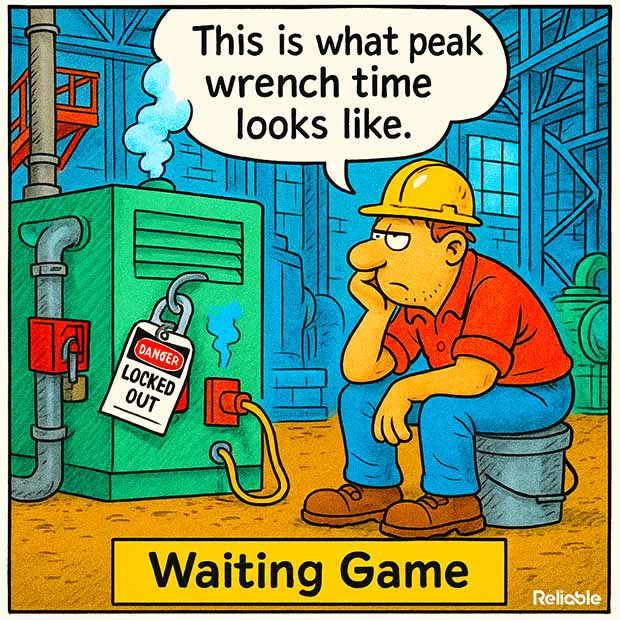
Waiting on operations. The asset is still running, the lockout is not ready, the operator is on break, the permit is unsigned. The technician sits with hands in pockets. This is the most invisible loss because nobody documents it.
Job planning at the job. When work is assigned without a planned procedure, technicians figure out the job standing at the equipment. Reading the manual, calling someone, deciding which approach to take. This is planning that should have happened the day before, performed instead at twice the cost on the floor.
Administrative work. Toolbox talks, safety meetings, training, paperwork, time entry, end-of-shift handoff. Some of this is necessary and unavoidable. The question is whether 90 minutes of it per shift is necessary, or whether it grew that way because nobody questioned it.
Wrench time and planned maintenance
Wrench time and planned maintenance percentage move together. They are not the same number, but they are tightly linked.
A plant with low planned maintenance percentage cannot have high wrench time. When most work arrives unplanned, technicians spend their day reacting: figuring out what to do, finding parts on the fly, troubleshooting at the asset. The planning that should have compressed a job to two hours of direct work stretches it to a six-hour day with two hours of wrenching in the middle.
This is why wrench time improvement programs almost always start with planning and scheduling discipline rather than with the technicians. The technicians are not the problem. The work that arrives at their hands without parts, without procedures, and without operations alignment is the problem.
Common mistakes when measuring wrench time
- Counting tool gathering and travel as direct work. Both are setup, not work. If you include them, your number means nothing.
- Studying only the day shift. Night and weekend shifts often have different wrench time profiles. A study that only captures the busiest shift gives you the most flattering number, not the most accurate one.
- Studying only the planners-favorite crew. Selection bias. The crew the planners trust gets the better-planned work, which means higher wrench time. Sample across crews.
- Using the result to discipline technicians. Wrench time is a system measurement, not a personal performance review. Plants that punish technicians for low wrench time get inflated future numbers and a damaged culture, in that order.
- Measuring once and never again. A single study is a snapshot. Wrench time drifts as priorities, leadership, and storeroom discipline change. Re-measure every 12 to 18 months.
What to do with the number
A wrench time study is only valuable if the number leads to specific, ranked changes. After the study, the lost time will sort itself into a Pareto. The top two or three categories will account for most of the loss. Those are the targets.
If waiting on parts is 18% of the day, the fix is not in the maintenance shop. It is in the storeroom and in the planning cycle. Kit the work. Stage parts at the job site the day before. Audit storeroom accuracy.
If travel is 15%, the fix is in shop layout, satellite tool cribs, and permit pre-staging.
If waiting on operations is 12%, the fix is in the daily scheduling meeting between maintenance and production. The schedule needs to be a contract, not a wish list.
Plants that take wrench time seriously can move from 25% to 45% within 18 months. That is not a productivity gain. That is a different plant. The same crew, doing the same work, completes nearly twice as much of it because the system stopped wasting their time.
FAQ
What does wrench time mean?
Wrench time is the percentage of a technician’s paid hours spent performing direct, hands-on maintenance work. It excludes travel, waiting, planning at the job, parts retrieval, paperwork, and meetings.
What is a good wrench time percentage?
World-class plants run 55 to 65% wrench time. Average plants run 25 to 35%. Reactive plants run below 20%. Most plants overestimate their wrench time by 15 to 25 percentage points before they measure it honestly.
How is wrench time measured?
Three methods: direct observation, work sampling, and CMMS-based self-reporting. Direct observation and work sampling are more accurate. CMMS self-reporting scales better but inflates the result. The strongest programs combine a periodic observed study with continuous CMMS tracking.
What is a wrench time study?
A structured measurement program, usually run over 2 to 4 weeks, that observes or samples technicians during their normal work and categorizes every minute of paid time into direct work or one of several non-productive categories. The output is a wrench time percentage and a Pareto of where the lost time goes.
Is wrench time the same as productivity?
No. Productivity also accounts for the quality and value of the work performed. A technician with high wrench time who does poor-quality work that fails again next week is not productive. Wrench time measures one specific dimension of how time is spent, not whether it is spent on the right things.
How can a plant improve wrench time?
Improvements rarely come from telling technicians to work faster. They come from fixing the system: better planning and kitting, disciplined scheduling with operations, accurate storeroom inventory, and removal of unnecessary administrative overhead. The system creates the wrench time, not the worker.