
Plant managers love the idea of more sensors. More data, more visibility, more confidence that nothing slips through the cracks.
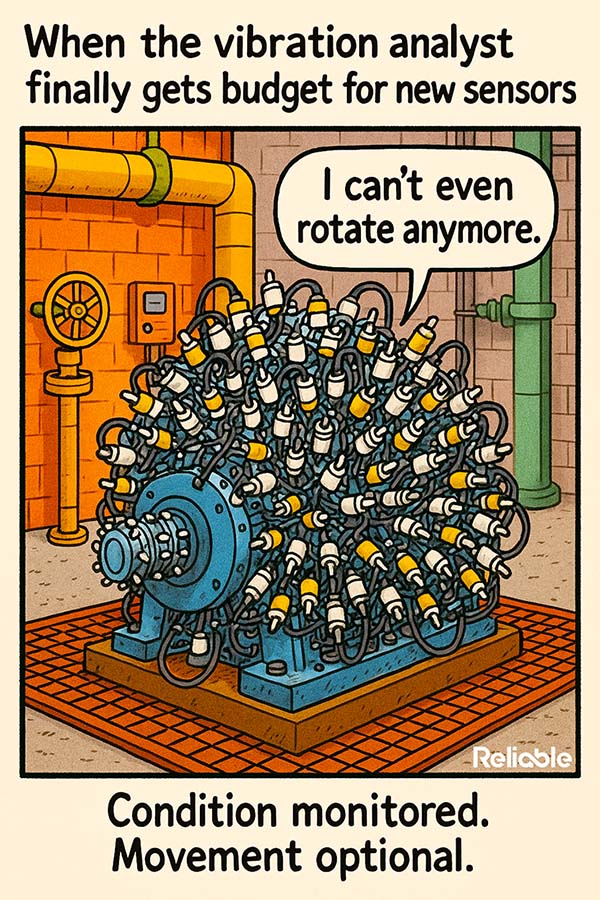
The problem with that instinct is straightforward. Sensors deployed without strategy create noise that buries actual signal. A motor wrapped in fifteen accelerometers feeding a dashboard nobody reads turns into an expensive budget line item that delivers nothing in return.
That’s why knowing how to prioritize assets for vibration monitoring matters more than knowing how to install transducers. Every sensor you deploy on a low-consequence asset is a sensor you didn’t deploy on the bearing that’s about to take down your main production line.
A 2024 ARC Advisory Group report found that 62% of industrial vibration programs cover assets contributing less than 20% of plant production value. The instrumentation budget keeps growing. The mean time between failures keeps slipping. Something is broken in how plants decide what gets watched.
Coverage without strategy is what happens when nobody made the hard calls about which assets actually matter.
A focused program watches the right 30% of assets and catches roughly 90% of the failures that hurt operations. The remaining sensor budget gets redirected toward training, software, or simply stays in the bank. That’s what a working program looks like at scale.
What Asset Criticality Actually Means
Most plants have a criticality matrix somewhere. It usually lives in a binder, gets updated every three years, and influences exactly zero of the day-to-day decisions about where to point a vibration analyst.
Criticality is the foundation of how to prioritize assets for vibration monitoring, so it has to be more than a checkbox exercise. A useful criticality assessment scores each asset on three dimensions:
- Production consequence: how much output disappears per hour of unplanned downtime, measured in dollars or tons
- Safety and environmental consequence: the realistic worst-case outcome if the asset fails catastrophically, including injury risk and regulatory exposure
- Replacement and repair cost: capital cost, lead time on spares, and labor hours required to recover the asset to service
Multiply those scores together and you get a ranked list. The top 10% to 20% of that list is where vibration monitoring earns its keep, and the bottom 50% almost never justifies the investment.
The Spare Parts Test
Here’s a quick gut check on any criticality ranking: walk through the storeroom. The assets with redundant spares on the shelf and standard motors in stock can usually run to failure without a vibration program watching them. The assets with twelve-week lead times on a custom gearbox are the ones that need continuous online monitoring.
If your criticality scores don’t roughly match what your storeroom strategy already says, one of the two pieces is wrong. Reconciling them is a one-day exercise that usually shifts five to ten assets up or down the priority list.
Failure History Is Your Best Filter
Criticality tells you what would hurt if it failed. Failure history tells you what actually does fail. Both matter, and a strong vibration program weights them together when building the monitoring roster.
Pull five years of work order data and rank assets by:
- Total unplanned downtime hours attributed to that asset
- Number of bearing or rotating-element failures
- Repair cost per event including parts, labor, and contractor support
- Trend direction (improving, flat, or worsening)
Most plants discover quickly that their failure history is concentrated in 15 to 25 specific assets. Those are the heavy hitters that drive the maintenance budget every year, regardless of how many other assets fill the equipment list.
The assets that broke last year are statistically more likely to break this year. Boring, but true.
Assets in the top quartile of historical failure frequency belong on the monitoring list almost regardless of their criticality score. They’ve already proven they fail. Vibration monitoring on those machines pays back fast because you’re catching events you know are coming.
Assets with five clean years and bulletproof designs can often live with periodic route-based monitoring instead of permanent sensors. Save the wireless and online systems for the trouble children that genuinely need adult supervision.
How to Prioritize Assets for Vibration Monitoring Using a Tiered Approach
The mistake most plants make is treating vibration monitoring as a binary, where an asset is either on the program or it gets ignored entirely. A tiered structure lets you match technology cost to asset value, which stretches the budget further and gets more meaningful coverage across the plant.
A practical three-tier model looks like this:
Tier 1: Continuous Online Monitoring
Reserved for the most critical 5% to 10% of rotating assets. Permanently installed accelerometers, real-time data streaming to a CMMS-integrated platform, automated alarms with engineer review on every threshold crossing.
These are the assets where unplanned failure costs more than $100,000 per event, has safety implications, or takes the plant offline. Examples typically include main process compressors, primary boiler feedwater pumps, large gearboxes on critical drives, and turbines.
Tier 2: Wireless Continuous Monitoring
The next 15% to 25% of assets. Battery-powered wireless sensors with daily or hourly readings, alarms with automated trending, periodic analyst review on a defined cadence.
This tier captures assets that matter but don’t justify the capital and infrastructure cost of full online systems. Wireless technology has matured to the point where deployment cost has dropped roughly 70% over the past decade, opening up coverage that used to be unaffordable for mid-tier equipment.
Tier 3: Route-Based Periodic Monitoring
The next 30% to 50% of rotating assets. Handheld data collectors, monthly or quarterly routes, condition monitoring analysts reviewing trended data and flagging anomalies that warrant follow-up.
Route-based monitoring is mature, well-understood technology that works fine for assets with longer failure progressions. Bearings on standard 50-horsepower motors, fan drives, and lower-criticality pumps fit this category cleanly without the cost burden of permanent instrumentation.
Permanent sensors on every motor is a vendor wish list dressed up as a reliability strategy.
The remaining 20% to 50% of plant rotating assets typically don’t need any vibration monitoring. They run to failure or sit on a basic preventive maintenance schedule, and that’s the right answer for them given how much they actually cost to replace.
Common Mistakes in Vibration Program Scoping
Plants that learn how to prioritize assets for vibration monitoring still tend to fall into a handful of predictable traps. Recognizing them upfront saves budget and credibility with leadership.
Buying Sensors Before Defining Failure Modes
Different bearing failures, gear faults, and shaft problems show up at different frequency ranges and amplitudes. A wireless sensor optimized for low-frequency imbalance detection might miss high-frequency bearing defects entirely.
Before purchasing, document the dominant failure modes for each candidate asset. Match sensor specifications to those failure modes. Otherwise you’re paying for instrumentation that can’t actually see what kills your equipment.
Over-Instrumenting Easy Assets
It’s tempting to put sensors on assets where deployment is cheap and access is easy. Loading dock fans, utility air compressors, makeup water pumps. The data flows in, dashboards fill up, and the program looks active to anyone walking past the screen.
Meanwhile the truly critical equipment in the production tunnel sits unmonitored because installation requires scaffolding, hot work permits, or a planned outage. The easy assets become a comfort blanket. Production keeps suffering from failures the program was supposed to prevent.
Ignoring Operator Knowledge
Operators know which machines run rough. They know which ones the previous shift complained about. They know which bearings get hot and which seals leak.
That knowledge belongs in the prioritization process. A formal criticality matrix combined with a structured operator interview consistently surfaces ten to twenty assets that would have been overlooked otherwise. Skip this step at your peril.
Building a Defensible Asset List
Once you’ve worked through criticality, failure history, and tiering, you should have a defensible list of assets for vibration monitoring with a clear rationale for each one. That defensibility matters when budget season hits and finance starts asking questions.
A useful asset list documents the following for each entry:
- Asset tag and description
- Criticality score and the consequences driving it
- Failure history summary (events per year, average downtime per event)
- Recommended monitoring tier and technology
- Estimated annual program cost including sensors, software, and labor
- Estimated annual avoided cost from caught failures
The estimated avoided cost column is what wins budget arguments. Plants that can show $400,000 in avoided downtime against a $90,000 program cost get their budget renewed without a fight. Plants that can only show “we have sensors on stuff” get cut the first time leadership tightens the belt.
Reviewing and Adjusting the Asset List
The list is a living document. Production lines change, equipment ages, criticality shifts, and the failure history database keeps growing. A review cycle keeps the program honest and the priorities aligned with current reality.
Schedule a formal review every twelve months. Pull the previous year’s caught failures, missed failures, and false alarms. Compare them against the asset list and adjust tiers up or down based on what actually happened in the field.
Assets that triggered three valid alarms in a year probably belong a tier higher. Assets that produced a stream of false positives might need different sensor placement, different alarm thresholds, or a different monitoring strategy altogether. Either way, the data tells you what to do, as long as you’re willing to look at it honestly.
The goal across all of this work is simple. Match the monitoring investment to the consequence of failure, weighted by how often failures actually happen, structured into a tiered program that the budget can sustain over multiple years. Get that right, and your vibration program stops being a sensor inventory and starts being a reliability tool that pays for itself every quarter.