Reciprocating Compressor Maintenance: A Practical Guide for Plants
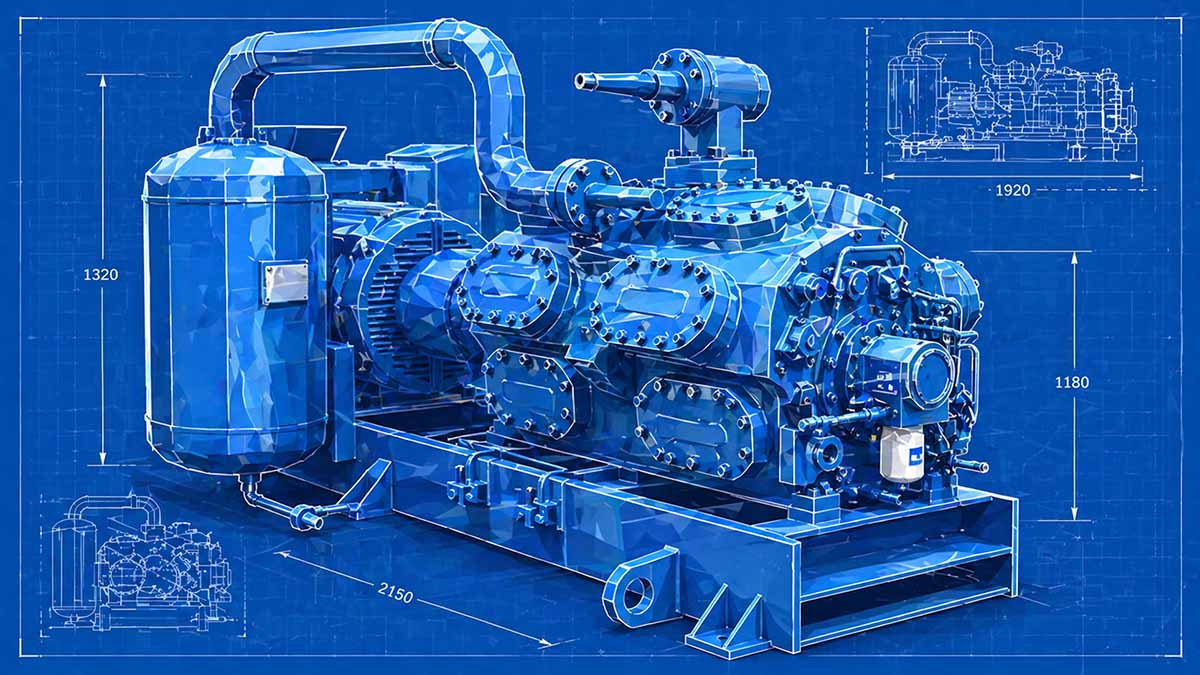
Reciprocating compressors do not fail the way rotating equipment fails. They have valves that open and close millions of times a day. They have piston rings that wear against cylinder walls under pressure. They have packing that leaks gas if you ignore it. They have rod loads that reverse direction every revolution. The maintenance program that keeps a centrifugal pump healthy will not keep a reciprocating compressor healthy.
This guide covers what actually matters: the failure modes that drive most unplanned outages, the inspections that catch them, and the schedule a competent program should run. It is written for plants that already own these machines and want to stop being surprised by them.
Why reciprocating compressors are different
A reciprocating compressor converts rotational motion into linear piston motion to compress gas. That conversion is what makes it efficient at high pressure ratios, and it is also what makes maintenance more demanding than rotating equipment.
Every stroke loads and unloads the rod, the bearings, the crosshead, and the cylinder in opposite directions. Valves slam open and closed at line frequency multiples. Piston rings and rider bands wear against cylinder walls. Packing wears against the rod. Pulsations in the gas stream beat against piping and bottles. Nothing in this machine sits still.
The result is that reciprocating compressors have more wear parts than any other major rotating asset in most plants, and they generate more vibration energy at more frequencies. A maintenance program that does not account for this will run the machine to failure on a predictable schedule.
The failure modes that drive most outages
1. Valve failure
Suction and discharge valves are the highest-failure-rate component on a reciprocating compressor. They are also the easiest to detect early if you watch for the right signals. A failing valve runs hot, leaks, or both. Discharge valve failure shows up as elevated suction temperature on the next stage and reduced flow. Suction valve failure shows up as elevated discharge temperature on the failed stage.
Most plants run valves to a fixed-interval replacement, typically 8,000 to 16,000 hours, and most plants over-replace some valves and under-replace others as a result. A condition-based program built on cylinder temperature monitoring and PV (pressure-volume) analysis will outperform a calendar program in both cost and reliability.
2. Packing leaks
The packing rings around the piston rod are a wear part. They will leak. The question is whether you find out from a routine inspection or from a process gas alarm. Plants in hydrogen, hydrocarbon, or sour service that ignore packing wear find out the second way.
Distance piece venting is the early warning. A clean, dry distance piece with low vent flow is healthy. A wet, oily, or high-flow distance piece is a packing in distress. Walk the compressors weekly and put a hand on the distance piece vents. The data is free.
3. Piston ring and rider band wear
Rings and rider bands wear against the cylinder bore. As they wear, blow-by past the piston increases, capacity drops, and discharge temperature rises. Severe wear can let the piston contact the cylinder wall, which destroys the cylinder.
The signal is the same as valve failure in the early stage: rising discharge temperature for no apparent reason. Distinguishing ring wear from valve failure requires PV analysis or a ring-wear inspection during a scheduled outage. Most plants only learn the difference after the cylinder is open.
4. Rod load reversal problems
A reciprocating compressor needs a clean reversal of rod load on every stroke for the crosshead pin and bushing to stay lubricated. Operating conditions that compress the reversal window, such as low suction pressure or unloader misadjustment, starve the bearings of lubrication and destroy them quickly.
This is one of the failures that catches plants off guard. The compressor seems to be running fine. Then a crosshead pin fails, the rod bends, and the cylinder is destroyed. The cause was a process condition that was inside the operating envelope but outside the rod load reversal limits the OEM published twenty years ago and nobody read.
5. Bearing failure
Main bearings, crosshead bearings, and crosshead pin bushings all fail from the same root causes: oil contamination, oil starvation, or load reversal problems. None of these are mysteries. All of them are detectable through oil analysis and bearing temperature monitoring before they cause a forced outage.
A reciprocating compressor will tell you it is dying for weeks before it actually dies. The plants that get caught off guard are not the ones whose compressor failed without warning. They are the ones whose maintenance program was not listening.
A maintenance program that actually works
A defensible reciprocating compressor maintenance program has four layers. Each layer catches different failure modes at different lead times.
Daily checks
Cylinder discharge temperatures, recorded and trended. A 10°F rise on one cylinder over a week is a valve or ring problem developing.
Distance piece vent flow and condition. Wet, oily, or high-flow vents are packing problems.
Lube oil pressure and temperature. Outside-normal readings get investigated, not noted and forgotten.
Visible and audible inspection. Operators who walk the machine daily catch things instruments miss.
Weekly to monthly
Vibration monitoring on cylinder, crosshead, and frame. Reciprocating compressors generate vibration at running speed, twice running speed, valve frequencies, and pulsation frequencies. A program that only watches running-speed vibration will miss most of the early signals.
Capacity and efficiency check. A drop in flow at constant operating conditions points to valve, ring, or unloader problems.
Lube oil sampling for trending. Wear metals, water, and fuel dilution catch problems early. See our coverage on oil analysis interpretation for the specifics.
Quarterly to semi-annually
PV analysis on each cylinder. This is the single most powerful diagnostic tool for a reciprocating compressor. It separates valve problems from ring problems, identifies leaking valves on specific cylinders, and quantifies efficiency loss.
Crosshead and frame inspection windows checked for clearance changes.
Cooler condition and approach temperatures.
Major overhaul
A reciprocating compressor major overhaul cycle ranges from 3 years for severe-service machines to 6 to 8 years for light-duty machines. The overhaul scope should be condition-based, informed by the trending data from the previous interval. Pulling apart a healthy machine on a fixed schedule wastes money. Ignoring a machine that the data says is in distress wastes more.
Vibration monitoring on reciprocating compressors
Vibration analysis on reciprocating machines is fundamentally different from rotating-equipment analysis. The signal is not a clean sinusoid. It is a complex waveform with impulses from valve events, piston reversal, and crosshead slap. Reading it well requires either time-domain analysis or order tracking, not just FFT spectra.
The most useful sensors are crankcase accelerometers for crosshead and bearing condition, and cylinder accelerometers for valve events. Adding a once-per-revolution trigger from the crankshaft turns a vibration plot into a phase-resolved diagnostic that can identify which valve, on which stroke, is failing.
This level of monitoring is not expensive. The discipline to actually look at the data is what most programs lack.
When could a reciprocating compressor be damaged?
There is a long list. The most common causes of unplanned damage:
Liquid carryover into the suction. Reciprocating compressors are positive-displacement machines and cannot compress liquid. A slug of liquid will bend a rod, blow a head gasket, or destroy a cylinder in one revolution.
Operating outside the rod load envelope. Low suction pressure, high discharge pressure, or unloader misadjustment can compress the rod load reversal window and starve the crosshead bearings.
Loss of lube oil pressure, even briefly. Crosshead pins and main bearings depend on continuous oil film. Seconds of oil loss equals hours of bearing damage.
Process upsets that drive cylinder temperatures above the lubricant flash point. Cylinder lube degrades, ring wear accelerates, and varnish builds up on valve plates.
Skipped overhaul on a high-runtime machine. Wear is cumulative. A machine pushed past its overhaul interval will eventually find its weakest part.
FAQ
Frequently Asked Questions
What is the maintenance schedule for a reciprocating compressor?
Daily operator checks of temperature, pressure, and distance piece vents. Weekly to monthly vibration monitoring and oil sampling. Quarterly to semi-annual PV analysis and inspection windows. Major overhaul every 3 to 8 years depending on service severity. The exact intervals should be condition-based, informed by trending data, not fixed-calendar.
What are the most common reciprocating compressor failures?
In rough order of frequency: valve failure, packing leaks, piston ring and rider band wear, bearing failure from oil contamination or rod load problems, and crosshead pin and bushing failure. Each has detectable early signals if the maintenance program is watching.
Can vibration analysis detect reciprocating compressor problems?
Yes, but it requires different techniques than rotating equipment. Time-domain analysis, phase-resolved triggering off the crankshaft, and impulse detection are all more useful than FFT spectra alone. Cylinder-mounted accelerometers detect valve events. Crankcase accelerometers detect bearing and crosshead condition.
How often should reciprocating compressor valves be replaced?
Calendar-based programs typically replace valves every 8,000 to 16,000 hours. Condition-based programs, driven by cylinder temperature trending and PV analysis, replace valves when the data shows they are failing. The condition-based approach almost always extends average valve life and reduces total cost.
What is PV analysis on a reciprocating compressor?
Pressure-volume analysis records cylinder pressure throughout the compression stroke and plots it against piston position. The shape of the resulting curve identifies valve leakage, ring blow-by, late valve opening, and other internal problems on each cylinder. It is the most powerful single diagnostic tool for a reciprocating compressor.
What causes sudden reciprocating compressor failure?
Almost always one of three things: liquid carryover into the suction, operation outside the rod load envelope, or loss of lube oil pressure. All three can destroy a machine in a single event. All three are preventable with proper instrumentation and operating discipline.