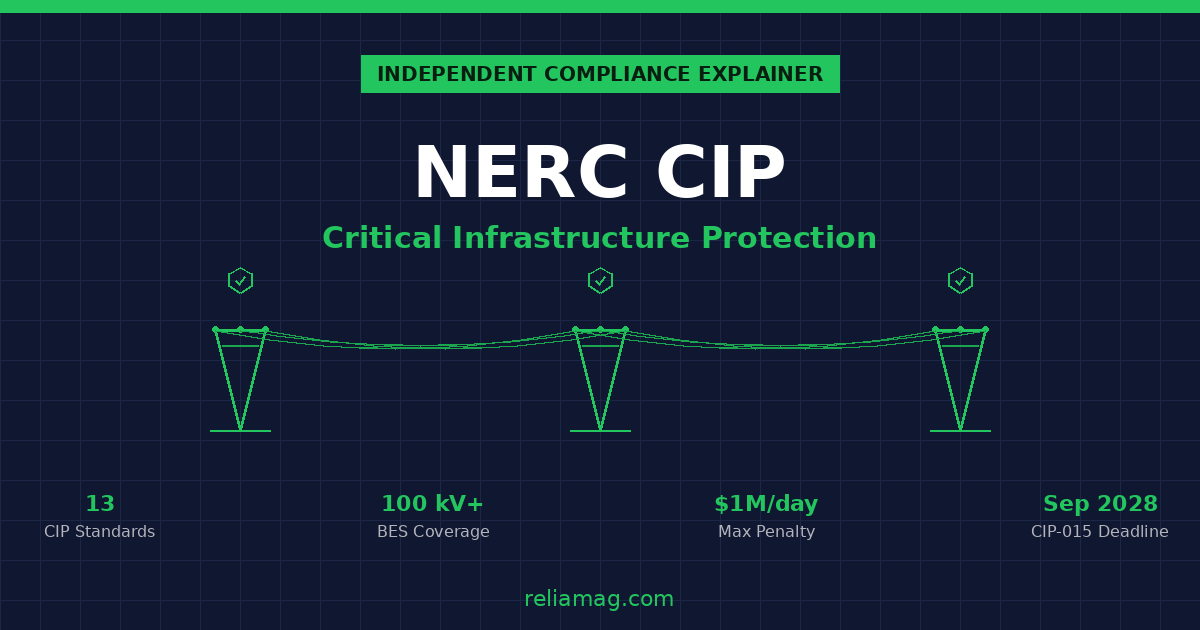

TL;DR: NERC CIP refers to the Critical Infrastructure Protection Reliability Standards developed by the North American Electric Reliability Corporation and approved by FERC and equivalent Canadian regulators. The standards establish mandatory cybersecurity and physical security requirements for entities that own or operate the Bulk Electric System. As of 2026, thirteen CIP standards are active – CIP-002 through CIP-014 plus the newer CIP-015 covering Internal Network Security Monitoring (INSM). Three significant changes shape the 2026 compliance landscape: CIP-003-9 enforcement began April 1, 2026, expanding governance requirements for low-impact BES Cyber Systems with focus on vendor remote access and supply chain; CIP-012-2 takes effect July 1, 2026, strengthening protection of real-time operational data exchanged between control centers; and CIP-015-1 became effective September 2, 2025 with phased compliance through September 2030, addressing the lateral-movement and east-west traffic visibility gap that perimeter defenses alone cannot close. Penalties for non-compliance can reach $1 million per violation per day. Asset management infrastructure – accurate cyber asset inventories, configuration baselines, software records, vendor tracking, and physical asset documentation – is the operational foundation that determines whether CIP compliance is sustainable or perpetually firefighting audit findings. CMMS and EAM platforms with native NERC CIP frameworks substantially reduce compliance overhead compared to fragmented documentation.
The Short Answer
NERC CIP is the regulatory framework that governs cybersecurity and physical security of the Bulk Electric System (BES) in North America. The standards apply to Registered Entities that own or operate BES facilities – Transmission Owners and Operators, Generator Owners and Operators, Balancing Authorities, Reliability Coordinators, and Independent System Operators among others. Compliance is mandatory, audits are routine, and penalties reach $1 million per violation per day.
Three things define the 2026 compliance landscape. The standards themselves continue to evolve, with major updates in CIP-003-9, CIP-012-2, and CIP-015-1 reshaping the operational baseline. The OT cybersecurity discipline has matured substantially – internal network security monitoring, supply chain risk management, and OT-specific threat detection are now operational expectations rather than emerging capabilities. And the asset management foundation that NERC CIP rests on – accurate cyber asset inventories, configuration baselines, vendor tracking – has become the practical limiting factor for compliance at scale. Utilities that have invested in asset management infrastructure tied to NERC CIP frameworks are in substantially better positions than utilities still operating from spreadsheets and fragmented documentation.
The Bulk Electric System and Why NERC CIP Exists
The Bulk Electric System (BES) is the high-voltage backbone of the North American electric grid – generation, transmission, and associated facilities that are critical to the reliable operation of electricity across the United States, the Canadian provinces, and the northern portion of Baja California in Mexico. The BES is generally defined as electrical generation, transmission, and associated facilities operating at 100 kV or above, plus generation facilities meeting specific size and connection criteria. A cyberattack or physical attack that compromised significant BES infrastructure could cause cascading outages affecting tens of millions of people, with restoration timelines measured in days to weeks for severe events.
NERC is the Electric Reliability Organization (ERO) certified by FERC to develop and enforce mandatory reliability standards for the BES. NERC’s authority derives from Section 215 of the Federal Power Act, established in 2005 following the August 2003 Northeast blackout that affected 50 million people across eight U.S. states and Ontario. The CIP standards specifically emerged from FERC concern that the original NERC Reliability Standards inadequately addressed cybersecurity and physical security risks to BES infrastructure.
The CIP standards have evolved through multiple versions over the past two decades. Early versions focused on cyber asset identification and basic security controls. Later versions reorganized requirements around BES Cyber Systems rather than individual cyber assets, enabling more holistic security architecture. Current versions address supply chain risk, physical security of critical transmission stations, communications between control centers, and internal network security monitoring. The progression reflects both the increasing sophistication of cyber threats against critical infrastructure and the maturation of operational technology security as a discipline.
Two events in particular shaped the modern CIP landscape. The April 2013 Metcalf substation attack in California – where attackers fired more than 100 rounds into 17 electrical transformers serving Silicon Valley, causing $15 million in damage – drove the creation of CIP-014 covering physical security of critical transmission facilities. The December 2022 Moore County substation attack in North Carolina, which knocked out power to approximately 45,000 customers, combined with subsequent attacks in Oregon, Washington, and the Pacific Northwest, accelerated FERC and NERC efforts to strengthen physical security requirements and broaden their applicability.
The Current State of NERC CIP in 2026
Thirteen NERC CIP Reliability Standards are currently active. The 2026 compliance landscape is shaped by three significant changes that took effect or take effect during 2026.
CIP-003-9 (Security Management Controls) – enforcement began April 1, 2026. CIP-003-9 replaces CIP-003-8 and expands governance requirements for low-impact BES Cyber Systems, with specific focus on vendor electronic remote access and supply-chain risk management. Entities must ensure that policies, access controls, and monitoring processes account for how vendors connect to and interact with low-impact OT environments. The standard is significant because low-impact systems – historically the lightest-regulated category under CIP-002 – now face meaningful governance requirements that previously applied only at medium and high impact. Operations with extensive low-impact BES Cyber System portfolios face the most substantial compliance changes under CIP-003-9.
CIP-012-2 (Communications between Control Centers) – effective July 1, 2026. CIP-012-2 strengthens protection of real-time operational data transmitted between control centers, addressing the confidentiality, integrity, and availability of data in transit. The standard applies to Responsible Entities that own or operate control centers, including Balancing Authorities, Reliability Coordinators, Transmission Operators, Transmission Owners, Generator Owners, and Generator Operators. Under Requirement R1, entities must implement one or more documented plans to mitigate risks of unauthorized disclosure, unauthorized modification, and loss of availability for real-time assessment and monitoring data exchanged between control centers. The expansion from CIP-012-1 reflects increased attention to the operational consequences of compromised inter-control-center communications.
CIP-015-1 (Internal Network Security Monitoring) – effective September 2, 2025 with phased compliance through 2030. CIP-015 is the newest NERC CIP standard, addressing the lateral-movement and east-west traffic visibility gap that perimeter defenses alone cannot close. FERC approved CIP-015-1 in Order No. 907 on June 26, 2025, with the standard becoming effective on September 2, 2025. Compliance deadlines are phased: September 2, 2028 for high-impact BES Cyber Systems and medium-impact BES Cyber Systems with External Routable Connectivity (ERC) located in Control Centers and backup Control Centers, and September 2, 2030 for all other applicable medium-impact systems with ERC. NERC must submit a CIP-015-2 modification by September 2, 2026 to extend INSM scope to Electronic Access Control or Monitoring Systems (EACMS) and Physical Access Control Systems (PACS) outside the Electronic Security Perimeter.
Beyond these three significant changes, NERC continues to advance additional CIP development work. CIP-002-8 has been adopted by NERC and filed with FERC (Docket RD25-8-000), introducing Aggregated Weighted Value (AWV) scoring to determine whether Control Centers and associated BES Cyber Systems qualify as Medium Impact. This change could recategorize some entities long considered Low Impact into Medium Impact, triggering additional authentication, monitoring, and evidence requirements. Enforcement timeline remains pending FERC approval. Additional CIP development projects are advancing through NERC’s 2026 standards development plan addressing virtualization, transient cyber assets, and other emerging operational realities.
The NERC CIP Standards Index
Each NERC CIP standard addresses a specific aspect of BES cybersecurity or physical security. Operations under NERC CIP coverage are subject to multiple standards simultaneously, with the specific scope determined by Function Registration and the impact level assigned to BES Cyber Systems under CIP-002.
CIP-002 – BES Cyber System Categorization. Establishes the foundational requirement to identify and categorize BES Cyber Systems as high, medium, or low impact based on the consequences of compromise. The categorization determines which downstream standards apply and at what depth. CIP-002 is the scoping foundation for the entire CIP framework – accurate asset identification and impact categorization is the prerequisite for everything else. Current version is CIP-002-5.1a, with CIP-002-8 awaiting FERC approval as discussed above.
CIP-003 – Security Management Controls. Establishes governance framework requirements including senior manager accountability, cyber security policies, and security management controls. CIP-003-9 enforcement began April 1, 2026, expanding governance requirements for low-impact systems with specific focus on vendor electronic remote access and supply-chain risk management.
CIP-004 – Personnel and Training. Establishes personnel risk assessment, training, and access management requirements for personnel with access to BES Cyber Systems. Includes background investigations, security awareness training, role-based training, and access management procedures including timely revocation of access for terminated personnel.
CIP-005 – Electronic Security Perimeters. Establishes requirements for Electronic Security Perimeters (ESPs) around BES Cyber Systems and Electronic Access Control or Monitoring Systems (EACMS) that protect access to the perimeter. The ESP concept defines the cyber boundary that separates protected BES Cyber Systems from less-trusted networks. Interactive remote access requires multi-factor authentication and encryption.
CIP-006 – Physical Security of BES Cyber Systems. Establishes physical security requirements for BES Cyber Systems including Physical Security Perimeters (PSPs), physical access controls, monitoring of physical access, and physical access logs. Distinct from CIP-014 – CIP-006 covers physical security of cyber assets themselves, while CIP-014 covers physical security of critical transmission stations.
CIP-007 – System Security Management. Establishes baseline configuration management, security patch management, malicious code prevention, security event monitoring, and account management requirements for BES Cyber Systems. Operationally one of the most consequential standards because it touches day-to-day operation of every covered BES Cyber System.
CIP-008 – Incident Reporting and Response Planning. Establishes cybersecurity incident response plans, incident classification, reporting requirements, and incident response testing. Reportable Cyber Security Incidents must be reported to the Electricity Information Sharing and Analysis Center (E-ISAC) within specified timeframes.
CIP-009 – Recovery Plans for BES Cyber Systems. Establishes recovery plans for BES Cyber Systems including roles and responsibilities, recovery procedures, backup and restoration processes, and recovery plan testing. Operations must demonstrate that BES Cyber Systems can be recovered following a cybersecurity incident or other compromise.
CIP-010 – Configuration Change Management and Vulnerability Assessments. Establishes configuration change management requirements including baseline configurations, change authorization, and configuration monitoring. Also establishes vulnerability assessment requirements at specified frequencies. Tightly coupled with CIP-007 baseline management and operationally consequential for maintenance workflows.
CIP-011 – Information Protection. Establishes requirements for protecting BES Cyber System Information from unauthorized access. Covers identification of BES Cyber System Information, information handling procedures, and information protection during media disposal and reuse.
CIP-012 – Communications between Control Centers. Establishes requirements for protecting communications between control centers including confidentiality, integrity, and availability of real-time operational data. CIP-012-2 takes effect July 1, 2026 as discussed above.
CIP-013 – Supply Chain Risk Management. Establishes supply chain cyber security risk management requirements addressing risks associated with vendors, products, services, and remote access. Operations must implement supply chain cyber security risk management plans covering vendor risk assessment, vendor remote access, and procurement controls. CIP-013 has substantially increased scrutiny of OT vendor security practices.
CIP-014 – Physical Security. Establishes physical security requirements for critical transmission stations, transmission substations, and their associated primary control centers. Current version is CIP-014-3. Covered in detail in the next section.
CIP-015 – Internal Network Security Monitoring (INSM). Establishes INSM requirements for east-west traffic monitoring within Electronic Security Perimeters. CIP-015-1 effective September 2, 2025 with phased compliance through September 2030, as discussed above. CIP-015-2 expected to expand scope to EACMS and PACS outside the ESP.
CIP-014 Deep Dive: Physical Security of Critical Transmission Facilities
CIP-014 originated from FERC Order No. 802 (issued November 2014) following the April 2013 Metcalf substation attack. The Metcalf attack – a coordinated firearms assault that destroyed or damaged 17 transformers serving Silicon Valley – demonstrated that physical attacks against critical transmission infrastructure could cause significant grid disruption and that existing physical security requirements were inadequate. FERC ordered NERC to develop a physical security reliability standard within 90 days. NERC delivered CIP-014-1, which has since been updated to the current CIP-014-3.
The standard targets the most critical transmission facilities in North America rather than the full population of approximately 55,000 transmission substations operating at 100 kV or higher. Applicability is determined primarily by transmission voltage and configuration. Substations operating at 500 kV are generally within applicability. Substations operating at 200 kV through 499 kV are within applicability when connected to three or more substations at 200 kV or higher. Additional criteria address generator interconnection facilities and Reliability Coordinator-designated facilities.
CIP-014-3 establishes six requirements that covered Transmission Owners and Transmission Operators must satisfy.
Requirement R1: Risk Assessment. Transmission Owners must perform an initial transmission risk assessment and subsequent risk assessments of their transmission stations and substations meeting the applicability criteria. The risk assessment must identify facilities that, if rendered inoperable or damaged, could result in instability, uncontrolled separation, or Cascading within an Interconnection. Subsequent risk assessments are required at least once every 30 calendar months for entities that have conducted prior assessments and identified critical facilities, or at least once every 60 calendar months for entities that have not previously identified critical facilities.
Requirement R2: Third-Party Verification. The Transmission Owner must have an unaffiliated third party verify the initial and subsequent risk assessments. Acceptable third parties include Registered Planning Coordinators, Transmission Planners, or Reliability Coordinators, as well as entities with experience in transmission planning or analysis. Following verification, entities must implement any recommended changes within 60 calendar days.
Requirement R3: Notification. If a Transmission Owner is not the operator of an identified critical facility, the owner must notify the Transmission Operator that operates the primary control center within seven calendar days of the verification under R2. Notification establishes the start date for the operator’s downstream R4 through R6 obligations.
Requirement R4: Threat and Vulnerability Assessment. For each identified critical transmission station, substation, and primary control center, entities must conduct a threat and vulnerability assessment (TVA) that considers physical characteristics of the facility, prior history of physical attacks or security events on similar facilities, and intelligence or threat warnings from law enforcement, the Electricity Information Sharing and Analysis Center (E-ISAC), and applicable governmental agencies.
Requirement R5: Physical Security Plan. Based on the TVA findings, entities must develop and implement documented physical security plans designed to deter, detect, delay, assess, communicate, and respond to potential physical threats. The five-function physical security model (deter, detect, delay, assess, respond) is a recurring framework in physical security plan design.
Requirement R6: Third-Party Review. The TVA and physical security plan must be reviewed by an unaffiliated third party. The review provides external validation that the assessment and plan address identified threats and vulnerabilities appropriately.
CIP-014 enforcement has been active for more than a decade and the compliance program is mature. NERC continues to refine the standard through additional development work. In response to FERC questions following the 2022-2023 substation attacks in North Carolina, Washington, and Oregon, NERC conducted a study evaluating whether CIP-014 applicability should be expanded and concluded that the current applicability criteria meet the standard’s objectives, but committed to additional development work to clarify risk assessment methodology and the specific expectations for transmission analyses. Entities should monitor NERC standards development for ongoing refinements to CIP-014 risk assessment requirements.
OT Cybersecurity Convergence Under NERC CIP
NERC CIP standards apply specifically to Operational Technology – the systems that monitor and control the Bulk Electric System. The OT scope includes SCADA systems, distributed control systems (DCS), programmable logic controllers (PLCs), intelligent electronic devices (IEDs), energy management systems (EMS), and related industrial control systems (ICS). Information Technology systems – corporate email, ERP, file servers, business networks – generally fall outside NERC CIP scope unless they directly connect to BES Cyber Systems.
The IT-OT distinction matters operationally because the two environments have fundamentally different security constraints. OT systems have extended equipment lifecycles measured in 15 to 30+ years compared to typical IT lifecycles of 3 to 7 years. OT uptime requirements often preclude routine patching during operations, requiring patches to be deployed during planned maintenance windows that may occur only every 12 to 24 months. OT systems frequently run proprietary protocols (Modbus, DNP3, IEC 61850, Profinet, and others) that traditional IT security tools handle poorly. And OT systems have operational consequences from security tool deployment that IT environments do not face – a network monitoring tool that crashes a server is an inconvenience in IT and a potential grid event in OT.
Several modern NERC CIP standards address the OT-specific cybersecurity challenges that pure IT security frameworks handle poorly. CIP-013 supply chain risk management specifically addresses OT vendor and component risk that traditional procurement practices do not cover. CIP-015 internal network security monitoring uses passive network monitoring approaches that minimize operational impact on OT systems compared to active scanning. CIP-003-9 expanded scope for vendor remote access addresses the operational reality that OT systems often require remote OEM support that creates persistent access paths into BES Cyber Systems.
OT cybersecurity has emerged as a specialized vendor category distinct from traditional IT security. Dragos, Nozomi Networks, Claroty, Industrial Defender, and Tenable OT Security are among the leading OT security platforms commonly deployed for NERC CIP compliance. These platforms provide passive OT network monitoring, OT asset discovery and inventory, OT-specific threat detection, and OT incident response capabilities that traditional IT security tools cannot match. Operations under NERC CIP coverage with serious INSM, CIP-013, and CIP-007 obligations typically deploy at least one OT security platform alongside their CMMS, EAM, and IT security infrastructure.
Asset Management Requirements Under NERC CIP
NERC CIP compliance rests on asset management infrastructure that ties cyber asset records, physical asset records, configuration baselines, software inventories, vendor information, and maintenance history into auditable documentation. The asset management requirements span multiple standards.
CIP-002 requires accurate identification and categorization of all BES Cyber Systems. Operations must identify every BES Cyber Asset, group those assets into BES Cyber Systems, and categorize each system as high, medium, or low impact. The categorization determines downstream compliance scope across every other CIP standard. Inaccurate asset identification under CIP-002 cascades into compliance gaps across the entire CIP framework – assets not identified are not protected, not monitored, not patched on schedule, and not included in incident response plans. CIP-002 is the most commonly cited foundational weakness in NERC enforcement findings.
CIP-007 requires baseline configuration management. Operations must establish baseline configurations for each BES Cyber System covering operating system, commercially available software, custom software, logical network accessible ports, and security patches. Baselines must be reviewed at specified intervals and updated when changes are authorized under CIP-010. Maintaining accurate baselines requires asset management infrastructure that tracks software inventory at the asset level – not aggregated counts but specific software and version on specific assets.
CIP-010 requires configuration change management tied to the baseline. Authorized changes to BES Cyber Systems must follow documented change management workflows, must update the baseline, and must be subject to vulnerability assessment at specified frequencies. Configuration change management overlaps directly with maintenance work order workflows – software updates, patches, and configuration changes that flow through CMMS work orders are CIP-010 events that require baseline updates.
CIP-013 requires supply chain tracking through asset lifecycle. Operations must implement supply chain cyber security risk management plans covering vendor identification, vendor risk assessment, procurement controls, and ongoing vendor management. Tracking which vendors supplied which components installed on which assets – and which vendors hold remote access to which assets – is asset management work at scale.
CIP-014 requires physical asset identification and documentation. Identified critical transmission stations and substations must be documented with their specific equipment, threat and vulnerability assessments, physical security plans, and third-party reviews. The physical asset records must align with the cyber asset records under CIP-002 because the same physical transmission facility may host BES Cyber Systems with cyber compliance obligations alongside physical security obligations.
Operationally, NERC CIP compliance is asset management at scale with cyber and physical security overlays. Operations that have invested in CMMS or EAM platforms with native NERC CIP frameworks substantially reduce audit overhead compared to operations running CIP compliance from spreadsheets, Word documents, and disconnected configuration databases. IBM Maximo for Utilities, Hexagon HxGN EAM, SAP S/4HANA Asset Management (Utilities), Oracle Utilities Work and Asset Management, and Infor EAM all include NERC CIP frameworks or configuration support, with depth varying substantially across platforms. The vendor selection details are covered in our independent utilities CMMS guide and utilities EAM guide.
How NERC CIP Connects to CMMS and EAM Operations
NERC CIP compliance touches CMMS and EAM operations at multiple integration points. The handshakes determine whether CIP compliance is sustainable as an integrated operational discipline or perpetually firefighting audit findings.
The asset master handshake. CIP-002 categorization, CIP-007 baseline management, and CIP-014 physical security plans all reference specific physical and cyber assets. The CMMS or EAM asset master must align with the CIP asset register so that maintenance work orders, configuration changes, and physical security inspections reference the same assets that appear in CIP documentation. Misalignment between CMMS asset records and CIP asset records is one of the most common compliance gaps identified during NERC audits.
The work order handshake for configuration changes. Software updates, patches, firmware updates, and configuration changes that flow through CMMS work orders are CIP-010 events. The work order workflow must capture the authorized change, link to the baseline update under CIP-007, and document the change in audit-ready form. Operations running CIP-010 separately from maintenance work orders typically struggle to maintain configuration documentation under audit pressure.
The personnel access handshake. CIP-004 personnel and training requirements include access management – timely revocation of access for terminated personnel, role-based access tied to job function, and training records tied to personnel. CMMS personnel records, training records, and contractor management workflows must align with CIP-004 access management to maintain compliance.
The physical security work handshake. CIP-014 physical security plans drive specific maintenance activities – perimeter inspection, fence and gate maintenance, surveillance system maintenance, access control system maintenance. These activities flow through CMMS work orders. Operations that run physical security work orders separately from CIP-014 documentation create audit findings when the maintenance evidence does not align with the security plan execution evidence.
The incident response handshake. CIP-008 incident response and CIP-009 recovery plans depend on infrastructure documentation that lives in CMMS and EAM systems. Recovery procedures reference specific assets, configurations, vendors, and replacement parts that must be maintained as current asset records.
The integration depth between NERC CIP frameworks and CMMS/EAM platforms substantially determines compliance overhead. Operations using CMMS platforms with mature NERC CIP modules (IBM Maximo for Utilities is the most established) typically run CIP compliance as a structured operational discipline. Operations using generic CMMS platforms without NERC CIP configuration depth typically run CIP compliance through parallel documentation that is harder to maintain and prone to audit findings.
The Audit and Enforcement Reality
NERC CIP compliance is enforced through the ERO Enterprise Compliance Monitoring and Enforcement Program (CMEP). The program includes Compliance Audits, Self-Certifications, Spot Checks, Compliance Investigations, Self-Reports, and Complaints. Audit cycles vary by entity size and risk profile but commonly run on three-year to six-year intervals for full Compliance Audits with additional Spot Checks and Self-Certifications in intervening periods.
Audit findings result in violations classified by Violation Risk Factor (VRF – Lower, Medium, High) and Violation Severity Level (VSL – Lower, Moderate, High, Severe). NERC can assess penalties of up to $1 million per violation per day. Aggregate fines for systemic non-compliance can substantially exceed $1 million – NERC has issued total penalties exceeding $10 million in single enforcement actions for serious violations spanning multiple standards.
Beyond financial penalties, NERC enforcement findings require Mitigation Plans that document the violation, identify the root cause, specify the corrective actions, establish a milestone schedule, and demonstrate completion. Mitigation Plans are audited for completion and effectiveness. The operational consequences of mitigation often exceed the financial penalty itself, particularly when violations are identified during a serious cybersecurity or physical security incident.
Common NERC CIP enforcement findings include inaccurate CIP-002 asset categorization, incomplete CIP-007 baseline configuration documentation, gaps in CIP-010 configuration change management, insufficient evidence of CIP-004 access management, weak CIP-008 incident response documentation, and inadequate CIP-013 supply chain risk management plans. The pattern is that documentation and evidence quality drive enforcement outcomes – operations that perform the substantive compliance work but cannot produce audit-ready evidence still receive enforcement findings.
What to Do Now
Operations under NERC CIP coverage should be working through a structured compliance program that addresses the 2026 changes and prepares for upcoming compliance deadlines.
- Confirm CIP-003-9 compliance. Enforcement began April 1, 2026. Operations with low-impact BES Cyber Systems should have completed governance updates addressing vendor electronic remote access and supply-chain risk management. If not yet complete, prioritize this immediately.
- Prepare for CIP-012-2 effectiveness July 1, 2026. Document plans to mitigate risks of unauthorized disclosure, unauthorized modification, and loss of availability for real-time operational data exchanged between control centers. Operations exchanging real-time data should have plans drafted and ready to implement by the July effective date.
- Plan for CIP-015-1 INSM deployment. September 2, 2028 is the compliance deadline for high-impact systems and Control Center medium-impact systems with ERC. Two and a half years is a short timeline for OT network monitoring deployment given procurement lead times of up to 18 months for medium and large utilities. Operations should be evaluating OT security platforms, planning network infrastructure upgrades, and beginning pilots now rather than later.
- Monitor CIP-002-8 progress. CIP-002-8 has been adopted by NERC and filed with FERC. Enforcement timeline is pending FERC approval, but operations should evaluate how Aggregated Weighted Value scoring would affect their Control Center categorization. Some entities long considered Low Impact may be recategorized into Medium Impact, triggering substantial new compliance obligations.
- Audit asset management infrastructure. CIP compliance rests on asset management. Operations running CIP compliance from spreadsheets and fragmented documentation should evaluate CMMS or EAM platforms with native NERC CIP frameworks. The integration depth between asset management and CIP documentation determines audit overhead substantially.
- Refresh CIP-014 risk assessments on schedule. Subsequent risk assessments are required every 30 calendar months for entities that have conducted prior assessments. Maintain the cadence regardless of operational pressure. Monitor NERC standards development for additional CIP-014 refinements following the 2023-2025 substation attack response work.
- Validate IT-OT coordination. CIP-013 supply chain, CIP-015 INSM, and CIP-003-9 vendor remote access all span IT and OT boundaries. Operations with weak IT-OT coordination typically discover gaps during audits. Establish governance and communication channels that span both environments before audit pressure surfaces problems.
- Engage the E-ISAC and Regional Entity proactively. The Electricity Information Sharing and Analysis Center and the eight Regional Entities (MRO, NPCC, RF, SERC, Texas RE, WECC, plus FRCC and TRE within their regions) provide guidance, training, and early warning of enforcement trends. Engagement with these resources reduces compliance surprises.
Frequently Asked Questions
What is NERC CIP?
NERC CIP refers to the Critical Infrastructure Protection Reliability Standards developed by the North American Electric Reliability Corporation and approved by FERC and equivalent Canadian regulators. The standards establish mandatory cybersecurity and physical security requirements for entities that own or operate the Bulk Electric System in North America. Thirteen CIP standards are active as of 2026, covering BES Cyber System categorization, security management controls, personnel and training, electronic security perimeters, physical security, system security management, incident reporting, recovery plans, configuration change management, information protection, communications between control centers, supply chain risk management, physical security of critical transmission stations, and internal network security monitoring.
What are the NERC CIP standards in 2026?
The active CIP standards are CIP-002 through CIP-014 plus CIP-015 covering Internal Network Security Monitoring. Three significant changes shape 2026: CIP-003-9 enforcement began April 1, 2026 expanding low-impact governance and vendor remote access requirements; CIP-012-2 takes effect July 1, 2026 strengthening protection of real-time operational data between control centers; and CIP-015-1 effective September 2, 2025 establishes INSM requirements with phased compliance through September 2030.
What is CIP-014?
CIP-014 is the NERC Reliability Standard for Physical Security of critical transmission stations, transmission substations, and their associated primary control centers. The current version is CIP-014-3. The standard requires Transmission Owners to perform risk assessments identifying critical transmission facilities, conduct threat and vulnerability assessments for identified facilities, develop and implement documented physical security plans, and have those plans verified by unaffiliated third parties. Risk assessments are required every 30 calendar months for entities with prior assessments or every 60 calendar months for entities performing initial assessments.
What is CIP-015?
CIP-015 is the newest NERC CIP standard, covering Internal Network Security Monitoring within Electronic Security Perimeters. CIP-015-1 was approved by FERC Order No. 907 on June 26, 2025 and effective September 2, 2025. Compliance deadlines: September 2, 2028 for high-impact systems and medium-impact systems with External Routable Connectivity in Control Centers; September 2, 2030 for other medium-impact systems with ERC. NERC must submit CIP-015-2 by September 2, 2026 extending scope to EACMS and PACS outside the ESP.
What is the difference between IT and OT in NERC CIP?
NERC CIP applies to Operational Technology – SCADA, DCS, PLCs, IEDs, EMS, and related industrial control systems that monitor and control the Bulk Electric System. Information Technology systems generally fall outside CIP scope unless they connect directly to BES Cyber Systems. The distinction matters because OT environments have extended equipment lifecycles, uptime constraints that limit patching, proprietary protocols, and operational consequences from security tool deployment that IT environments do not face.
What are the asset management requirements under NERC CIP?
Asset management requirements span multiple standards. CIP-002 requires accurate BES Cyber System identification and impact categorization. CIP-007 requires baseline configuration management and software inventory. CIP-010 requires configuration change management tied to the baseline. CIP-013 requires supply chain tracking through asset lifecycle. CIP-014 requires physical asset identification and documentation for critical transmission facilities. Operationally, CIP compliance is asset management at scale with cyber and physical security overlays.
What is the penalty for NERC CIP non-compliance?
NERC can assess penalties of up to $1 million per violation per day. Aggregate fines for systemic non-compliance can exceed $10 million for serious violations spanning multiple standards. Beyond financial penalties, enforcement findings require Mitigation Plans that document violations, identify root causes, specify corrective actions, and demonstrate completion under audit oversight.
Who must comply with NERC CIP?
NERC CIP applies to entities that own or operate the Bulk Electric System in North America (the United States, much of Canada, and the northern portion of Baja California in Mexico). Specifically, the standards apply to Registered Entities including Transmission Owners and Operators, Generator Owners and Operators, Balancing Authorities, Reliability Coordinators, Transmission Planners, certain Distribution Providers, and Independent System Operators and Regional Transmission Organizations. The BES generally includes electrical generation, transmission, and associated facilities operating at 100 kV or above.
How long does NERC CIP compliance take to implement?
Initial compliance typically requires 12 to 24 months for new Registered Entities. Major standard updates have phased implementation – CIP-015-1 provides 36 months for high-impact and Control Center systems with ERC, 60 months for other medium-impact systems with ERC. Operations should plan substantial procurement lead time for OT security tools, network monitoring solutions, and physical security infrastructure given specialized vendor markets and OT deployment complexity.
Related Guides
- Best CMMS for Utilities 2026: Independent Comparison
- Best CMMS for Power Generation 2026
- Best EAM Software for Utilities 2026
- Best Asset Performance Management Software 2026
- Best EHS / Safety Management Software 2026
Sources
- North American Electric Reliability Corporation – Reliability Standards, nerc.com/standards/reliability-standards/cip
- CIP-014-3 Physical Security Reliability Standard – official NERC standard text
- CIP-015-1 Internal Network Security Monitoring – official NERC standard text
- FERC Order No. 802 (November 2014) – Physical Security Reliability Standard
- FERC Order No. 887 (January 2023) – directing INSM standard development
- FERC Order No. 907 (June 26, 2025) – approving CIP-015-1
- NERC Reliability Standards Development Plan 2026-2028 (December 4, 2025)
- NERC ERO Enterprise Compliance Monitoring and Enforcement Program documentation
- NERC Glossary of Terms Used in Reliability Standards
- Electricity Information Sharing and Analysis Center (E-ISAC) guidance
- FERC physical security study findings (April 2023) following 2022 substation attacks
- U.S. Federal Energy Regulatory Commission – ferc.gov
- Reliable Magazine independent editorial analysis
Last updated: May 15, 2026. This guide is editorial analysis by Reliable Magazine and is not legal or compliance advice. Operations under NERC CIP coverage should consult qualified compliance counsel and engage with their Regional Entity for specific compliance determinations.