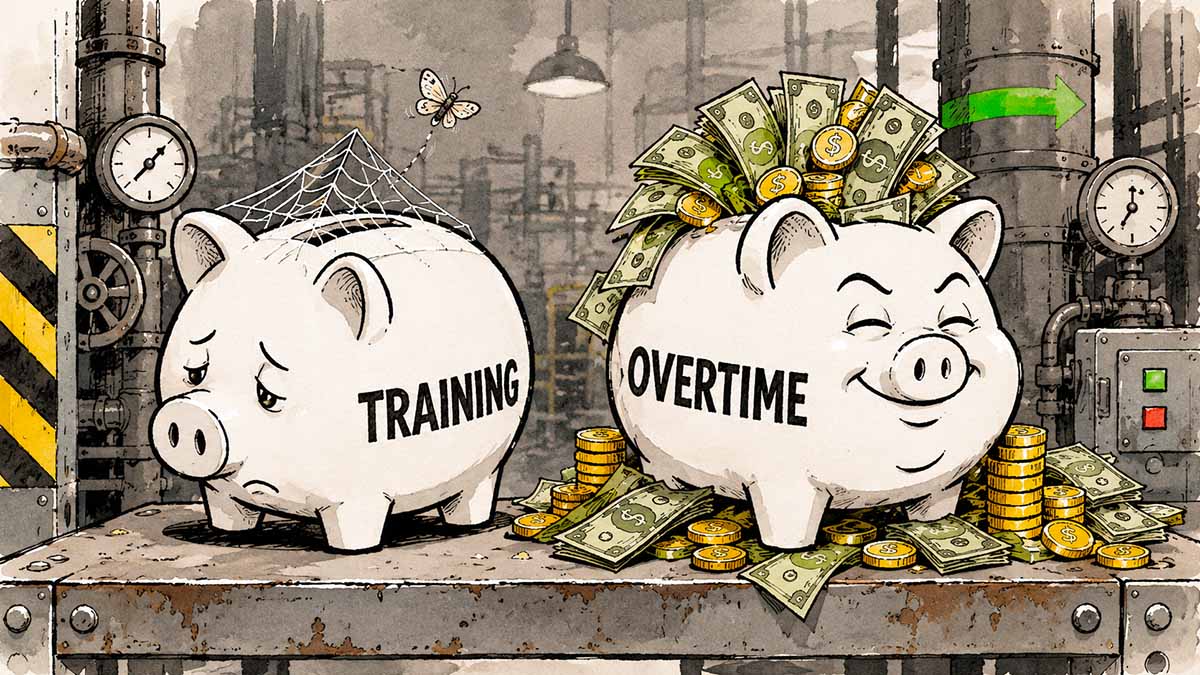

Every manager swears training matters. Then Q4 hits, the numbers tighten, and the first line item to vanish from the spreadsheet is the one that builds the people running the equipment. Training comes back when there’s a crisis, a new piece of capital, or a regulator at the door. It rarely comes back as a strategy.
The cost shows up later, in slower troubleshooting, sloppier PMs, and a workforce that learns by trial and error on million-dollar assets. These 20 questions are designed to drag training out of the “nice to have” column and put it where it belongs: on the same line as spares, tools, and uptime.
Conversation Starters
- “When we cut the training budget last year, what specific reliability or productivity gain did we get in return?”
- “If training is the first thing we cut and the last thing we restore, what does that say about how we actually value the workforce?”
- “Who in this room can name the dollar amount we spent per technician on training last year, and how it compared to what we spent on outside contractors?”
- “When we approve a $400,000 capital project, why don’t we automatically fund the training required to maintain it?”
- “How many of our last 10 unplanned failures involved a technician working outside their formal training?”
- “What’s our average mean time to repair on assets where the lead tech has under two years of experience versus assets where the lead tech has ten?”
- “How much do we spend per year on warranty-voiding repairs, rework, and contractor callbacks that better-trained internal staff could have handled?”
- “When a senior tech retires, how many years of cumulative judgment walk out the door, and what’s our plan to replace it?”
- “If we audited our maintenance crew’s actual competency on precision alignment, vibration interpretation, and lubrication best practices, what percentage would pass?”
- “How many of our technicians have been formally trained on the CMMS we’ve owned for five years?”
- “Are operators trained to recognize early-stage failure indicators on the equipment they run every shift, or are we relying on luck?”
- “When we hire a new technician, what’s the structured onboarding plan, and who owns it?”
- “What would happen to our MTBF if every technician received 40 hours of failure-mode-specific training per year?”
- “Which of our top 10 bad actor assets are bad actors partly because nobody on site knows how to maintain them properly?”
- “If precision maintenance practices reduce bearing failures by a documented 30 to 50 percent, why are we still treating that training as optional?”
- “How does our training spend per technician compare to plants in our industry that publish reliability metrics we’d like to match?”
- “What’s the financial argument for tying training spend to a percentage of maintenance budget, the way we tie spares to asset value?”
- “If we presented training as a downtime reduction investment instead of an HR expense, would it survive the next budget cycle?”
- “Who on the leadership team owns the training budget, and is that person measured on reliability outcomes or on cost containment?”
- “What’s one specific failure or downtime event in the last 12 months where we can directly trace the cause to a training gap, and how do we make sure that story gets told the next time the budget gets reviewed?”
The Real Question
Training is one of the few maintenance investments that compounds. A technician trained today is sharper next year, and sharper still the year after. Cutting that investment buys a small win on this quarter’s P&L and quietly mortgages the next decade of plant performance.
The plants that consistently outperform their peers have better-trained people running their equipment. So the question worth raising in your next budget meeting is simple: how many more years can you afford to pretend training is optional?