

In several recent conversations with colleagues and clients, the topic of succession planning keeps coming up. We see the outcomes when a long-term front-line employee has earned a well-deserved retirement, while no one has picked up the daily condition-monitoring tasks that have largely gone unnoticed for 40 years.
These undocumented tasks were the ‘look, listen, feel, smell’ of whether the rotating equipment was operating as expected, whether something had changed, whether the lubrication reservoir needed a top-up, or whether a belt was wearing. It took several months after the person’s retirement date, but all the random equipment failures due to missing preventive and predictive maintenance were starting to show.
In many companies, reliability and asset management teams are starting to confront a quiet but significant risk: the loss of critical knowledge as experienced employees retire or move into other roles, either within the company or at a competitor.
Companies invest heavily in predictive maintenance technologies, equipment health monitoring, and capital project upgrades and improvements; however, many still underestimate the impact of losing people who understand how the physical assets and equipment perform in the real world of our plants and production environments.
Many companies still underestimate the impact of losing the people who understand how their equipment performs in the real world.
Too often, succession planning is viewed as an HR responsibility that focuses on leadership replacement. Within the field of reliability management, however, succession planning is a business continuity and operational risk consideration.
The retirement or loss of an asset manager, reliability engineer, condition-monitoring specialist, planner, maintenance supervisor, or experienced skilled tradesperson can affect safety, equipment availability, uptime, production costs, and product quality long before a replacement can be hired.
In a cost-rationalization environment, attrition may be viewed as a way to reduce workforce numbers, so the person may not be replaced. We need to ask ourselves whether we have considered succession planning with the same mindset that we apply to equipment criticality, failure prevention, and risk mitigation.
Risks of Institutional Knowledge Gaps
My conversations with colleagues have confirmed my anecdotal perspective that industrial organizations continue to depend on institutional knowledge to keep physical assets running.
Experienced employees know which pumps will routinely fail on startup after an outage or shutdown, which process conditions accelerate equipment wear, and which temporary fixes have become permanent over time. These are the historical equipment failures patterns that have never been documented in a CMMS or captured in an equipment maintenance program. When those experienced employees leave, companies discover slowly, and then increasingly quickly, that critical operational and institutional knowledge has left with them.
Some signs that your company may be in the middle of this shift in workforce experience and competency include:
- An aging workforce with an increase in retirements
- Higher turnover rates, especially among mid-career employees
- Increased competition for skilled technical talent is seen through rapid advancement and promotions into internal leadership and supervisory roles, and externally through increased numbers of job postings or recruitment calls
- Reduced time for mentoring and employee development
- Increased technological complexity and increased automation
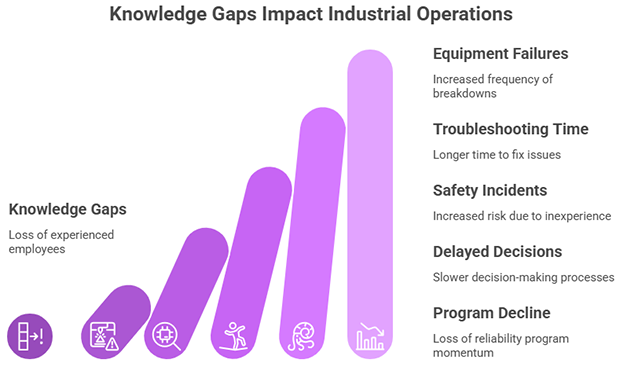
These signs all point to a widening gap between experienced reliability specialists and those newer employees who are still learning about the operations. Without a structured succession plan, organizations become vulnerable to a variety of operational impacts, the most obvious of which include:
- Increased frequency of equipment failures
- Longer troubleshooting time
- Safety incidents linked to inexperience
- Delayed decision making
- Loss of momentum in implementing and improving the reliability program
- Increased dependency on contractors
Companies have spent years building cost-effective maintenance programs to improve reliability, only to see them fade and operational performance decline after key people depart. The balance of cost, risk, and performance to deliver value has shifted.
Succession Planning as Risk Mitigation
Far too often, consideration for succession planning is focused solely on senior management positions. However, in asset-intensive industries, the operational expertise is often found within technical and front-line roles.
This is particularly true when organizational structures have a relatively small head office and specialist roles may be geographically dispersed across many production sites, across several provinces or states, or even in different countries.
In asset-intensive industries, the deepest operational expertise often lives within technical and front-line roles.
Losing one or two experienced maintenance or reliability technicians without adequate succession planning and preparation, even when the retirement date is known for months in advance, can result in additional operational risk exposure that may not be obvious from a standard organizational chart.
Effective succession planning helps to identify not only who is slated to retire or may choose to depart, but also encourages asking the following questions.
- What institutional knowledge is business critical for continuity?
- Which roles create the highest operational risks?
- Which competencies can be difficult to replace?
- How long can it take for replacements to become fully effective and competent?
- What is the current state of employee development and succession planning?
In industry sectors and key roles where technical competency builds over many years of work experience, these are not trivial questions.
Documentation: Is it Enough?
A typical response by companies with succession planning concerns is to focus on procedures, documentation, and CMMS updates. It is a natural first instinct. However, while documentation is a good first step, it rarely captures all the factors and considerations for operational decision-making.
For example, a preventive maintenance (PM) job plan and schedule may detail how to complete the task and on what frequency, but it rarely includes the rationale for why it matters, what subtle equipment performance changes may signal an impending equipment failure, or how changes in operating context may influence the equipment’s performance.
Institutional reliability knowledge lives in experience as much as it lives in any procedure or written document.
Institutional reliability knowledge is often based on experience as much as it is on process or procedure. Succession planning to capture this knowledge relies on more than written documentation. Consider using methods such as mentoring or job shadowing, cross-functional rotations, opportunities to participate in root cause analysis (RCA) or reliability-centered maintenance (RCM) workshops, technical communities of practice, and formal structured coaching to develop capability and competency in the next generation.
In my experience, the organizations that are successful at improving reliability outcomes typically create a culture and work environment where knowledge transfer happens as part of daily work, rather than as a panicked, last-minute activity once a retirement party is scheduled on the calendar.
Establishing an Internal Pipeline
Knowing that documentation alone is not enough, establishing an internal talent pipeline can be a good second step in risk mitigation. Leaders and managers should ask:
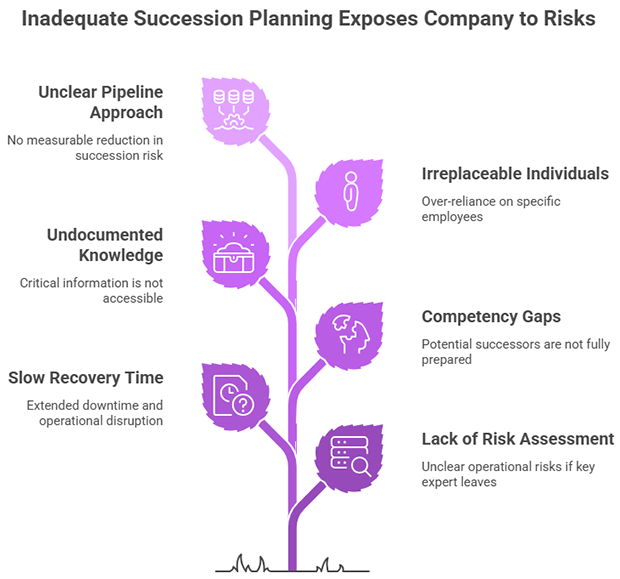
- If a key expert left the company tomorrow, what operational risks would emerge in the next 30 days, 60 days, or a year?
- How long will it take to recover?
- Who is ready to step in? Are they fully ready to take over, or is there a gap in their competencies that needs to be closed?
- Are there any known but undocumented knowledge, procedures, or practices?
- Who are the individuals that we depend on that we consider irreplaceable?
- What is our internal talent pipeline approach? How does it measurably reduce our succession risk?
What if We Wait Too Long?
One of the biggest risks with succession planning is waiting too long to start. Employees typically provide limited notice, mere weeks, after resigning to move to another job. Imminent retirees often provide slightly more notice to employers, but still not enough time for managers and leaders to develop and implement a succession plan for meaningful transfer of expertise. The hidden risk just becomes evident!
This succession-planning risk becomes even more severe when companies rely on a few highly experienced employees to address emerging operational problems. A hallmark of a good reliability and maintenance program is to avoid a single point of failure (SPOF) in production systems, and succession planning is no different. We are trying to avoid a SPOF in our people and talent pipeline.
A hallmark of any good reliability program is avoiding a single point of failure, and the same standard should apply to people and talent.
Obviously, the size of the company and the complexity of the operations play a role. A small startup with fewer than 10 employees faces a different level of risk and requires different mitigation than a company with 1,000 or more employees.
Succession planning should reduce risk by developing redundancy in knowledge, capabilities, and competencies. It can also support the organization through a smooth transition and improved resilience during promotions, reorganizations, periods of rapid business growth, and addressing unexpected people departures.
How Do We Start a Succession Plan?
A succession plan should be structured, aligned with company priorities, and take into account the company culture. It is just as important to a company’s success as identifying its critical physical assets and building maintenance programs. Typical succession planning steps are:
- Identify the critical technical and operational roles
- Map key competencies (i.e., knowledge, skills, work experience) to these roles
- Assess retirement and turnover risks
- Review internal talent pipelines. If they do not exist, start to develop them
- Review individuals’ capabilities against the identified competencies.
- Develop a specific plan to address gaps (for example: focused training, competency criteria for internal people transfers, potential external hires to fill gaps, etc.)
- Establish cross-training for employees
- Create and implement mentoring expectations for senior employees, particularly where retirements are foreseen in the short term
- Continued monitoring of workforce capabilities against the necessary competencies and addressing gaps as required
Ideally, succession planning should become part of the company’s reliability culture. Over my career, managing reliability teams, I was often asked about the number of early-career reliability specialists who worked in my department for a few years before moving on to other roles in the company. The adage ‘what if we train them and they leave?’ has a corollary ‘what if we don’t and they stay?’.
I see these career moves as an opportunity for more people to understand the value the reliability team brings to the company, to influence problem-solving approaches across operations, and to promote continuous improvement. It is far better to have someone who understands reliability move to other roles in the company than to have them leave for external job opportunities.
It is far better to have someone who understands reliability move into other roles than to lose them to an external opportunity.
Several people returned to my team after gaining additional experience in other roles within the company, bringing greater depth and understanding to their future reliability roles.
Reliability Depends on People
As quickly and as exciting as it can be to see technology improvements integrated into our workplaces, it is still important to remember that reliable equipment and desired operational performance are outcomes of the decisions made by people. If organizations fail to plan for workforce transitions, they are taking on substantial risk without implementing mitigation activities.
Succession planning is not a one-and-done exercise. It should be considered a core component of business continuity, resilience, and operational risk mitigation. Succession planning is essential to a long-term approach to managing the knowledge, talent, and competencies that support the reliable outcomes we expect from our physical assets.