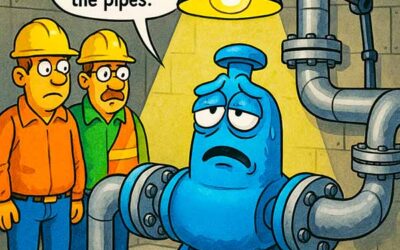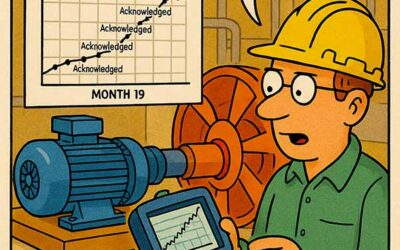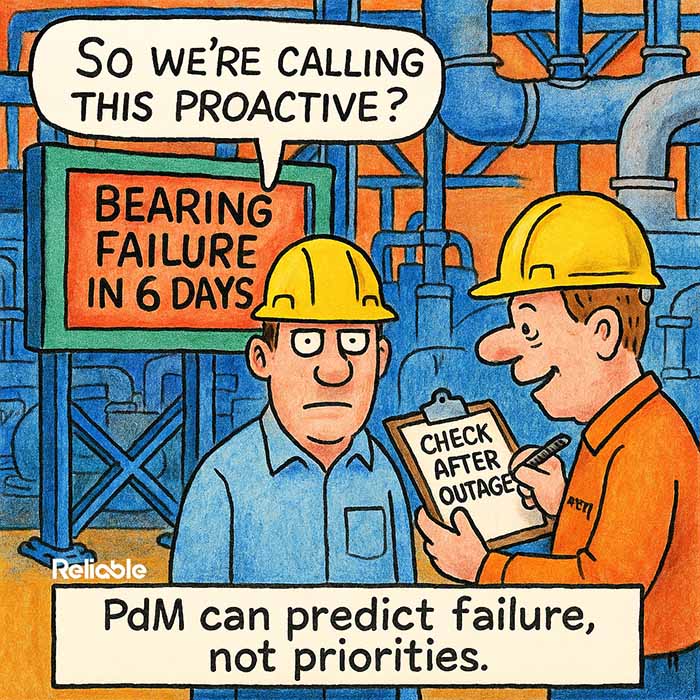

The technology works. Vibration sensors catch bearing degradation months in advance. Oil analysis flags contamination before it causes scuffing. Infrared cameras reveal hotspots that the human hand would never detect. So why predictive maintenance programs fail has less to do with the sensors and everything to do with what happens after the alert lands.
Most PdM programs collapse in the gap between detection and action. The data comes in, the reports get filed, and the repair gets deferred to the next outage, the next budget cycle, the next convenient window that never quite arrives. This is the central paradox of predictive maintenance: the better your detection capability, the more painful your inaction becomes.
The Detection Side Works Fine
Modern condition monitoring tools are remarkably good at their jobs. A well-configured vibration analysis program can detect inner race defects, misalignment, imbalance, and looseness with months of lead time. Ultrasound catches compressed gas leaks, steam trap failures, and electrical discharge. Oil analysis identifies wear metals, moisture ingress, and additive depletion with parts-per-million precision.
The sensor technology has matured to the point where most failure modes in rotating equipment can be detected in their earliest stages. Online systems can monitor continuously, generate automated alerts, and trend the rate of degradation over time. Some platforms incorporate machine learning to reduce false positives and rank alerts by urgency.
That’s the easy part. The hard part starts when the alert lands on someone’s desk and competes with the 14 other urgent things already sitting there.
Why Predictive Maintenance Programs Fail After the Alert
Detection without execution is expensive awareness. You’ve spent the money on sensors, software, analysts, and training, only to watch the identified problem march steadily toward catastrophic failure while the work order sits in a queue.
Several patterns explain why this happens at plant after plant, across industries, regardless of budget size or management commitment.
The Priority Queue Problem
PdM findings compete with reactive emergencies for the same maintenance resources. When a conveyor goes down at 2 PM and production is screaming, the work order to replace a bearing that might fail in 90 days gets pushed. Tomorrow brings another emergency, and the cycle repeats.
The result: your predictive maintenance strategy generates findings that sit unaddressed until the predicted failure actually happens. At that point, the repair costs three to ten times what the planned replacement would have cost, and you’ve lost any ROI the PdM program was supposed to deliver.
Reactive work consumes the schedule like a fire consuming oxygen. Every emergency displaces a planned job, and every displaced planned job becomes the next emergency. Breaking this cycle requires protected scheduling windows for PdM-driven work, backed by management commitment and enforced weekly.
The most expensive PdM program is the one that detects every failure and fixes none of them.
A study across 40 manufacturing facilities found that nearly half of all PdM findings were still unresolved 90 days after detection. The sensors did their job. The organization didn’t do its part.
No Clear Handoff Between Analyst and Planner
In too many organizations, the PdM analyst writes a report, emails it to someone in maintenance, and considers the job done. The report may contain excellent diagnostics: the failure mode, the severity, the recommended action, and the estimated time to failure. But without a formal workflow that converts that report into a planned, scheduled, and resourced work order, the information disappears into inboxes and shared drives.
The fix requires a defined handoff process. Every PdM finding above a certain severity threshold should automatically generate a work order in the CMMS. That work order needs an assigned planner, a target completion date, and a priority code tied to the estimated time to failure.
- Severity 1 (failure likely within 7 days): Emergency priority. Schedule within 48 hours.
- Severity 2 (failure likely within 30 days): Urgent. Schedule within the next weekly plan.
- Severity 3 (failure likely within 90 days): Normal priority. Schedule during the next planned outage or PM window.
Without these tiers, everything sits at the same ambiguous priority, which in practice means everything waits. The discipline of tiered severity codes forces the organization to treat a 7-day finding differently from a 90-day finding, which seems obvious on paper but rarely happens in practice.
Budget and Approval Bottlenecks
Some PdM findings require parts that cost real money: a $4,000 coupling, a $12,000 motor, a set of specialty bearings with a 16-week lead time. When procurement requires three signatures and a capital expenditure form, the clock runs out before the purchase order gets approved.
Smart spare parts management anticipates this. If your condition monitoring history tells you that a particular motor fails every 18 to 24 months, the replacement should already be on the shelf. Waiting for a PdM alert to start the procurement process guarantees you’ll miss the repair window.
Lead time awareness belongs in every PdM workflow. When the analyst identifies a finding, the work order should immediately flag whether the required parts are in stock. If they’re out of stock, procurement starts the same day the finding is confirmed, so the part arrives before the asset fails.
Fixing the Action Gap in Your PdM Program
Understanding why predictive maintenance programs fail points directly to the solution. The gap between detection and execution closes only when the process after the alert gets the same investment as the technology before it.
- Assign ownership of every PdM finding. A finding without a name attached is a finding that stays unresolved.
- Track PdM compliance the same way you track PM compliance. If only 60% of PdM findings are addressed within the recommended window, that number needs to be on the monthly reliability scorecard.
- Pre-authorize spending thresholds for PdM-driven repairs. If the analyst identifies a critical bearing defect, the planner should be able to order the replacement without navigating a capital approval cycle.
- Brief operations on PdM findings weekly. When operators understand that a specific asset is trending toward failure, they can adjust run conditions, reduce loading, or plan production around the repair window.
The best-performing PdM programs treat findings as commitments, with due dates, owners, and consequences for inaction. They measure the average time from detection to repair and work relentlessly to shrink it.
A PdM program that tracks detection-to-repair time as a KPI will outperform one that only measures how many data points it collects.
One petrochemical plant cut its average detection-to-repair window from 67 days to 14 days by implementing a weekly PdM review meeting where the reliability engineer, maintenance planning lead, and operations supervisor reviewed every open finding together. The meeting took 30 minutes. The annual savings in avoided failures exceeded $1.2 million.
The Technology Trap
A related reason why predictive maintenance programs fail is overinvestment in technology and underinvestment in process. Adding more sensors to a plant that already ignores its existing alerts just increases the volume of unactioned data.
Before buying the next wireless vibration sensor or AI-powered analytics platform, ask a simpler question: are we acting on the findings we already have? If the compliance rate on existing PdM findings is below 80%, the investment belongs in planning, scheduling, and execution discipline.
- Audit your last 50 PdM findings. How many were resolved before failure? How many were deferred until the asset broke?
- Calculate the cost of each deferred finding that resulted in an unplanned failure. The total will fund your process improvements several times over.
- Benchmark your detection-to-repair time against industry targets: 14 days for critical assets, 30 days for essential, 60 days for general purpose.
Predictive maintenance works when the entire chain works: sensors, analysts, planners, schedulers, supervisors, and operators all pulling in the same direction. Break any link in that chain and the program delivers expensive data collection disguised as proactive maintenance.
The organizations that get the most value from PdM share a common trait. They built the execution process first, layered the technology on top, and held every level of the organization accountable for closing the loop between detection and repair. The technology has never been the bottleneck. The organizational discipline to act on what the technology reveals is where every struggling PdM program needs to focus its energy and its budget.