
Predictive maintenance sells itself in the boardroom because the math is clean. Sensors detect early-stage faults, work gets scheduled before failure, downtime drops.
The investment pays back. Everyone signs.
Then the first quarterly report lands on the planner’s desk and the second story begins. Acting on predictive maintenance findings turns out to be much harder than collecting them.
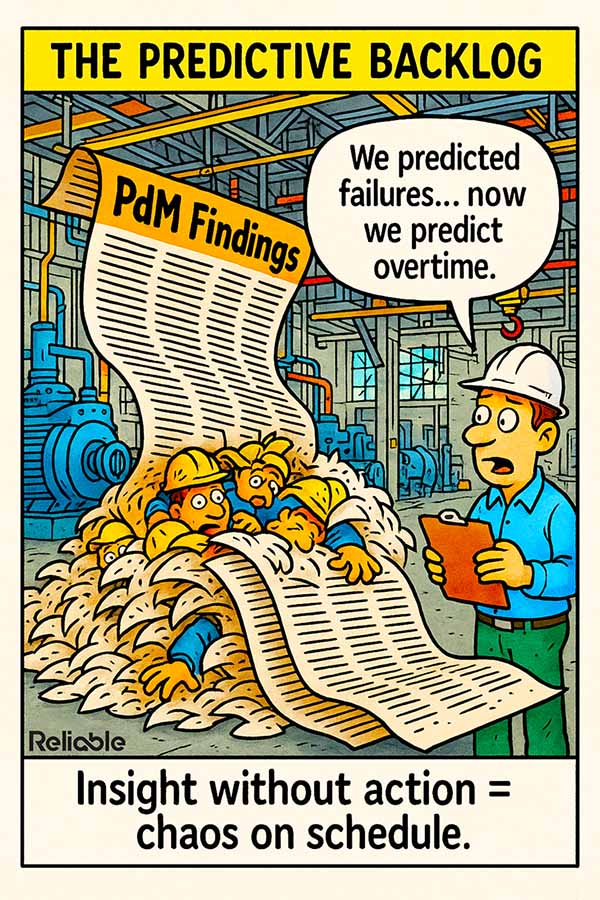
The sensors may generate three hundred alerts. Forty may be actionable. Twelve may require near-term action.
The planner may only have scheduling capacity for six. The remaining work becomes overtime, deferral, or another fight for an outage window. The math from the boardroom starts to wobble.
This is the gap that quietly destroys PdM programs. Detection works. Execution lags.
The findings keep coming, the backlog grows, and the team starts to resent the technology that was supposed to help them.
Why Acting on Predictive Maintenance Findings Is Harder Than Collecting Them
A finding is just data with a date attached. Turning it into a completed work order requires planning capacity, parts availability, operational windows, technician hours, and management willingness to displace whatever was already on this week’s schedule.
Each link adds friction. Each one is somewhere the finding can stall.
Most programs underinvest in the execution side because the sensors are the visible part of the program. Vendors sell sensors. Internal champions defend sensor budgets.
Nobody gets promoted for designing a practical triage workflow. So the bottleneck moves downstream, from “we do not know what is failing” to “we know what may be failing and we cannot keep up.”
A mature predictive maintenance strategy treats findings throughput as one of the headline metrics. Finding volume tells you the sensors are producing data. Throughput tells you whether the program is turning findings into completed work.
A finding the team cannot execute is just an expensive way to feel guilty.
The diagnostic question to ask of any PdM program is simple. Of the findings raised last quarter, what percentage closed inside their recommended action window?
If the answer is consistently low, the program has an execution problem regardless of how good the detection is. That closure rate, more than any sensor uptime statistic, is a better indicator of whether the program is creating value.
Build a Triage Discipline Around Every Finding
Findings arrive with implied urgency, but implied is the wrong basis for scheduling. Every finding needs an explicit time-to-action label, set when the finding is opened and visible to operations.
A workable three-tier model:
- Red: action required within seven days. The asset is showing a fault that may progress to failure within weeks if untouched.
- Yellow: action required within thirty days. The asset is showing early-stage degradation that appears to have weeks to months of lead time.
- Green: monitor only. Trend the parameter and review again at the next reporting cycle.
The labels do two things. They give the planner permission to push back when operations wants every finding treated as red.
They also force the analyst to defend each assessment with measured data instead of intuition. Over time, this discipline reduces false urgency and helps keep the planner from drowning.
Acting on Predictive Maintenance Findings Means Closing the Analyst-Planner Loop
The biggest single fix to acting on predictive maintenance findings is the weekly handshake between the analyst and the planner. Most sites have neither.
The analyst publishes findings to a report. The report goes to a distribution list. The planner sees it next week, maybe.
Replace that flow with a thirty-minute meeting. Every Tuesday morning, the analyst walks the planner through every new finding from the previous week.
They agree on the tier label, the recommended action, and the target completion date. The planner enters the work order while they are still in the meeting. The finding becomes a job before it has a chance to age.
A PdM finding that sits for two weeks before becoming a work order may have already lost much of its lead-time advantage.
This single meeting can fix execution problems that dashboards alone usually cannot. It also builds the relationship that makes the rest of the program work.
The analyst learns what the planner can realistically schedule. The planner learns which findings are well-supported. Over time, both sides start volunteering improvements neither would have thought of alone.
Measure What Actually Matters
Most PdM dashboards measure detection. Number of findings, number of catches per asset class, lead time on detection.
These are useful for the analyst and largely invisible to the maintenance manager who pays the bills. They also tell almost nothing about whether the program is delivering value.
The maintenance manager needs three numbers, updated weekly:
- Open findings older than their recommended action window.
- Closed findings as a percentage of total findings raised in the period.
- Avoided unplanned downtime, estimated conservatively from findings actually closed in time.
The first number is the early warning. When it starts climbing, the program is sliding from predictive into reactive even though the sensors still look healthy.
The third number is the one that gets the budget renewed.
One common reason why predictive maintenance programs fail is the absence of these three numbers in any executive review. Without them, the program may be judged on sensor uptime and analyst headcount, both of which can look healthy while the actual benefit drains away.
Bring Operations Into the Conversation Early
Operations owns the windows. Maintenance owns the work. PdM findings usually only convert to closed jobs when operations agrees to release the asset.
That conversation should happen inside the first two weeks while the lead time is still useful, well before the planner is chasing a late finding.
The fix is a standing item on the weekly production planning meeting. The analyst or planner brings three to five upcoming findings, with proposed windows, and operations either confirms or counters.
The decision is made in the room. The work order moves forward.
Sites that do this consistently can improve Early Failure Detection outcomes because the lead time the sensors provide actually gets used.
Sites that skip this step keep generating findings that operations only learns about when the planner shows up at their door, by which point the window has narrowed and the disruption is higher.
The Honest Test of Any PdM Program
Run this test on your own program this month. Pull every finding raised between sixty and ninety days ago.
For each one, answer two questions. Did the recommended work happen? Did it happen inside the recommended window?
If both answers are yes for most findings, the program is delivering. If either answer is consistently no, the team has an execution problem that no new sensor will fix.
The honest answer is uncomfortable for most programs that try the test for the first time. Teams serious about acting on predictive maintenance findings start there, because every other metric depends on it.
The cheapest way to improve PdM ROI this year is often to stop adding sensors and start closing findings. That sentence reads as common sense, yet many programs invert it.