
Failures don’t wait for an opening on the calendar. A pump seizes, a gearbox grinds, a line drops, and the clock on lost production starts the same second. What the team does next decides whether that same failure comes back around next quarter. Strong root cause analysis meeting best practices for maintenance convert one breakdown into permanent knowledge. Weak ones convert it into a recurring tax on output.
Most of the discipline comes down to three things: timing, structure, and follow-through. Get those right and the session becomes a problem-solving engine. Get them wrong and you end up with a room full of pointed fingers and a work order that closes without changing a thing. Here’s how high-performing teams run it.
Why Root Cause Analysis Meeting Best Practices for Maintenance Start Before the Meeting
The most common mistake is treating the analysis as something that begins when everyone sits down. By then, the evidence you needed most is often gone. The failed component has been cleaned, scrapped, or reinstalled. The operator who heard the odd noise has rotated to another shift and lost the detail. Process data has aged out of the historian.
High-hazard industries learned this lesson the expensive way. For processes covered by OSHA’s Process Safety Management standard, investigations of incidents that caused, or could reasonably have caused, a catastrophic chemical release must begin no later than 48 hours afterward (29 CFR 1910.119). That deadline doesn’t govern routine equipment failures, yet the underlying logic carries over to any breakdown worth investigating: the faster you capture the facts, the more your conclusions hold up.
Good preparation follows a structured collection routine. One widely used framework, often called the five P’s, covers parts, position, people, paper, and paradigms. Photograph and document the failed components in place before anyone disturbs them, then label and preserve the parts in clean, compatible containers under documented custody. Hold off on washing or disassembling anything until the examination plan is set, since cleaning can wipe out the deposits and wear marks that explain the failure. Capture the position of components and the surrounding conditions. Interview people while the memory is fresh. Pull the paper, including work orders, run logs, and alarm history. And record the paradigms, meaning the assumptions the crew held about how the asset was supposed to behave. Walking into the room with that material already gathered is the first of the root cause analysis meeting best practices for maintenance that separates effective teams from merely busy ones.
The Five Root Cause Analysis Meeting Best Practices for Maintenance Teams
Once the evidence is secured, the working session needs a backbone. These five practices keep the discussion anchored to fact and pointed at corrective action.
1. Charter the investigation against clear trigger criteria
Not every failure earns a formal analysis. Set the threshold in advance: a safety consequence, a repair cost above a defined dollar figure, a repeat event, or the loss of a critical asset. IEC 62740, the international standard on root cause analysis, supports defining the purpose, scope, criteria, team, and resources up front rather than applying full analysis to every hiccup. A written charter is a practical way to lock that down: name the problem, draw the boundary, list the team, and set a deadline. That single page prevents scope creep and keeps people from sliding into unrelated complaints.
2. Present the evidence before the opinions
Open with what the data shows, not with theories about what went wrong. Lay out the failed parts, the timeline, and the process trends on the screen. When the group reasons forward from physical evidence, the conversation stays grounded and the loudest voice in the room stops carrying more weight than the facts.
3. Distinguish failure mechanisms, human-performance factors, and latent conditions
A mature analysis works through three layers. Start with the failure mechanism, the physical process that did the damage. A seized bearing is the event you observe. ISO 15243 classifies rolling-bearing damage modes such as fatigue, wear, corrosion, electrical erosion, plastic deformation, and cracking, while the conditions driving that damage might include inadequate lubrication, contamination, overload, or misalignment. Next come the human-performance factors, the actions, omissions, or decisions that let the mechanism develop, such as a missed lubrication route or a wrong torque value, along with the task design and workload behind them. Then the latent layer, the system gap sitting underneath, like a planning process that never scheduled the route or a procedure that printed the wrong number. Stopping at the visibly failed part leaves recurrence risk uncontrolled. Working down to the latent conditions tends to surface broader, more durable controls that keep the same causal path from recurring, and it’s the step weak investigations skip most often.
4. Assign corrective actions with owners and dates
A finding without an owner is a wish. Each corrective action gets one accountable name, a due date, measurable acceptance criteria, and the resources to carry it out. Tie every action back to the specific causal factor it addresses, so nobody can quietly let it slide once the urgency fades. A complex investigation may rightly produce several actions across several owners. The warning sign is an action with no single owner, no completion criteria, and no date.
5. Verify the fix and close the loop
The analysis isn’t finished when actions get handed out. Define your effectiveness criteria before closing the investigation, then verify them over an observation period matched to the asset’s duty cycle and its previous failure interval. The aim is confirming that recurrence likelihood or consequence has dropped to an acceptable level, not simply that the work order closed. For organizations using ISO 14224, which was developed for petroleum, petrochemical, and natural-gas operations, its standardized failure and maintenance taxonomy can support fleet-level trending and help you catch recurrence even when the same problem returns under a differently coded work order.
Where Root Cause Analysis Meeting Best Practices for Maintenance Break Down
Even well-run programs slip. A handful of patterns show up over and over.
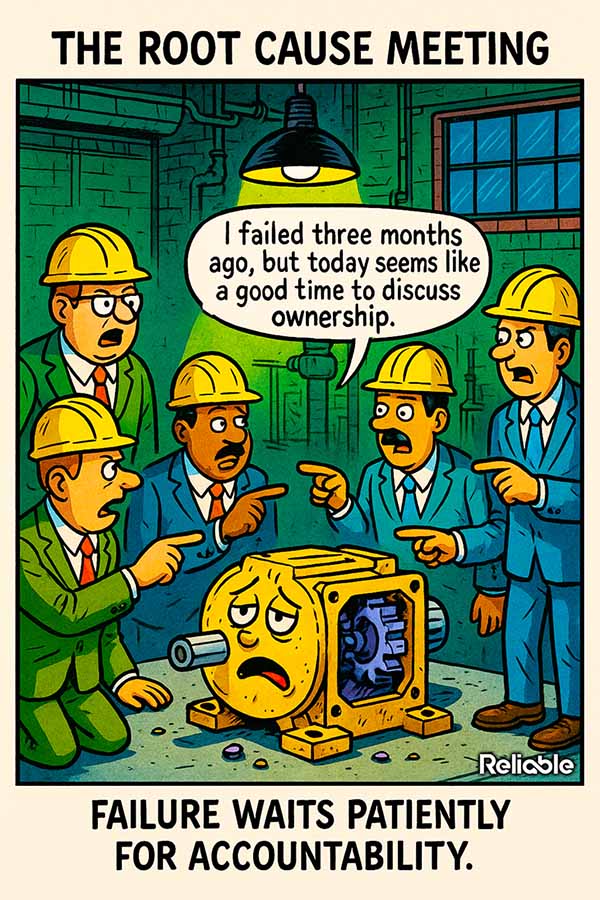
Blame stands in for analysis. The moment a session swings toward who is at fault, people stop volunteering facts. The investigation should hunt for system weaknesses rather than scapegoats, because the same conditions may trip up the next person no matter whose name goes on the report.
The team settles for the first plausible answer. “Operator error” feels like a finding. It rarely is. Ask what made that error easy and likely, and you’ll often find a design, procedure, training, interface, or scheduling weakness underneath it.
Actions close without verification. Work orders get marked complete, yet nobody confirms the controls are effective or that recurrence risk has dropped. A few months later the same asset fails the same way, and the loop restarts from zero.
Findings stay trapped in one room. A lesson learned on Line 3 should reach the planner, the storeroom, and the crew running the identical pump on Line 7. Without a path to circulate the results, the plant pays for the same education twice.
Turning Findings Into Business Value
An analysis is an investment, and like any investment it has to earn its keep. Every hour a cross-functional team spends in a session carries a real labor cost, so the output has to justify the time. When the findings are correct and the actions get implemented and sustained, the return shows up as avoided downtime, fewer emergency call-outs, longer asset life, and lower life-cycle cost on the equipment you’ve corrected. Framed that way, the meeting stops being overhead and becomes one of the better-returning things the department does.
Leadership largely determines whether that return shows up. When managers push the team to investigate contributing factors and underlying system conditions rather than settle for the comfortable answer, when they protect the time needed to gather evidence, and when they track corrective actions all the way to completion, the program compounds. When they treat each breakdown as an isolated emergency to be cleared and forgotten, the organization keeps relearning the same costly lessons on a loop.
The strongest maintenance organizations treat every failure as tuition already paid. The money went out the door the moment the asset went down. Running disciplined root cause analysis meeting best practices for maintenance is how they collect on that expense instead of writing it off. Document the findings, apply the lessons to similar assets, and fold the proven controls into your standards and preventive plans. That materially cuts the odds of the same failure coming back.
That’s the line between a maintenance group that fights the same fires every year and one that steadily clears them out of the building.