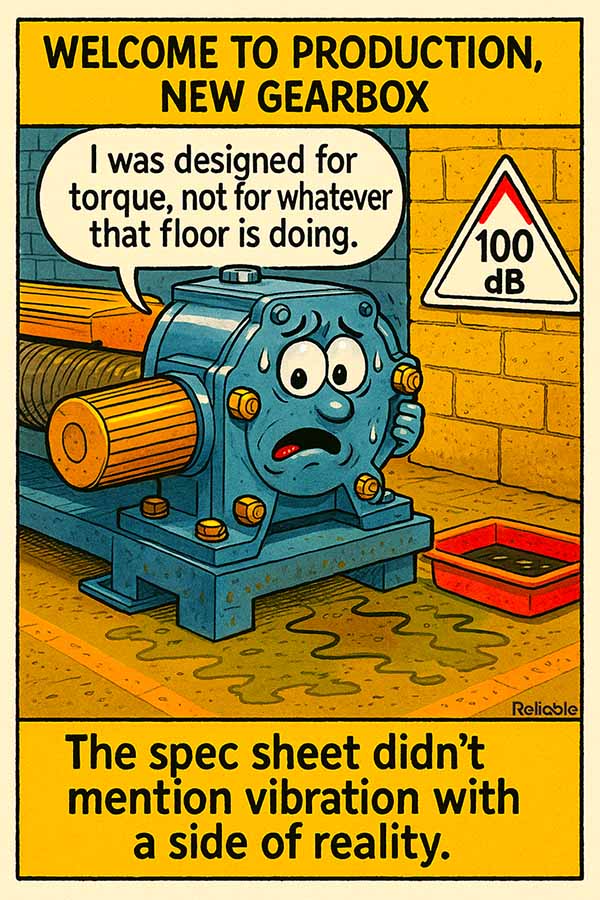

A gearbox shows up rated for torque and speed, and the spec sheet stops there. The real operating world adds vibration, and plenty of it, which is why so many new gearboxes get loud the moment they are bolted to an actual floor. Figuring out what causes excessive gearbox vibration is the first step toward a drive that runs quiet and lasts.
Vibration is a common symptom of many mechanical and structural problems. Misalignment, imbalance, bearing damage, gear defects, and foundation issues can all produce measurable vibration, although some faults may require other condition-monitoring methods to confirm.
The catalog promised one thing. The floor, the coupling, and the load deliver another, and the gap between them rattles.
What Causes Excessive Gearbox Vibration: The Usual Suspects
Most gearbox vibration traces back to a short list of mechanical causes. Knowing the list turns a vague complaint about shaking into a real diagnosis.
- Misalignment between the gearbox and the driving or driven machine
- Imbalance in couplings, shafts, or attached rotating parts
- Bearing defects, from installation damage to ordinary end of life
- Gear wear, tooth damage, or incorrect backlash
- Looseness in mounting bolts, the baseplate, or the foundation
- Resonance, where running speed lines up with a natural frequency
Each can produce characteristic patterns, but those patterns often overlap. Reliable diagnosis usually combines spectra, time waveforms, phase, operating conditions, inspection findings, and trend history.
Every fault can leave clues in the frequency spectrum. The gearbox is providing evidence, but the analyst still has to interpret it in context.
Once you can read that language, what causes excessive gearbox vibration stops being a mystery and becomes a checklist you work through in order.
Work the list in a logical order based on the installation, operating history, and measured symptoms. Start with accessible checks such as mounting condition, alignment, lubrication, and operating load before opening the gearbox.
Misalignment and Imbalance
Misalignment is common and preventable. When connected shafts are not aligned within the coupling and equipment tolerances, the coupling and bearings experience additional forces. The vibration may appear at 1x, 2x, or higher harmonics of running speed, often with elevated axial vibration, depending on the type and severity of misalignment.
Imbalance is simpler. A heavy spot anywhere on a rotating element throws a once-per-revolution force that grows with the square of speed. Double the rpm and you quadruple the force.
Both can often be corrected in the field, and both can accelerate wear when allowed to continue. The rate of deterioration depends on severity, speed, load, coupling design, lubrication, and the condition of the connected equipment.
Pay attention to which one you are seeing, because the cure is different. You correct alignment by moving the machine, and you correct imbalance by adding or removing weight. Treating one like the other wastes a shift and fixes nothing.
Bearings, Gears, and Looseness
Bearing faults often begin with subtle high-frequency vibration or impact-related energy before they become obvious by touch or sound. Detection depends on sensor placement, speed, load, bearing geometry, and the analysis method used.
Gear-related vibration commonly appears at gear-mesh frequency, calculated as the number of teeth multiplied by shaft rotational frequency. Sidebands, harmonics, modulation, and changes in amplitude can indicate wear, eccentricity, looseness, or tooth damage, but confirmation requires context and trending.
Mechanical looseness can create harmonics, subharmonics, impacts, and broadband energy. Its response may change with load and temperature, but the exact pattern depends on where the looseness is located and how the structure responds.
The tricky part is that these faults overlap. A worn bearing lets a shaft wander, which mimics imbalance, which loads the gear teeth unevenly. Untangling that chain is the whole job, and it is why a single reading rarely tells the full story on its own.
How to Diagnose What Causes Excessive Gearbox Vibration
Diagnosis starts by collecting repeatable data at the correct locations and under comparable operating conditions. Overall vibration can indicate a change in condition, while spectra and other analysis tools help narrow the likely source.
This is where vibration analysis helps distinguish imbalance, misalignment, bearing-related vibration, gear-mesh effects, looseness, and resonance without opening the gearbox. No single frequency component should be treated as proof by itself.
These patterns are useful starting points, not stand-alone diagnoses:
- 1x running speed commonly appears with imbalance, but it can also be influenced by misalignment, bent shafts, eccentricity, or structural response
- 2x running speed may be associated with misalignment, looseness, or other nonlinear mechanical conditions
- High-frequency impacts or demodulated vibration can indicate rolling-element bearing damage, lubrication distress, or another impact source
- Gear-mesh frequency with changing harmonics or sidebands can indicate gear wear, eccentricity, looseness, load variation, or tooth damage
- Broadband energy, harmonics, or subharmonics can suggest looseness, rubbing, impacts, or structural resonance
These patterns help guide a repeatable investigation. Severity decisions should consider amplitude, trend rate, frequency content, phase, waveform characteristics, operating condition, machine criticality, and applicable alarm guidance.
With suitable sensors, repeatable measurements, and competent analysis, much of a gearbox condition assessment can be completed without opening the housing.
Following gearbox vibration analysis best practices improves repeatability by controlling sensor location, mounting, operating state, measurement settings, and data-collection intervals.
Do Not Forget the Foundation
Sometimes the gears are fine and the floor is the problem. A baseplate that flexes, grout that has cracked, or anchor bolts that have loosened all let the whole machine move.
A healthy gearbox often gets blamed for what its mounting is doing, so always rule out the structure before you condemn the internals.
Check for soft foot, confirm the baseplate is rigid, and verify the grout and anchors before you tear into the gear set. The cheapest fix is the one where you never open the housing at all.
Confirm the installation before assuming the gearbox itself is defective. Mounting, alignment, pipe or shaft strain, base rigidity, and connected-equipment conditions can all create vibration in a new drive.
Watch for Resonance
Resonance is the quiet multiplier. When a running speed happens to match a natural frequency of the gearbox or its support steel, ordinary forces get amplified into damaging ones.
A drive that runs smoothly at one speed can vibrate severely at another because of resonance. Corrective options may include changing stiffness or mass, improving damping, modifying supports, or avoiding the resonant operating range after confirming the mode through testing or analysis.
Fixing Excessive Gearbox Vibration for Good
Diagnosis points straight to the fix. Once you understand what causes excessive gearbox vibration in a given drive, the correction is usually direct and far cheaper than the failure it prevents.
- Align the train to spec with proper alignment tools instead of a straightedge and optimism
- Balance rotating components that show a once-per-revolution signature
- Confirm suspected bearing damage, assess severity and trend, and plan replacement before secondary damage develops
- Correct loose fasteners, soft foot, damaged grout, and baseplate defects; address resonance only after identifying the affected structural mode
Then continue monitoring. Alignment, mounting condition, bearings, gears, and operating loads can change over time, so follow-up measurements should verify that the correction remains effective.
Permanent sensors can help. online vibration monitoring can collect data consistently and flag meaningful changes early enough to support planned investigation and repair, provided alarms are configured, reviewed, and acted on.
Frequent, reliable monitoring reduces the chance of an undetected developing fault, especially when alarms are reviewed and acted on promptly.
That continuous view also shortens the next diagnosis, because you already have a baseline to compare against the moment something shifts.
It also builds a record. Six months of clean trend data is the strongest answer there is when someone asks whether the monitoring spend was worth keeping.
What Excessive Gearbox Vibration Really Costs
Excessive vibration can increase dynamic loads on bearings, seals, fasteners, couplings, shafts, and supporting structures. The resulting damage may appear across several maintenance cost categories rather than on a single invoice.
It also drags the connected machine into the problem. A motor coupled to a shaking gearbox sees the same forces, so one untreated drive can age two assets at once.
Misalignment, rubbing, bearing distress, or other mechanical problems can increase frictional losses and power demand. The energy effect varies by fault type and severity and should be confirmed with operating data.
Across a fleet, recurring vibration problems can increase parts consumption, labor, downtime, and in some cases energy use. Tracking those costs by asset helps show where corrective work will provide the greatest return.
Build It Into the Routine
The plants that stay quiet treat vibration as a vital sign, checked on a schedule like temperature or pressure.
They trend the data, set alarm thresholds that actually mean something, and act on early warnings instead of waiting for noise loud enough to fill a room.
Quiet machines are built deliberately. The spec sheet starts the job, and disciplined monitoring finishes it.
That habit is what turns a fragile new install into a drive the operators stop worrying about and start trusting.
The Takeaway
A new gearbox may experience installation, structural, process, and load conditions that are not fully represented by its catalog ratings. Vibration monitoring is one way to identify and manage those conditions.
Learn the signatures, measure them consistently, and act early. Understanding what causes excessive gearbox vibration turns a noisy surprise into a problem you saw coming and already had a plan for.