
Every manufacturing plant has a few problems everyone knows about and nobody fixes. The conveyor that jams at the same spot every shift. The tool crib located a five-minute walk from the work area. The HMI button layout that forces operators into a three-step workaround for a one-step task.
These are the kinds of simple fixes for manufacturing inefficiency that get overlooked because they seem too small to matter. They compound.
Why Plants Overlook Simple Fixes for Manufacturing Inefficiency
The natural instinct when facing a performance gap is to reach for a big solution: a capital project, a new software platform, a full process redesign. These have their place. But they also take months to scope, approve, and implement. Meanwhile, the small inefficiencies keep draining time and money every single shift.
Industry reports regularly estimate that unplanned downtime costs manufacturers tens of billions of dollars annually. Some of those losses trace back to preventable workflow problems, poor material staging, unclear procedures, and slow response to known issues.
The most expensive inefficiency in any plant is the one everyone sees and nobody fixes.
Most manufacturing facilities have a list (formal or informal) of known pain points that operators and technicians complain about regularly. Asking floor personnel for their top three frustrations often surfaces problems that management has been stepping over for years. The solutions are usually obvious once someone decides to look.
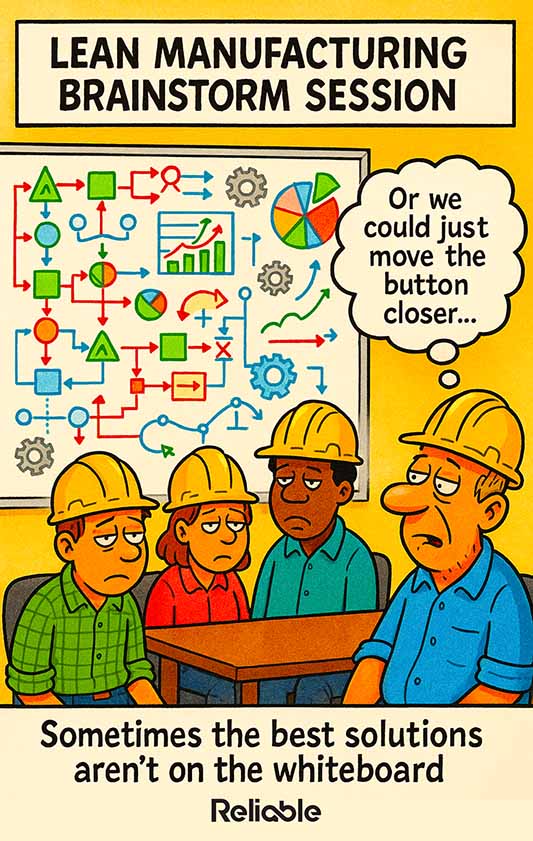
The bias toward complex solutions is closely related to overprocessing in lean thinking. When teams spend weeks designing an elaborate system to solve a problem that could be addressed by rearranging a workstation, the solution itself can become waste.
Complexity also creates inertia. A $2 million automation project may require executive sponsorship, engineering resources, and a long approval timeline. A $200 workstation reorganization may require a supervisor, a short shutdown window, and a simple follow-up check. The smaller fix often delivers useful gains faster and at a fraction of the cost.
Simple Fixes for Manufacturing Inefficiency That Actually Work
The highest-impact improvements are often the cheapest and fastest to implement.
Layout and Workflow Changes
Material flow and poor staging can consume a surprising amount of lost wrench time on the shop floor. When technicians or operators repeatedly walk to fetch parts, tools, or information, an eight-hour shift can lose significant productive time to movement alone.
Fixes include:
- Relocate frequently used tools and spare parts to the point of use
- Arrange workstations to follow the natural sequence of tasks
- Eliminate backtracking by positioning inputs and outputs on logical sides of the work area
These changes often cost very little compared with the time they recover. A focused rearrangement of a maintenance shop can return meaningful productive time per technician per shift. Over a year, that can add up to hundreds of labor hours returned to actual maintenance work.
Workplace Standardization and Posted Instructions
When procedures live in binders that nobody opens, variation creeps in. Posted work instructions, mounted at the workstation and arranged in the sequence the work happens, can reduce errors and shorten training time.
- Color-coded lubrication points reduce guesswork about which grease goes where
- Shadow boards for tools help make it immediately obvious when something is missing
- Floor markings for staging areas prevent the delays that slow every handoff
Maintenance optimization gets easier when the right information is posted at the right moment, rather than buried in a system that requires three clicks and a login.
Operator-Led Improvements
Operators are often the best source of simple manufacturing fixes because they experience the inefficiencies firsthand, every shift. Structured programs like autonomous maintenance give operators ownership of basic care tasks, such as cleaning, inspection, and minor adjustments, and a formal channel for surfacing improvement ideas.
The pattern is consistent: the operator who runs a machine eight hours a day will spot a fix that the engineer visiting once a quarter will miss. The fix might be as simple as adding a guard to prevent contamination, repositioning a gauge for better visibility, or changing a startup sequence to reduce warm-up time.
The key is giving these ideas a practical path to evaluation and implementation. When an operator suggests a change and it takes six months of forms and approvals to execute, the suggestions stop. When a safe, low-risk change gets tested quickly, the ideas keep flowing.
A focused rearrangement of a maintenance shop can return meaningful productive time per technician per shift.
Manufacturing plants that formalize operator feedback loops can generate a steady stream of actionable improvement ideas. Many are inexpensive to test. The cumulative effect can support larger capital projects and, in some cases, deliver faster payback.
How to Prioritize the Quick Wins
With a list of potential improvements, the question becomes: which ones first? A simple prioritization matrix helps.
- Impact: how much time, cost, or quality improvement does this fix deliver?
- Effort: how much time, money, and coordination does it require?
- Risk: what safety, quality, compliance, or operational problems could the change create, and how easily can it be reversed?
Start with high-impact, low-effort items. These build momentum and credibility for the program. The fast wins also generate the data needed to justify larger projects later.
Track the results. Even informal tracking (a whiteboard showing before-and-after cycle times, for example) makes the gains visible and keeps the team engaged. When people see that their simple fix saved 12 minutes per shift, they start looking for the next one.
Many effective manufacturing improvements do not require new technology or large capital expenditures. They require observation, willingness to act on what is obvious, and discipline to measure the results. Simple fixes for manufacturing inefficiency are often available. The question is whether anyone makes time to implement them.