
Deferred maintenance feels free. You skip the repair, the asset keeps running, and the savings land on this quarter’s report. The long-term risks of deferred maintenance show up later, and they rarely arrive politely.
A postponed repair keeps working against you. The worn bearing keeps grinding, the small leak keeps spreading, the misalignment keeps loading the next component in line. Every deferral compounds while you look the other way.
A repair you postpone keeps working against you the entire time it waits.
The math of deferral is simple and unkind. Small problems left alone turn into big problems on someone else’s schedule, usually at full production rate and usually on a Friday afternoon.
Plants tell themselves the deferral is temporary, and sometimes it is. More often the postponed job slides to the bottom of a growing list, and the next time anyone thinks about it, the asset has already failed and taken the decision out of their hands.
The Long-Term Risks of Deferred Maintenance Add Up Quietly
Deferral looks fine right up until the morning it stops looking fine. A single skipped PM usually passes without incident. String enough of them together and the backlog eventually breaks something expensive at the worst possible moment.
The failure is rarely polite enough to stay contained. One seized component loads the next, trips the line, and turns a 200 dollar part into a day of lost production. That cascade is the real shape of deferral, and it’s why the carried risk grows faster than the backlog list suggests.
Three kinds of damage tend to stack on top of each other:
- Rising cost. A planned bearing swap is cheap. That same bearing seizing in service takes the shaft, seal, and coupling, and the bill multiplies.
- Shrinking asset life. Run components past their service condition and the whole machine ages faster than the spreadsheet assumes.
- Safety and compliance exposure. A deferred inspection or a limped-along guard is a liability that grows with every shift.
Cost is the part finance sees first. Companies that put a real number on deferred maintenance risks usually find the carried backlog costs several times what the original repairs would have.
The cheapest version of every repair is the one you do on schedule.
Asset life is the cost nobody books. Run a motor on a failing bearing and you risk more than the bearing; you cook the windings, score the shaft, and knock years off a machine that should have run for decades. The repair bill is visible. The shortened life shows up quietly as a capital replacement three years early.
Safety exposure is the risk that refuses to average out. A deferred guard or a skipped inspection might ride along fine for months, then cause the one incident that makes every saved dollar irrelevant. Regulators and insurers read a backlog of deferred safety work as exactly what it is.
The longer the backlog sits, the more it costs to clear. Interest compounds on maintenance the same way it does on debt, quietly, then all at once.
There is a human cost folded into all of this. Crews that spend every shift firefighting burn out, the good ones leave, and the knowledge of which assets are limping walks out the door with them. A backlog erodes the team as surely as it erodes the equipment.
Why Deferral Becomes a Habit
No one plans to run a plant on deferral. It creeps in. A parts delay here, a staffing gap there, a quarter where the budget got cut and the PMs were the easiest line to trim.
Budget pressure makes it worse. When a quarter goes sideways, the maintenance line looks soft because the consequences stay invisible this month. Cutting it feels painless right up until the breakdowns arrive, by which point the people who made the cut have often moved on.
Then the backlog feeds itself. Crews spend their days chasing breakdowns, which leaves no time for planned work, which creates more breakdowns. Breaking that loop is the whole point of efforts to reduce reactive maintenance.
The trap is that a busy reactive plant feels productive. Everyone is moving, problems are getting solved, the day is full. The motion hides a quieter truth: the same problems keep coming back, because the root causes never make it onto the schedule.
Spotting the Backlog Before It Bites
A few signals tell you deferral has taken hold:
- PM compliance is sliding below 80 percent and trending down.
- The same assets show up on the breakdown report month after month.
- Temporary fixes have been in place long enough to feel permanent.
- Overtime keeps climbing while planned work keeps slipping.
Each of these signals is obvious once you look. The hard part is looking while the plant still runs, because a crew chasing breakdowns rarely stops to count them. Pull the numbers anyway. A quarterly trend on PM compliance and repeat failures will tell you the truth faster than anyone’s gut.
The earlier you catch the trend, the cheaper the fix. A bearing flagged at the first sign of wear is a quick scheduled swap. The same bearing caught after it has chewed the housing is a rebuild. The one nobody catches at all is a breakdown with a tow truck attached and a production line standing still.
Getting Ahead of the Long-Term Risks of Deferred Maintenance
Catching up starts with seeing the whole backlog. Prioritizing the work starts with listing every item of it, with nothing hidden in one supervisor’s head or one forgotten spreadsheet.
- List every deferred job in one place, with no exceptions buried in someone’s memory.
- Rank the backlog by risk to production and safety first, then by cost.
- Protect a fixed block of weekly hours for planned work so the backlog actually shrinks.
A predictive maintenance strategy keeps you from sliding back. Condition data turns we think this is overdue into this asset is degrading now, which lets the team schedule the fix before failure instead of after it.
Funding the catch-up is its own conversation, and it’s an easier one than it sounds. The carried cost of the backlog, the overtime, the repeat failures, the emergency freight, usually dwarfs the cost of clearing it. Put those numbers side by side and the case for a focused catch-up campaign makes itself.
Pace the campaign so it sticks. A plant that tries to clear years of backlog in one quarter just trades one kind of chaos for another. Steady, protected hours week after week beat a heroic push that burns everyone out and then quietly collapses.
A backlog you’ve measured is a plan. A backlog you’re ignoring is a countdown.
Catching up is slow work, and that’s fine. The goal is a steady reduction in carried risk, week over week, until planned jobs outnumber surprises and the breakdown report finally starts to shrink.
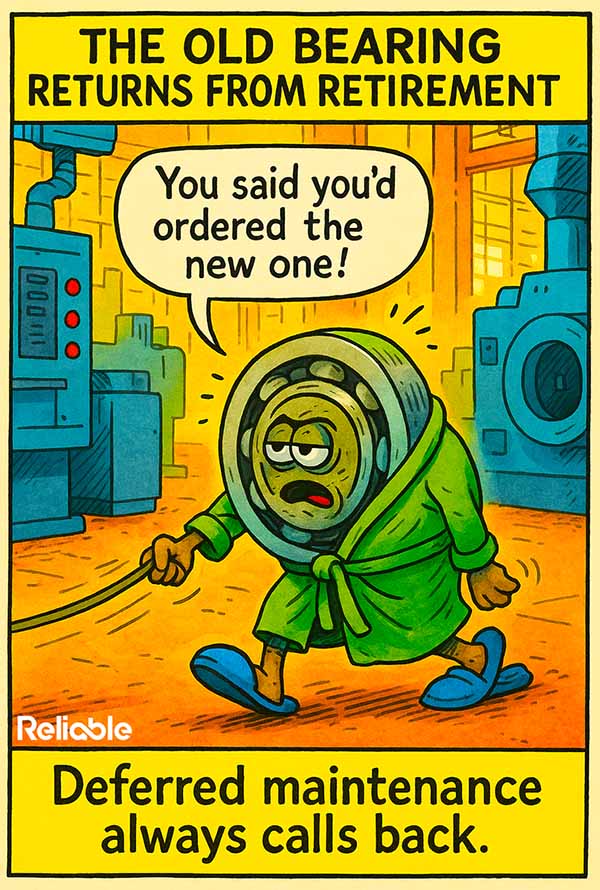
Deferred maintenance always sends an invoice. The choice is whether you pay the small, scheduled version now or the large, unscheduled version later, with downtime attached. Plants that take the long-term risks of deferred maintenance seriously do the cheap repair on time and keep the expensive surprise off the books.