
Understanding how to reduce reactive maintenance is the difference between a crew that controls its week and one that gets dragged through it. Every unplanned breakdown that lands on the schedule displaces a planned job. Do that often enough, and the planned work never recovers.
Most maintenance organizations know reactive work is expensive. The wrench time on emergency repairs is often significantly lower than on planned jobs, because technicians spend the balance of their hours chasing parts, reading drawings they’ve never seen, and waiting for operations to isolate equipment. The real damage, though, is cumulative: every deferred PM creates the conditions for the next emergency.
Why Reactive Maintenance Takes Over
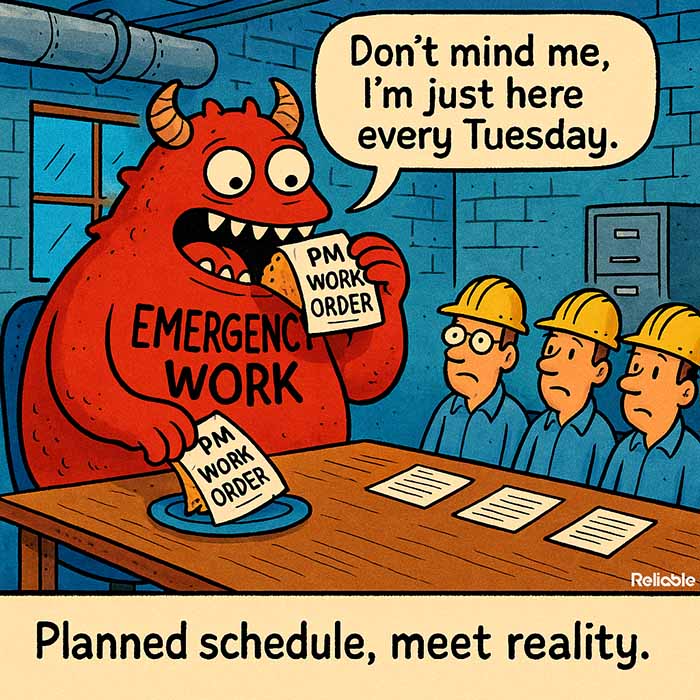
Reactive work is self-reinforcing. A pump bearing fails because its lubrication PM was bumped three weeks in a row by emergency jobs on other equipment. That bearing failure becomes tomorrow’s emergency, which bumps another PM somewhere else. The cycle accelerates until the maintenance planning function exists in name only.
Many maintenance departments still spend a large share of labor hours on reactive tasks. At that level, planning often becomes more aspirational than operational. The schedule gets built on Monday and abandoned by Wednesday.
Every deferred PM is a deposit in the emergency work account. Eventually, the balance comes due all at once.
For many plants, the schedule starts to become unstable when reactive work reaches roughly 30% to 40% of total work. Below that threshold, the planning team can absorb disruptions and keep the schedule roughly intact. Above it, the backlog grows faster than the team can work it down, and the operation slides into permanent firefighting mode.
There’s also a morale dimension. Technicians who spend every shift chasing emergencies burn out faster, make more mistakes during repairs, and eventually stop trusting that planned work will ever happen. That erosion of trust makes reducing reactive maintenance even harder, because the workforce stops investing in prevention.
How to Reduce Reactive Maintenance Step by Step
Breaking the cycle requires action on multiple fronts simultaneously. Picking one tactic in isolation rarely works because the problem is systemic. Here’s what moves the needle.
Classify and Prioritize Emergency Work Honestly
Most plants label far too much work as “emergency.” When everything is urgent, nothing gets planned. A rigorous priority system separates genuine emergencies (imminent safety hazard, environmental release, total production loss) from urgent work that can wait 24 to 48 hours.
The difference matters enormously. True emergencies should represent a small share of total work orders. “Urgent but plannable” work is often a much larger category. Recapturing that second category for the planning process dramatically reduces schedule disruption.
- Define emergency criteria in writing: safety risk, environmental risk, or complete loss of a critical production function. Everything else should move through the planning process unless leadership makes a deliberate exception.
- Require supervisor approval for emergency classification. One signature eliminates most convenience-driven escalations.
- Track emergency work orders weekly as a percentage of total. Publish the number. Visibility alone drives behavior change.
- Conduct a weekly review of every emergency work order to determine if better planning or earlier detection could have prevented it.
Strengthen the Weekly Schedule
A schedule that collapses at the first disruption was too fragile to begin with. Building in a buffer of 10% to 15% unscheduled capacity gives the crew room to handle genuinely urgent work without gutting the plan.
A practical target for maintenance scheduling compliance is often 80% to 90%, depending on asset criticality, staffing, and operating volatility. That means 85% of the jobs on Monday’s schedule actually get completed that week. Tracking this number forces honest conversations about how much reactive work is truly unavoidable and how much is organizational habit.
Fix the Repeat Offenders
In many plants, a relatively small percentage of assets generate a disproportionate share of the reactive work orders. These chronic bad actors are the fastest lever for anyone learning how to reduce reactive maintenance in a real facility.
Pull the work order history for your top 20 reactive assets. Sort them by frequency, not cost. The $800 pump that fails every six weeks is consuming more total planning capacity than the $40,000 gearbox that failed once last year.
- Assign a reliability engineer or senior technician to each top-5 repeat offender with a mandate to eliminate the recurring failure mode.
- Set a 90-day target for each asset: reduce failure frequency by at least 50% through root cause correction, design modification, or operating procedure changes.
- Track results monthly and rotate new assets onto the list as the original offenders stabilize.
This approach can deliver visible results within one quarter when the repeat failures are well understood and the fixes are funded. The backlog starts shrinking, schedule compliance improves, and the planning team can finally get ahead of the work instead of chasing it.
Sustaining the Gains Over Time
Reducing reactive maintenance from roughly half of total work to closer to one-third is achievable in many facilities within 12 to 18 months, provided leadership protects the schedule and funds corrective actions. Sustaining those gains requires embedding the new practices into daily management routines.
A daily scheduling meeting (15 minutes, no longer) keeps the current week’s plan visible and forces real-time trade-off decisions when emergencies do arise. A weekly backlog review ensures that deferred work doesn’t silently accumulate until it triggers the next wave of failures.
The organizations that hold below 20% reactive work treat their schedule as a contract with operations, and they protect it accordingly. When someone requests an emergency job that doesn’t meet the criteria, the answer is “we’ll plan it for next week” rather than “we’ll squeeze it in.” That discipline is uncomfortable at first. It also works.
Reactive maintenance will never reach zero. Equipment fails, surprises happen, and some fraction of every week will always be unplanned. The goal is to shrink that fraction to a level where it stops dictating the entire operation. When the crew starts the week knowing they’ll complete most of what’s on the board, everything else (morale, quality, cost, safety) follows.