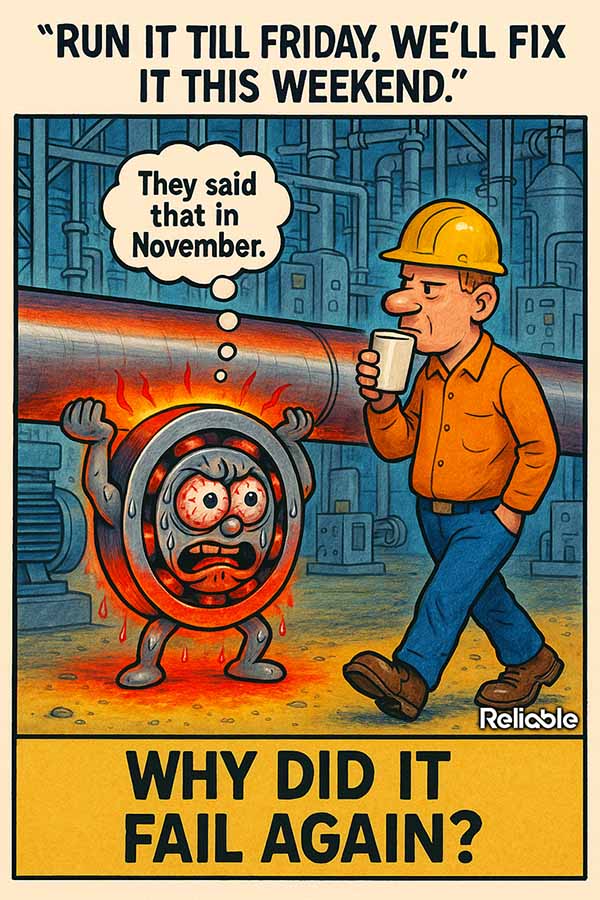

Everyone in maintenance has heard some version of the same line: “Just keep it running through the weekend. We’ll get to it next week.” Next week becomes next month. Next month becomes next quarter. And by the time someone finally writes the work order, the repair that would have taken four hours now takes four days, three additional parts, and a root cause investigation. Deferred maintenance risks are the kind of problem that feels manageable in the moment and catastrophic in hindsight.
The logic behind deferral usually makes sense at the time. Production is running. The spare parts aren’t in stock. There’s no outage window. And the equipment is still functioning, technically. So the repair gets bumped. Then bumped again.
The trouble is that equipment degradation keeps advancing while you wait for a convenient time to fix it.
How Deferred Maintenance Risks Compound Over Time
A small vibration anomaly in a pump bearing is a straightforward repair: swap the bearing, realign the coupling, return to service. Estimated downtime, maybe three hours. Estimated cost, a few hundred dollars in parts and labor.
Defer that repair for six weeks and the picture changes. The bearing deteriorates further, generating heat and metal particulate that contaminates the lubricant. That contaminated oil now accelerates wear on the shaft sleeve. The increased vibration puts stress on the mechanical seal, which starts leaking. By the time the pump finally fails, you’re replacing the bearing, the shaft sleeve, the mechanical seal, and possibly the coupling. Downtime jumps from three hours to two days. The parts bill goes from hundreds to thousands.
This pattern repeats across every equipment class in every industry. Deferred maintenance risks follow an exponential curve, where each week of delay multiplies the eventual repair scope rather than adding a fixed increment.
Every deferred repair is a bet that the equipment will hold out longer than the consequences of waiting. Most of those bets lose.
And that exponential curve stays invisible in the maintenance budget forecast. It surfaces in the emergency repair invoice three months later, when nobody connects it to the original deferral decision.
The Hidden Costs Nobody Tracks
Direct repair costs are just the start. Deferred maintenance creates a cascade of secondary costs that rarely get attributed back to the deferral decision.
- Safety incidents increase as equipment operates in degraded condition. Guards vibrate loose, leaks develop near hot surfaces, electrical connections corrode and arc
- Energy consumption rises as equipment efficiency drops. A misaligned pump or a fouled heat exchanger burns more power to deliver the same output
- Product quality suffers when process equipment drifts out of specification. In food, pharmaceutical, and chemical manufacturing, this can mean scrapped batches worth more than the repair itself
- Maintenance team morale erodes when technicians repeatedly flag problems that get deferred. After enough ignored recommendations, they stop flagging them at all
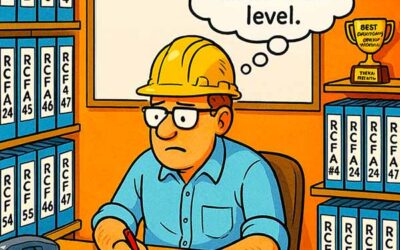
That last point deserves emphasis. When a maintenance team learns that their professional judgment gets overruled by production schedules, the result is disengagement. The technician who used to write detailed inspection findings starts writing “checked, OK” because the detailed findings never led to action anyway. The organization loses its early warning system.
The Backlog Snowball
Each deferred repair adds to the maintenance backlog. A healthy backlog sits between two and four weeks of work. Once it stretches beyond six weeks, the planning function starts to break down. Planners can’t accurately schedule work when the list is too long to triage effectively. Priority calls get made based on urgency (what’s about to fail) instead of criticality (what matters most to the business).
This creates a vicious cycle. The growing backlog forces more reactive work, which consumes resources that should be handling planned repairs, which adds more deferred items to the backlog. Plants caught in this cycle often find that 60% or more of their maintenance work is unplanned, a ratio that drives costs up by 30% to 50% compared to a planned maintenance operation.
- Backlog over six weeks signals a systemic deferral problem
- Reactive maintenance ratios above 40% indicate the backlog has tipped into self-reinforcing territory
- Schedule compliance drops below 70% when the planning function can’t keep up with incoming deferrals
Breaking the Deferral Cycle
The fix requires discipline at two levels: the decision to defer and the system that tracks it.
Every deferral should go through a documented risk assessment. What’s the consequence of this equipment failing before the repair happens? What’s the probability of failure over the deferral period? What’s the incremental cost of waiting versus acting now? If the risk assessment doesn’t happen in writing, the deferral is just a verbal agreement that nobody is accountable for.
A deferral without a documented risk assessment is a gamble disguised as a decision.
On the systems side, deferred work orders need visibility. They should appear on a separate report reviewed weekly by maintenance and operations leadership together. When a deferred item hits 30 days, it gets escalated. When it hits 60 days, it goes to the plant manager. This kind of escalation structure creates accountability without bureaucracy.
Some plants use a “deferred maintenance cost” metric that estimates the accumulated risk exposure from all open deferrals. When that number crosses a threshold, it triggers a review. This approach works because it translates the abstract concept of deferred maintenance risks into a dollar figure that leadership can act on.
The Compounding Problem Requires a Compounding Solution
Deferred maintenance risks grow the same way compound interest does: slowly at first, then all at once. The organizations that manage this well treat every deferral as a conscious, documented, time-limited decision with an owner and a review date. The ones that struggle treat deferrals as the default answer whenever production and maintenance priorities collide.
The equipment will tell you how long it’s willing to wait. The question is whether anyone is still listening when it does.