
Walk any plant, and you’ll find a maintenance schedule for almost everything that moves. Pumps, motors, gearboxes, valves, breathers. If it spins, holds pressure, or carries a load, it’s got a record in the CMMS and a tech who owns it.
The floor doesn’t.
The stairs, grating, ramps, and elevated walkways your people use thousands of times per shift sit entirely outside the asset register. In most plants, no one trends their condition or runs them on a defined inspection route. They get filed under “building” and handled as housekeeping, when they’re really equipment that wears.
That gap runs straight into an existing rule. OSHA’s walking-working surfaces standard (29 CFR 1910.22) requires employers to keep these surfaces in safe condition and to inspect them regularly and as necessary. What’s usually missing is the program behind the rule: defined routes, records, thresholds, and an owner. Plenty of facilities meet the requirement by providing informal housekeeping and calling it done.
It adds up. By Liberty Mutual’s 2025 Workplace Safety Index, falls on the same level cost U.S. employers an estimated $10.5 billion a year in workers’ comp costs, the second-costliest category of workplace injury, a rank it has held in every edition of the index for 25 years.
A Walking Surface Is a Component, and Components Wear
Friction isn’t a fixed property. The coefficient of friction on a steel stair tread the day it’s installed isn’t the number your crew is walking on three years later.
Foot traffic polishes the high points. Corrosion erodes the raised texture. Oil mist, washdown residue, and fine dust pack into whatever grip pattern the surface started with.
A walking surface degrades on a curve, the same way a bearing does. The only difference is you’re measuring the bearing.
Nearly every load-bearing component in the plant gets a PM card. The one people stand on rarely does.
Picture a set of exterior access stairs. Year one, the diamond plate bites. By year three, the center of each tread is burnished flat where every boot lands, while the edges still look factory-fresh. The check that matters reads the worn center line, because the pristine corners will lie to you.
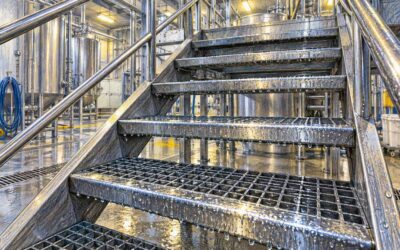
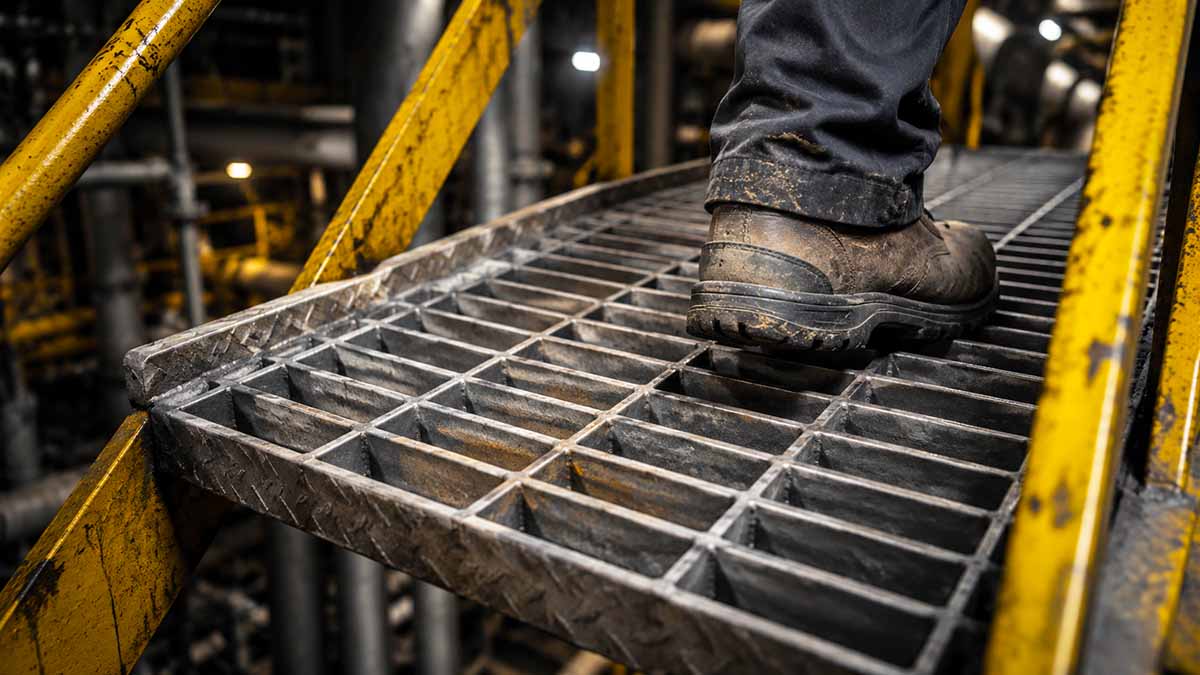
Grating presents a different inspection challenge. Open bar grating reads as inherently safe because you can see straight through it, so it rarely earns a second look. But the top edge of each bar is a narrow contact strip. Once that strip rounds over from wear or fills with frozen condensate, the open design that was supposed to shed liquid leaves you walking on a row of polished rails. The hazard hides in plain sight.
The decline stays invisible until it isn’t. A tread that passed a wet-condition test two years ago can sit well below the threshold today and look identical from across the room. No alarm, no vibration spike, no temperature flag. Just a slow slide toward the moment a foot doesn’t catch.
What “Inspectable” Actually Means for a Floor
Treat a walkway like an asset and the inspection stops being vague. It becomes a short list of observable, repeatable checks that fit on a route.
- Surface texture: is the original grip pattern worn smooth along the high-traffic line, especially the stair nose?
- Contamination: where do oil, water, or product consistently pool, film over, or freeze?
- Corrosion: are grating bars, tread edges, or fasteners thinning, flaking, or working loose?
- Existing traction hardware: are nosings, coatings, or clip-on devices still attached and still gripping?
- Transitions: do concrete-to-steel or indoor-to-outdoor handoffs change grip abruptly?
A trained employee can run the routine visual check. What it takes is somebody actually looking, on a frequency that matches how hard the area gets used. Any correction or repair affecting structural integrity, such as replacing heavily corroded grating or repairing a compromised tread, must be performed or supervised by a qualified person.
Frequency is where most programs get lazy. A default annual walkthrough treats a frosty exterior catwalk the same as a climate-controlled hallway, which makes no sense. Tie the interval to exposure: contamination, traffic volume, temperature swings, and the consequence of a fall. A grated platform over a tank receives more attention than a break-room floor, and the schedule should reflect that.
Where the consequences are high, the visual check can be backed with slip-resistance testing under defined, representative conditions. A single meter reading isn’t a universal safe-or-unsafe verdict. The number shifts with the device, the contaminant, the test method, and the surface. Use a validated tribometer, a documented procedure, and consistent operators where you can, and trend the results against a facility-selected criterion matched to the surface and its exposure.
Friction is a performance spec. Specs drift. You wouldn’t ignore a bearing’s clearance for three years.
Inspection Only Matters If You Can Act On It
Finding a degraded surface is half the job. The other half is closing the gap, and that’s where most programs stall. Ripping out a full run of stairs or replacing a grated platform rarely fits within this quarter’s budget, so the finding remains open until the next shutdown (or the next incident, whichever lands first).

Example of anti-slip clips. Courtesy Titan Safety, LLC.
For compatible open bar grating, one corrective option is a knock-on traction clip. Titan Safety Anti-Slip Clips fit over individual grating bars and lock on with a few taps of a rubber mallet, no welding, adhesive, nuts, or bolts. They add high-grip cleats along the leading edges of grated stairs and across platform travel lanes, and because there’s no hot work involved, a traction-related finding on compatible grating can often be corrected during a routine maintenance window instead of waiting on a capital line item two budget cycles out. Compatibility, bar profile, and spacing still have to be verified. But for grated surfaces, it turns a finding into something you can act on this week.
The economics reinforce the habit. A clip retrofit on compatible grating can be considerably cheaper and less disruptive than replacing a full stair or platform, while a single lost-time slip can run into tens of thousands once you add the claim, the investigation, and the lost production. When the corrective action is that quick, there’s little reason to let a traction finding age in a backlog.
Why the Floor Falls Off the Radar
Three predictable cracks are usually to blame.
No Record Means No Route
If it’s not in the CMMS, it’s not on anybody’s rounds. Walking surfaces often do not get an asset number, so they never generate a work order and are never looked at on purpose.
Nobody Owns Them
Maintenance assumes facilities has it. Facilities assumes safety has it. Safety assumes maintenance has it. The walkway lives in the gap between three departments, and gaps don’t get inspected.
A degrading surface may give no automatic warning. It waits for someone to inspect it, or to slip on it.
They Fail Slowly
A pump that seizes creates an event. A walkway that quietly loses much of its traction over a few years creates nothing, right up until it produces a recordable. By the time that trend would surface in an injury log, multiple unreported near misses may already have happened. Slow failures don’t catch anyone’s attention, which is exactly why they need a schedule rather than a reaction.
Building the Floor Into the Program
You already know how to manage assets. The fix is applying that same discipline to the surfaces underfoot.
- Add walking surfaces to the asset register by zone, the same way you’d register a production line or a header.
- Set inspection frequency by exposure rather than a default calendar. A washdown bay and an office corridor don’t belong on the same interval.
- Define a clear pass/fail trigger tied to a corrective action, so a finding generates work instead of a note nobody reads.
- Keep retrofit traction hardware in standard stock, so the fix isn’t gated by a six-week procurement cycle.
- Feed near-miss and minor-slip reports back into the route as leading indicators, and re-rank the high-traffic, high-contamination zones first.
Do that, and the floor stops being a mystery. It turns into a line item with a condition history, a threshold, and an owner, like everything else you trust your people’s safety to.
Stop Running Your Floors to Failure
Plenty of slips trace back to a surface that quietly stopped doing its job while everyone assumed it still was. Footwear, lighting, contamination, and behavior all play a part, but surface condition is the hidden contributor because no one is assigned to look at it. Carelessness gets the blame because it’s easier to write on an incident report.
You wouldn’t run a critical pump for years without a single inspection. The walking surface carries every person in the building, every shift, and many plants still run it to failure without a second look.
Put it on the list. Give it a number, a frequency, and an owner. Inspect it like it can hurt someone, because walking-surface condition is one controllable contributor to falls on the same level, the second-costliest category of serious workplace injuries in Liberty Mutual’s 2025 index.