
TL;DR: Autonomous maintenance (Jishu Hozen) is a maintenance strategy where machine operators take ownership of routine equipment care – cleaning, lubrication, inspection, and minor adjustments – rather than relying entirely on a separate maintenance department. It is the first of the eight pillars of Total Productive Maintenance (TPM) developed by the Japan Institute of Plant Maintenance (JIPM). The implementation framework is JIPM’s seven steps of Jishu Hozen, beginning with initial cleaning and inspection and progressing through to operator-led continuous improvement. Autonomous maintenance succeeds when management commits to sustained training investment and treats it as an equipment ownership transformation rather than a cleaning program. It fails more often than it succeeds, and the failure modes are predictable. This guide covers the seven JIPM steps with worked examples, modern CMMS integration, common failure modes, and how autonomous maintenance fits into the broader TPM and reliability methodology stack.
What Autonomous Maintenance Actually Is
Autonomous maintenance is a maintenance strategy where machine operators continuously monitor, adjust, and perform routine maintenance on their own equipment. The Japanese term is Jishu Hozen, often abbreviated JH, and the two terms are used interchangeably in modern reliability literature. The methodology is the first of the eight pillars of Total Productive Maintenance (TPM) and was codified by the Japan Institute of Plant Maintenance (JIPM) as a seven-step implementation framework.
The core principle is a shift in operator mindset. Traditional maintenance organization assigns operators an “I operate, you maintain” role and assigns maintenance technicians an “I maintain, you operate” role. The two functions exist in tension, with operators viewing equipment as production tools to be used and maintenance technicians viewing equipment as systems to be preserved. Autonomous maintenance restructures the relationship around shared ownership: “I operate and I maintain — and we improve together.” Operators take responsibility for the routine care that prevents deterioration, freeing maintenance technicians for the higher-skill preventive and predictive work that operators are not trained to perform.
The methodology originated at Nippondenso (now Denso Corporation), a Toyota group company, in the 1960s and 1970s. JIPM awarded the first TPM Excellence Award to Nippondenso in 1971, recognizing the framework that would become the global TPM standard. Seiichi Nakajima of JIPM is widely credited as the father of TPM, and his books published in Japanese in the 1980s and translated into English in the late 1980s introduced autonomous maintenance to international audiences. The seven-step Jishu Hozen framework has remained the JIPM standard since its original codification.
Autonomous maintenance is not a cleaning program, even though it begins with deep cleaning. The cleaning is a means to a larger end – operators learning their equipment intimately, identifying abnormalities that obscured grime hides, and developing the skills to take ownership of equipment health. Programs that treat autonomous maintenance as a cleaning initiative deliver short-term Step 1 conditions without the cultural and skill transformations that the later steps require. This is the single most common failure mode and is addressed explicitly in the honest middle ground section below.
How Autonomous Maintenance Fits in the TPM and Reliability Stack
Autonomous maintenance is one of eight TPM pillars. The complete framework includes:
- Autonomous Maintenance (Jishu Hozen) – operator-led equipment care
- Planned Maintenance – maintenance technician-led preventive and predictive maintenance
- Focused Improvement (Kobetsu Kaizen) – small-team improvement projects targeting specific equipment losses
- Quality Maintenance (Hinshitsu Hozen) – equipment-related quality defect prevention
- Early Equipment Management – design and procurement practices that build maintainability into new equipment
- Education and Training – skill development across operations and maintenance
- Safety, Health, and Environment – workplace safety and environmental compliance
- Office TPM – administrative process improvement
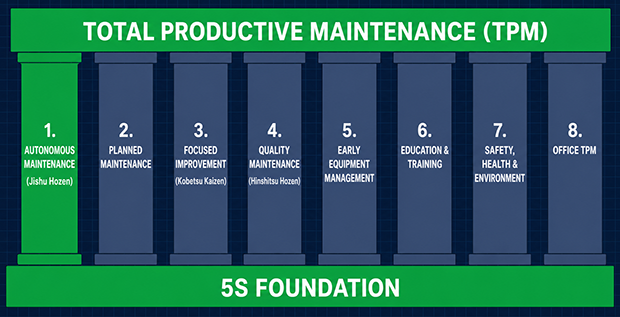
Autonomous maintenance is foundational because operator engagement is the prerequisite for the other pillars. Planned maintenance programs cannot identify the right work without operator-reported abnormalities. Focused improvement teams cannot solve equipment problems without operators who understand their equipment. Quality maintenance cannot prevent equipment-related defects without operator awareness of process variation. The other pillars layer on top of autonomous maintenance rather than running in parallel.
Autonomous maintenance also connects to the broader reliability methodology stack. Asset Criticality Analysis identifies which assets warrant the autonomous maintenance investment – non-critical assets typically do not justify the operator skill development cost. Reliability-Centered Maintenance (RCM) determines what maintenance strategy applies to critical assets, with autonomous maintenance handling the operator-executable portion. Overall Equipment Effectiveness (OEE) is the primary success metric for autonomous maintenance programs because the methodology directly targets the availability, performance, and quality losses that OEE measures.
The Seven Steps of Jishu Hozen (JIPM Standard)
Implementation varies by operation, but the JIPM framework is consistent across industries and countries. The seven steps are sequential – each step builds on the prior step, and skipping or compressing steps is the most common cause of program failure.
Step 1: Initial Cleaning and Inspection
The purpose of Step 1 is to restore equipment to like-new condition through deep cleaning and to expose hidden defects through the act of cleaning. The Japanese principle is “cleaning is inspection” – the act of cleaning surfaces visual contact with every component, revealing the abnormalities (called fuguai in Japanese) that obscured grime had been hiding.
Cross-functional teams perform Step 1 together: operators, maintenance technicians, engineering, production supervision, and management. The team disassembles guards, removes accumulated dirt and contamination, restores surface finishes, replaces missing fasteners, and documents every defect found. Photographs of before-and-after conditions become the baseline for sustaining Step 1 conditions in later steps.
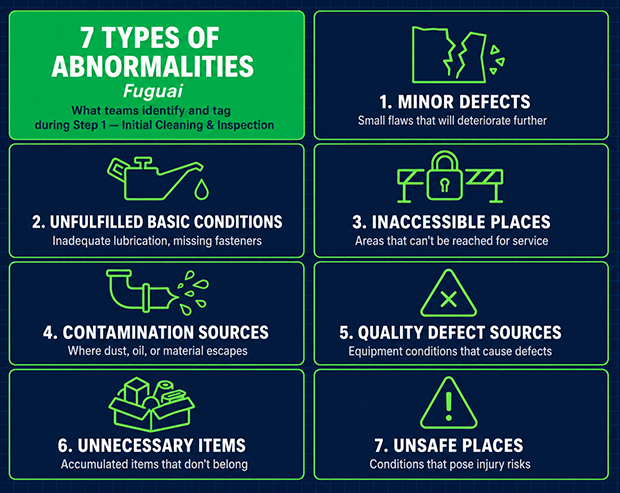
The seven types of abnormalities that teams identify and tag during Step 1 are:
- Minor defects – small deficiencies that do not currently affect operation but will deteriorate further
- Unfulfilled basic conditions – missing or degraded baseline conditions like inadequate lubrication or fastener tension
- Inaccessible places – areas that cannot be reached for cleaning, lubrication, or inspection
- Contamination sources – points where dust, oil, water, or process material escapes into the surrounding equipment
- Quality defect sources – equipment conditions that cause product defects
- Unnecessary and non-urgent items – accumulated items that do not belong in the equipment area
- Unsafe places – conditions that pose injury or health risks to operators or technicians
Each abnormality is tagged physically (typically with red tags or yellow tags depending on severity) and logged for resolution in subsequent steps. The tag count from Step 1 typically runs into the hundreds for a single piece of complex production equipment. Teams that find few abnormalities in Step 1 are usually not looking carefully enough – the methodology assumes that years of accumulated wear, contamination, and informal modifications have produced abnormalities that nobody has noticed.
Step 1 typically takes one to three months for a single production line. The deliverable is a complete abnormality inventory plus a restored baseline condition that subsequent steps will protect.
Step 2: Eliminate Sources of Contamination and Improve Hard-to-Access Areas
The purpose of Step 2 is to make Step 1 conditions sustainable. Step 1 produces a one-time restoration; Step 2 prevents the equipment from drifting back to its prior condition. The work focuses on two categories: sources of contamination (SOC) and hard-to-access areas (HTA).
SOC elimination addresses the contamination identified in Step 1 at its origin rather than at its destination. If a process pump leaks coolant onto adjacent equipment, the SOC fix is the pump seal – not better cleaning of the adjacent equipment. If conveyor belt slip drops product material onto the floor, the SOC fix is belt tension or alignment – not floor cleaning. SOC elimination requires kaizen activities, often with engineering support, because the fixes typically involve equipment modifications rather than cleaning intensity.
HTA improvement addresses access for cleaning, lubrication, and inspection. Common HTA improvements include replacing opaque covers with transparent ones (so operators can visually inspect rotating components without disassembly), adding access panels to areas that previously required full disassembly, installing quick-disconnect lubrication points to replace difficult-to-reach grease fittings, and redesigning guards to swing rather than bolt-mount.
Step 2 takes three to six months. The deliverable is a set of physical equipment modifications that eliminate the highest-priority contamination sources and improve access to inspection points. Programs that skip Step 2 typically discover that Step 1 conditions deteriorate within months as contamination resumes from unaddressed sources.
Step 3: Develop Tentative Cleaning, Lubrication, and Inspection Standards
The purpose of Step 3 is to develop tentative cleaning, lubrication, and inspection (CLI) standards that operators can execute reliably. The standards must specify:
- What to clean, lubricate, and inspect (specific components and access points)
- How to perform each task (technique, tools, materials)
- Frequency for each task (per shift, daily, weekly, monthly)
- Time budget per task (so operators can plan execution within available time)
- Acceptance criteria (what good looks like, with photographs where possible)
The word “tentative” is important. These standards will be refined in later steps as operators identify what works in practice and what does not. Programs that treat Step 3 standards as final tend to produce standards that are either too aggressive (operators cannot complete them in available time, leading to skipping) or too conservative (the standards do not actually protect Step 1 conditions). Tentative standards are starting points, not finished products.
Step 3 typically takes one to two months. The deliverable is a CLI standard document for each major asset, accessible to operators at the equipment, with the understanding that the standard will evolve through Steps 4 and 5.
Step 4: General Inspection Training
The purpose of Step 4 is to train operators on equipment fundamentals – structure, function, and operating principles – so they can perform deeper inspection than the basic CLI work of Steps 1 through 3. This is the most training-intensive step and the one most commonly underbudgeted.
General inspection training typically covers:
- Equipment structure and components – how the major subsystems work together, what each component does, what operating parameters indicate normal versus abnormal conditions
- Mechanical fundamentals – bearing types and failure modes, fastener loosening patterns, lubrication theory, vibration basics, alignment principles
- Electrical fundamentals – connection integrity, insulation degradation indicators, motor health basics
- Hydraulic and pneumatic fundamentals – pressure indicators, leak detection, contamination control
- Process fundamentals – what good product looks like, what process variation indicates, how equipment condition affects product quality
The depth varies by equipment criticality and operator skill level. Critical equipment with complex failure modes may require six to twelve months of operator training before Step 5 can begin. Simple equipment may require only one to three months. Programs that compress Step 4 training to save calendar time consistently produce Step 5 inspection programs that operators cannot execute reliably, which surfaces as inspection skip rates rising over time.
Step 4 also produces an autonomous inspection standard that documents the inspection routine operators will execute in Step 5. This is distinct from the CLI standard developed in Step 3 – Step 3 covers the basic care work; Step 4 covers the diagnostic inspection work that requires the deeper skills developed during training.
Step 5: Autonomous Inspection
The purpose of Step 5 is to transfer routine inspection responsibilities from maintenance technicians to operators. Operators execute the autonomous inspection standard developed in Step 4, capturing inspection results, identifying abnormalities, and triggering work requests for technician follow-up on findings beyond their authorized work scope.
Step 5 also streamlines the CLI and inspection standards developed in earlier steps. Duplicate tasks (where operators and technicians both inspect the same components) are eliminated. Inspection time is reduced through visual management techniques: color coding for normal versus abnormal conditions on gauges and sight glasses, match marks on fastener positions, flow direction arrows on piping, calibrated wear indicators on belts and chains, and pressure level markings on pneumatic and hydraulic systems.
The visual management techniques deserve specific attention because they multiply inspection effectiveness. An operator scanning a row of pressure gauges with no calibration markings must remember the normal range for each gauge – an unrealistic cognitive load that produces missed abnormalities. The same operator scanning gauges with green normal ranges and red abnormal ranges marked physically on the gauge face can identify abnormalities at a glance. Visual management is what makes operator inspection scalable across hundreds of inspection points.
Step 5 typically takes two to four months. The deliverable is operator-executed inspection coverage of the equipment, with maintenance technicians transitioning from performing routine inspections to auditing operator-performed inspections and handling the deeper diagnostic work that operators are not trained for.
Step 6: Standardization
The purpose of Step 6 is to standardize all autonomous maintenance activities and management systems across the plant. Steps 1 through 5 typically deploy on a pilot basis to demonstrate the methodology; Step 6 scales the pilot work to the full operation.
Standardization extends beyond equipment-level CLI standards to broader management systems:
- Work distribution criteria – clear definitions of operator versus technician responsibilities
- Data recording standards – consistent formats for inspection results, abnormality logs, and work requests
- Tool, die, and fixture management – organized storage with visual identification
- Spare parts management – operator-stocked consumables versus technician-stocked critical spares
- Process and product quality standards – equipment condition criteria tied to product quality outcomes
- Cleaning standards – consistent expectations across shifts and equipment
- Training standards – operator skill certification levels and renewal requirements
Visual management deepens significantly in Step 6. Beyond gauge calibration markings, the equipment becomes self-explanatory – flow directions marked on piping, valve open and close positions labeled, electrical panels with one-line diagrams visible, lockout-tagout points clearly marked, and lubrication frequency schedules posted at lubrication points. The goal is equipment that can be operated and maintained correctly by any qualified operator without referring to documentation.
Step 6 typically takes two to four months at the pilot equipment level and significantly longer for plant-wide deployment. The deliverable is a standardized autonomous maintenance system that produces consistent results across operators, shifts, and equipment.
Step 7: Autonomous Management (Self-Management)
The purpose of Step 7 is operator-led continuous improvement. Operators identify improvement opportunities, lead kaizen events, and own equipment performance metrics. Daily management and policy management transition from imposed externally to driven by the operator team.
Step 7 activities include:
- Daily management – operators run morning shift meetings, review prior shift performance, and set daily targets
- Equipment performance ownership – operators monitor OEE, MTBF, MTTR, and other reliability metrics for their equipment
- Continuous improvement – operators identify and lead kaizen events to address performance gaps
- Cross-functional collaboration – operators participate in design reviews for new equipment, applying lessons learned from existing equipment
- Mentoring and training – experienced operators train newer operators in autonomous maintenance practices
Maintenance technicians transition fully into the role of technical experts and continuous improvement coaches rather than task executors. The “we maintain” mindset becomes operationally real rather than aspirational, with operators and technicians collaborating on improvement projects rather than coexisting in parallel functions.
Step 7 is the longest step in calendar terms because it does not have a clear endpoint – autonomous management is a continuous state rather than a deliverable. JIPM TPM Excellence Award certification typically requires three to five years of demonstrated Step 7 performance before consideration. Programs that declare completion of Step 7 in less than two years typically have not transitioned to genuine operator-led continuous improvement.
Worked Example: Autonomous Maintenance for a Centrifugal Pump
The seven steps work the same way regardless of equipment class, but the specifics matter for operator understanding. Here is what each step looks like applied to a primary cooling water pump in a process operation.
Step 1: Initial Cleaning and Inspection. The cross-functional team disassembles pump guards, cleans the bearing housing, mechanical seal area, baseplate, suction and discharge piping, instrumentation, and surrounding floor area. Hidden defects discovered during cleaning typically include: oil leakage at the seal flush line (SOC), corrosion on the baseplate (minor defect), missing fasteners on the coupling guard (unfulfilled basic condition), inaccessible grease fittings on the motor bearings (HTA), and unsafe access to the inboard bearing (unsafe place). The team tags each defect and photographs before-and-after conditions.
Step 2: Eliminate SOC and Improve HTA. The seal flush line leak is fixed at its source by replacing the gasket and torquing connections to specification. The baseplate corrosion is addressed by repainting and installing a drip pan to prevent future contamination. The inaccessible motor bearing grease fittings are extended through remote lubrication lines to a common lubrication point at floor level. The coupling guard is redesigned to swing open rather than bolt-mount for faster access.
Step 3: Develop Tentative CLI Standards. The CLI standard specifies: daily visual inspection of bearing housing oil level (sight glass), suction and discharge pressure gauge readings (logged on inspection sheet), and seal area for visible leaks; weekly cleaning of motor cooling fins and lubrication of motor bearings via the relocated grease points; monthly oil change on bearing housing; quarterly vibration check using portable analyzer at four bearing positions. Acceptance criteria include sight glass oil level between min and max marks, pressure readings within marked normal range, no visible seal leaks, and vibration readings below 0.15 in/sec velocity overall.
Step 4: General Inspection Training. Operators receive training on centrifugal pump fundamentals: how the impeller, casing, mechanical seal, and bearings work together; how to identify cavitation by sound and pressure signature; how to recognize seal failure symptoms (drip rates, flush water clarity); how to interpret vibration readings (overall velocity versus spectral analysis is reserved for technicians); how lubrication condition affects bearing life; and how alignment between motor and pump affects operating life. Training combines classroom instruction, hands-on equipment time, and shadowing maintenance technicians during repairs.
Step 5: Autonomous Inspection. Operators execute the inspection routine. Visual management on the pump includes green/red zones marked on the pressure gauges, oil level marks on the sight glass, vibration acceptance criteria stickered on the bearing housing, and lubrication frequency tags at the grease points. Operators log inspection results in the CMMS via mobile app and trigger work requests for any abnormality outside their authorized work scope (oil top-off and grease application are operator scope; seal replacement and vibration spectrum analysis are technician scope).
Step 6: Standardization. The pump-specific standards developed in Steps 3 through 5 become templates applied to the broader pump population (typically 50 to 500 pumps in a process operation). Visual management techniques are standardized across the pump fleet. Inspection routes are organized to minimize walking time and maximize coverage. Operator training is standardized as a curriculum applied to all new operators rather than ad hoc.
Step 7: Autonomous Management. Operators identify performance improvement opportunities. The pump team notices that seal failures cluster at the end of summer (when cooling tower water quality degrades), proposes a kaizen project to install a seal flush filtration system, builds the business case, and leads the implementation in collaboration with engineering. Operators monitor pump fleet MTBF and MTTR monthly, recognize trends, and drive improvement projects without external direction.
Modern Autonomous Maintenance: CMMS, Connected Worker, and Digital Integration
The JIPM seven-step framework was developed in an analog era. Modern implementations integrate the methodology with digital tools that did not exist in the 1970s and 1980s, and the integration changes how the methodology is deployed in practice.
CMMS integration is the foundation. Operator-identified abnormalities are logged as CMMS work requests rather than paper tags, routed to maintenance technicians automatically, and tracked through completion. CLI standards are scheduled as recurring CMMS work orders assigned to operator teams rather than maintenance technicians. Operator inspection results are captured in CMMS via mobile app, building a structured data set that supports failure analysis and continuous improvement. Major CMMS platforms including IBM Maximo, SAP S/4HANA Asset Management, eMaint, MaintainX, and Limble support autonomous maintenance workflows natively. See our CMMS comparison guide for platform options.
Connected worker platforms deliver one-point lessons (OPLs), training content, and inspection guidance to operators on tablets and smart glasses at the equipment. Augmentir, Parsable, Tulip, and SwipeGuide all support autonomous maintenance use cases – operators receive contextual instruction when they need it rather than referring to paper documents stored elsewhere. Step-by-step inspection guidance with photo verification ensures consistent execution across operators and shifts. See our connected worker platform guide for the platform landscape.
Mobile inspection apps capture operator inspection data, photograph defects, and trigger work requests directly from the equipment. The data structure supports trending, alerting on deviations from baseline, and identifying inspection gaps. Manual inspection sheets that get filed and forgotten become structured data that drives continuous improvement.
Condition monitoring integration bridges autonomous maintenance and predictive maintenance. Operator-collected inspection data combined with sensor-collected condition data produces a more complete picture of equipment health than either alone. Vibration sensors trigger work orders when condition changes; operators verify and contextualize the sensor signals through visual inspection.
Visual management at scale is enabled by digital signage, augmented reality overlays, and mobile dashboards that show real-time equipment performance to operators. The goal is unchanged from the JIPM standard – equipment status that is obvious at a glance – but the techniques have evolved beyond paint and stickers.
The methodology has not changed. The implementation has evolved. Programs that try to implement autonomous maintenance with paper documentation in 2026 encounter friction that did not exist in 1985 — operator expectations, technician expectations, management visibility requirements, and compliance documentation requirements all assume digital integration. Modern implementations deploy autonomous maintenance and digital integration in parallel rather than sequentially.
Sustaining Autonomous Maintenance
The methodology produces results during initial implementation. The harder problem is sustaining results over years as operators turn over, equipment ages, production pressure rises, and management attention shifts. Sustaining autonomous maintenance requires deliberate management systems beyond the seven implementation steps.
Daily stand-up meetings are five to ten minute team gatherings at the start of each shift. Operators review the prior shift’s performance, identify issues encountered, and align on the day’s targets. The meetings keep autonomous maintenance visible in daily operations rather than fading into background activity. Effective stand-ups follow a structured agenda: prior shift status, current shift targets, equipment issues, safety items, and improvement opportunities.
One-point lessons (OPLs) are short visual training documents – typically a single page or single screen – that capture a specific operating tip, safety point, or troubleshooting technique. OPLs are created by experienced operators, technicians, and engineers as they encounter situations worth documenting. New operators absorb tribal knowledge through OPLs rather than waiting for the situation to recur. Connected worker platforms deliver OPLs digitally rather than as paper documents posted at the equipment.
Activity boards visualize autonomous maintenance status at a team level. Boards typically show inspection completion rates, abnormality counts and resolution status, kaizen project status, OEE trends, and skill development progress. Activity boards make program performance visible to operators, supervisors, and management without requiring system access.
Audit and gate-review processes verify step completion and prevent regression. JIPM-aligned programs use formal audits at each step gate before progressing to the next step, with audits performed by the team that did the work, the area manager, and a senior auditor (often the TPM coordinator). The three-stage audit pattern catches gaps that single-auditor reviews miss.
Equipment performance metrics track autonomous maintenance results over time. Primary metrics include OEE (the most direct measure of equipment effectiveness), MTBF and MTTR (reliability metrics), inspection completion rates, abnormality identification rates, and abnormality resolution time. Programs that track activity (inspection completions) without tracking outcomes (OEE, MTBF) often deteriorate because activity becomes the goal.
Skills certification formalizes operator capability levels. Operator Level 1 might cover Steps 1 through 3 capability; Level 2 adds Step 4 inspection skills; Level 3 adds Step 7 continuous improvement leadership. Certification is renewed periodically rather than awarded permanently. Skills certification creates clear development paths for operators and prevents skill drift over time.
Honest Middle Ground: Why Autonomous Maintenance Programs Fail
The methodology is well-defined, but autonomous maintenance programs fail more often than they succeed. The recurring failure modes are predictable, and most are preventable with adequate management awareness.
Treating autonomous maintenance as a cleaning program. The most common failure mode. Programs that focus on Step 1 cleaning without committing to Steps 2 through 7 produce one-time restoration that deteriorates within months. The cleaning is a means to the larger end of operator skill development and equipment ownership transformation. Programs that stop at the cleaning never deliver the methodology’s actual benefits.
Insufficient operator training investment. Step 4 is the most frequently underbudgeted step. Programs that compress Step 4 training to save calendar time produce Step 5 inspection programs that operators cannot execute reliably. The result is rising inspection skip rates, missed abnormalities, and program credibility erosion. General inspection training takes the time it takes, and programs that try to compress it consistently fail.
Weak management commitment that fades under production pressure. Autonomous maintenance requires sustained management commitment over multi-year deployment timelines. When production pressure rises, the temptation to suspend autonomous maintenance activities (“we’ll catch up next month”) is enormous, and the suspension typically becomes permanent. Programs that survive this pressure share strong management sponsorship at multiple levels, with autonomous maintenance treated as non-negotiable rather than nice-to-have.
Operator resistance from misaligned incentives. Operators paid by the unit, by the hour with overtime opportunity, or under union work rules that limit operator scope often resist autonomous maintenance because the program adds unpaid work without compensating skill recognition. Successful programs typically address compensation explicitly – paying for skill levels, providing development paths into maintenance technician or reliability engineering roles, and recognizing autonomous maintenance contributions in performance reviews.
Maintenance technician resistance. Maintenance technicians who view autonomous maintenance as a threat to their job security undermine the program through subtle non-cooperation. Successful programs reframe the technician role explicitly – autonomous maintenance frees technicians from routine work to focus on higher-skill predictive and preventive work, not eliminate technicians. The reframing requires actual investment in technician development to make the new role real, not just rhetorical.
Conflict with union work rules. Operations where operators and maintenance technicians are represented by different bargaining units sometimes have contractual restrictions on operator-performed maintenance. Programs in these environments require negotiated work rule modifications, which is a substantive labor relations effort beyond the technical implementation. Programs that ignore this reality and attempt to implement autonomous maintenance through technical channels alone consistently fail.
Inadequate audit and gate-review processes. Programs without formal step gates progress operators to Step 5 inspection responsibilities before Step 4 training is genuinely complete, or declare Step 6 standardization without verifying Steps 1 through 5 are actually sustained. The gaps surface six to twelve months later as program credibility erodes. JIPM-aligned three-stage audits at each step gate catch most of these gaps before they cascade.
Misalignment with maintenance team culture. Maintenance teams that view their role as fixing what breaks rather than preventing breaks resist the cultural shift autonomous maintenance requires. Successful programs typically begin with maintenance team development – RCM training, predictive maintenance skill development, reliability engineering exposure – that shifts the maintenance team’s frame from reactive to proactive before asking them to coach operators in the proactive approach.
Treating autonomous maintenance as a project rather than a transformation. Projects have endpoints. Transformations do not. Programs that declare autonomous maintenance “complete” after the seven implementation steps and remove dedicated TPM resources typically see the program deteriorate within two to three years as the supporting management systems fade. Sustained autonomous maintenance requires ongoing TPM coordination, ongoing training, ongoing audits, and ongoing leadership attention. Plants that treat the methodology as a permanent operating model sustain results; plants that treat it as a deployment project do not.
The right answer for organizations considering autonomous maintenance is honest assessment of management commitment depth, training investment willingness, labor relations complexity, and time horizon. Autonomous maintenance done well delivers substantial OEE, reliability, and cultural improvements. Autonomous maintenance done as a checkbox initiative produces short-term cleaning results without sustained transformation. The methodology rewards organizations that commit to the full seven-step implementation and the multi-year cultural change; it punishes organizations that try to extract benefits without making the corresponding investment.
Frequently Asked Questions
What is autonomous maintenance?
Autonomous maintenance is a maintenance strategy where machine operators perform routine cleaning, lubrication, inspection, and minor maintenance on their own equipment rather than relying entirely on a separate maintenance department. The Japanese term is Jishu Hozen. It is the first of the eight pillars of Total Productive Maintenance (TPM), developed by the Japan Institute of Plant Maintenance (JIPM).
What are the seven steps of autonomous maintenance?
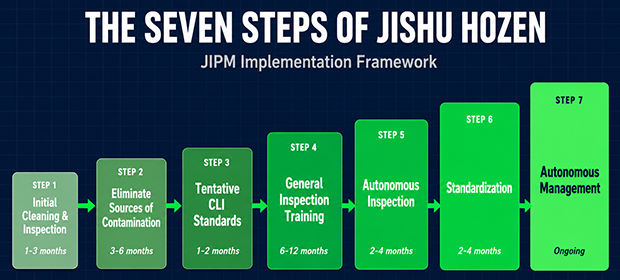
The JIPM seven steps are: (1) Initial Cleaning and Inspection, (2) Eliminate Sources of Contamination and Improve Hard-to-Access Areas, (3) Develop Tentative Cleaning, Lubrication, and Inspection Standards, (4) General Inspection Training, (5) Autonomous Inspection, (6) Standardization, and (7) Autonomous Management (Self-Management).
What is Jishu Hozen?
Jishu Hozen is the Japanese term for autonomous maintenance and is one of the eight pillars of TPM. The phrase translates as “autonomous (Jishu) maintenance (Hozen)” and refers to maintenance performed by equipment operators rather than dedicated maintenance technicians. The methodology was codified by JIPM as a seven-step framework.
What is the difference between autonomous maintenance and preventive maintenance?
Autonomous maintenance is performed by operators and covers routine cleaning, lubrication, inspection, and minor adjustments. Preventive maintenance is performed primarily by maintenance technicians and covers scheduled component replacements, calibrations, and overhauls. The two are complementary — autonomous maintenance handles daily routine work that prevents deterioration, freeing technicians to focus on the higher-skill preventive and predictive maintenance tasks operators are not trained for.
What is the difference between autonomous maintenance and TPM?
Autonomous maintenance is one of the eight pillars of Total Productive Maintenance (TPM) – the first and most foundational pillar. TPM is the complete framework that includes Autonomous Maintenance, Planned Maintenance, Focused Improvement, Quality Maintenance, Early Equipment Management, Education and Training, Safety Health and Environment, and Office TPM. Autonomous maintenance alone is not TPM.
Who developed autonomous maintenance?
Autonomous maintenance was developed at Nippondenso (now Denso Corporation) in the 1960s and 1970s as part of the broader development of TPM. The methodology was codified by JIPM, which awarded the first TPM Excellence Award to Nippondenso in 1971. Seiichi Nakajima of JIPM is widely credited as the father of TPM and the primary author of the foundational TPM literature that introduced autonomous maintenance to international audiences.
How long does autonomous maintenance implementation take?
Full implementation through all seven JIPM steps typically takes 12 to 36 months for a single production line. Step 1 takes 1 to 3 months, Step 2 takes 3 to 6 months, Step 3 takes 1 to 2 months, Step 4 takes 6 to 12 months, and Steps 5 through 7 take 2 to 4 months each. Plant-wide deployments scale these timelines significantly. JIPM TPM Excellence Award certification typically requires three to five years of demonstrated Step 7 performance.
What are the benefits of autonomous maintenance?
Benefits include higher equipment availability, fewer unplanned breakdowns, improved OEE, freeing skilled technicians from routine work, lower maintenance labor cost, earlier defect detection, fewer quality defects, cleaner work environments, increased operator skill, reduced turnover, and improved team cohesion between operations and maintenance.
Why do autonomous maintenance programs fail?
The most common failure modes are: treating it as a cleaning program rather than equipment ownership transformation, insufficient operator training investment (especially Step 4), weak management commitment that fades under production pressure, operator resistance from misaligned incentives, maintenance technician resistance, conflict with union work rules, inadequate audit and gate-review processes, misalignment with maintenance team culture, and treating it as a project rather than a transformation. Programs that survive share strong management sponsorship, sustained training investment, and cultural alignment between operations and maintenance leadership.
How does autonomous maintenance integrate with CMMS?
Modern autonomous maintenance programs integrate with CMMS for work order management, PM scheduling, and abnormality tracking. Operator-identified abnormalities are logged as CMMS work requests. CLI standards are scheduled as recurring CMMS work orders assigned to operator teams. Mobile CMMS apps enable operators to log inspections and trigger work requests from the equipment. Major CMMS platforms including IBM Maximo, SAP, eMaint, MaintainX, and Limble support autonomous maintenance workflows natively.
Related Guides
- How to Calculate OEE: Methodology and Worked Examples
- How to Calculate MTBF and MTTR: Methodology and Worked Examples
- How to Calculate Asset Criticality
- How to Perform RCM: Reliability-Centered Maintenance Methodology
- How to Perform FMEA: Failure Mode and Effects Analysis
- Best CMMS Software 2026: Independent Comparison
- Best Connected Worker Platforms
Sources & References
- Japan Institute of Plant Maintenance (JIPM) – TPM and Jishu Hozen standards
- Seiichi Nakajima – Introduction to TPM: Total Productive Maintenance (1988)
- Seiichi Nakajima – TPM Development Program: Implementing Total Productive Maintenance (1989)
- SMRP Best Practices Framework – Society for Maintenance & Reliability Professionals
- Hartmann, E.H. – Successfully Installing TPM in a Non-Japanese Plant (TPM Press, 1992)
- Suzuki, T. – TPM in Process Industries (Productivity Press, 1994)
This guide is reviewed and updated annually. Last review: May 2026. View all Reliable guides.