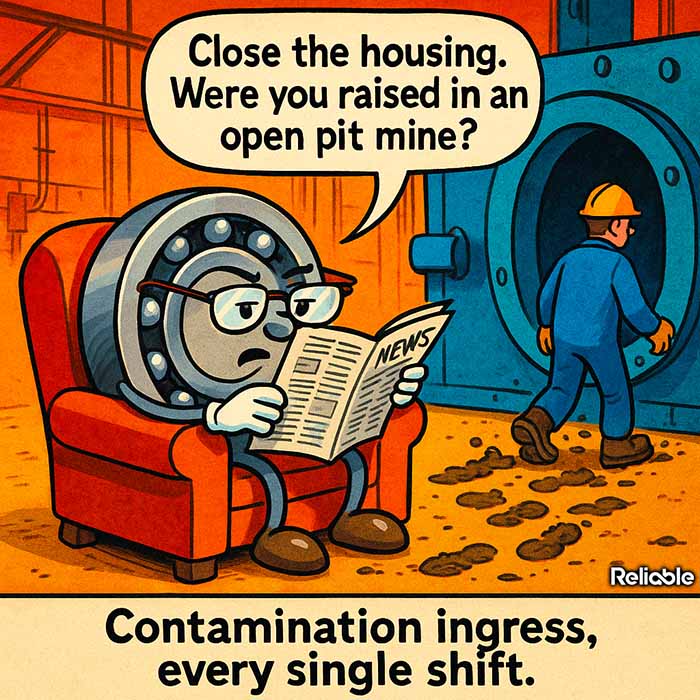

Every bearing failure investigation tells a story, and contamination is the villain in roughly 20% of them. Dirt, moisture, and process debris find their way into housings, reservoirs, and gearboxes through gaps that should have been sealed, covers that should have been closed, and breathers that should have been upgraded years ago. Understanding how to prevent equipment contamination ingress starts with accepting an uncomfortable truth: most contamination is self-inflicted.
The particles doing the damage are often smaller than what the human eye can detect. ISO cleanliness codes measure contamination in fluids at 4, 6, and 14 micron thresholds. A single fingerprint on a clean bearing race introduces enough salt and moisture to initiate corrosion pitting. The problem is rarely dramatic; it’s incremental, silent, and relentless.
Why Preventing Equipment Contamination Ingress Saves Real Money
Contamination drives up maintenance costs in ways that rarely show up on a single work order. Bearings wear faster. Hydraulic valves stick. Lubricant life drops by half (or worse). A study by the National Research Council of Canada found that controlling particulate contamination in hydraulic systems could extend component life by a factor of five.
That math changes budget conversations fast. A $200 desiccant breather on a gearbox might prevent a $15,000 rebuild six months down the road. A $50 seal replacement on a pillow block bearing housing could avoid three unplanned shutdowns in a single calendar year.
A $200 desiccant breather on a gearbox might prevent a $15,000 rebuild six months later. The economics of contamination control are lopsided in your favor.
The real cost multiplier is secondary damage. Contaminated oil circulating through a hydraulic system scores valve spools, erodes cylinder walls, and clogs proportional valves. One contamination event creates a cascade that shows up as multiple seemingly unrelated failures over the following 90 days.
A thorough root cause failure analysis on premature bearing or pump failures will often trace back to contamination ingress as the true origin. What looks mechanical at first glance is environmental when you dig deeper.
The Most Common Ingress Points
Contamination enters through predictable pathways. Every one of them is manageable with basic discipline and modest hardware upgrades.
- Breathers and vents: standard fill caps and open-pipe breathers pull in ambient dust with every thermal breathing cycle. Desiccant breathers with particulate filters solve this at low cost.
- Shaft seals and bearing housing seals: worn lip seals and outdated labyrinth designs allow wash water and airborne particles to migrate inward. Bearing isolators and upgraded contact seals are proven alternatives.
- Fill ports and sample points: topping off a reservoir with a funnel and a dirty bucket introduces more contamination in five minutes than the system generates internally in a month.
- Hatch covers and inspection ports: every time an access point opens, contamination has a direct path inside. Gasket integrity and disciplined closure practices matter.
Most contamination control failures trace back to one of these four categories. The fix is rarely expensive. The gap is awareness and follow-through.
How to Prevent Equipment Contamination Ingress with a Practical Action Plan
Effective contamination control programs share a consistent structure. They prioritize exclusion first (keeping contaminants out), detection second (catching what gets through), and removal third (filtering and flushing). That sequence matters. Filtration can’t keep pace with an open fill port or a missing breather cap.
Contamination control that works follows a strict hierarchy: exclude first, detect second, remove third. Skip the first step and the other two can’t compensate.
Start with a contamination ingress survey. Walk the plant floor with a checklist and a camera. Document every breather, every seal, every fill point. Photograph the ones that are clearly compromised. This survey becomes the backbone of a prioritized upgrade plan that pays for itself within months.
- Replace standard breathers with desiccant breathers on all critical gearboxes, hydraulic reservoirs, and bulk storage tanks.
- Install bearing isolators on pumps and motors operating in wet, dusty, or washdown environments.
- Implement closed-loop transfer systems for lubricant top-offs. Eliminate funnels and open buckets entirely.
- Add quick-connect sample ports to enable clean oil sampling without cracking open drain valves.
Pairing these hardware upgrades with a solid predictive maintenance strategy closes the loop. Oil analysis catches what exclusion misses, and vibration data reveals damage before catastrophic failure arrives.
Building Contamination Awareness into Every Shift
The biggest barrier to preventing contamination ingress effectively is habit, not hardware. Equipment gets opened and left open. Breathers get knocked off and nobody replaces them. Seals wear out and the work order sits in the backlog for three weeks.
Shift-level contamination checks belong on the operator care route. Three questions cover the essentials: Are all covers, caps, and breathers in place? Are there visible signs of oil leaks, water intrusion, or dust accumulation near seals? Has anything changed since the last round?
Shift-level contamination checks take minutes. The failures they prevent take days to repair and weeks to recover from.
Training works best when it’s tangible. Show a technician what 50 milliliters of water does to a bearing in an accelerated test rig. Let an operator look at contaminated oil under a portable microscope next to a clean sample. The visual contrast drives the point home faster than any slide deck or classroom lecture.
Measuring Progress: Oil Analysis and Contamination Trending
You can’t manage contamination by gut feel. Regular oil analysis report data gives you objective evidence of whether exclusion strategies are working. ISO cleanliness codes (reported as three numbers, like 18/16/13) track particle counts at specific micron levels. Trending these codes over time shows whether a system is getting cleaner or dirtier.
Set target cleanliness levels for each asset class. Hydraulic servo valves need much cleaner fluid than a splash-lubricated gearbox. Publish those targets so operators and technicians know what “clean enough” actually means in measurable terms.
- Hydraulic servo systems: ISO 16/14/11 or better
- Proportional valve hydraulics: ISO 18/16/13
- General industrial gearboxes: ISO 19/17/14
- Splash-lubricated systems: ISO 20/18/15
When a system’s cleanliness code suddenly jumps two or three points, that’s your early warning. Something changed. A seal failed, a breather was removed, or a contaminated top-off entered the system. Investigating these spikes immediately prevents the slow cascade of secondary damage that follows over weeks and months.
The Payoff of Consistent Contamination Control
Plants that take contamination control seriously see measurable results in their maintenance spend within 12 to 18 months. Bearing replacements drop. Hydraulic component failures become less frequent. Oil change intervals extend because the lubricant stays clean longer and retains its additive package.
The discipline required to prevent equipment contamination ingress effectively is straightforward. Close the covers. Upgrade the breathers. Seal the housings. Sample the oil. Train the people. None of this is exotic or expensive. The hard part is doing it consistently, on every shift, across every asset, until it becomes the default behavior rather than the exception.