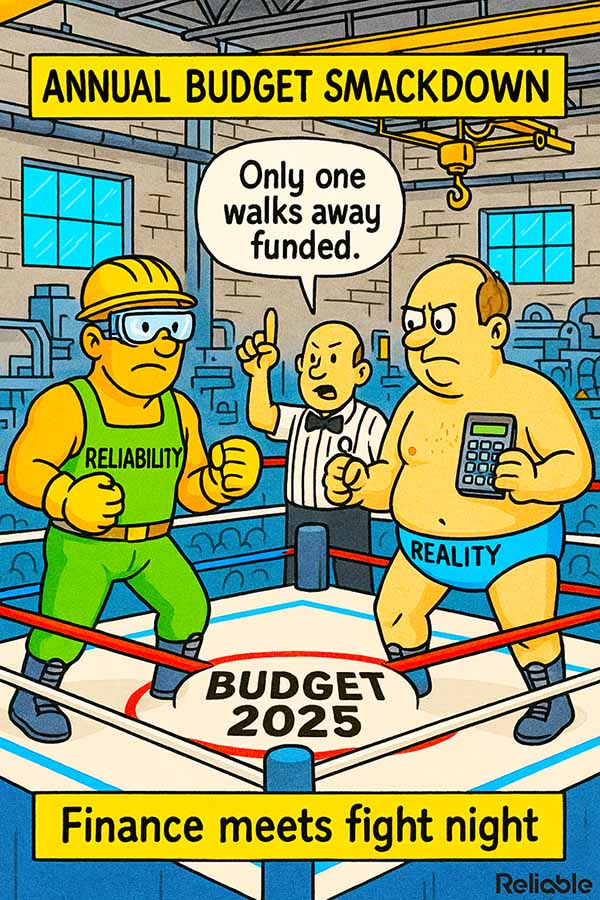

Budget season in most maintenance departments follows a familiar script. The reliability team builds a case for the resources they need, finance looks at the total, and the negotiation begins. Knowing how to justify maintenance budget requests is the difference between walking out of that meeting funded and walking out with a mandate to “do more with less.”
The frustrating part: maintenance leaders usually have the data on their side. Equipment failure costs, downtime losses, safety incidents tied to deferred repairs. The problem is packaging that data in a language that finance teams and senior leadership actually respond to.
Why Maintenance Budgets Get Cut First
Maintenance spending is uniquely vulnerable during budget reviews because the department’s greatest successes are invisible. When equipment runs smoothly, nobody credits the PM program that kept it running. When something breaks, everyone remembers maintenance exists.
This creates a perception problem. Finance sees a department that spent $2.4 million last year and concludes that everything is fine. The logical (and wrong) next step: “If things ran well at $2.4 million, surely they’ll be fine at $2.1 million.”
Three structural factors make maintenance budgets easy targets:
- Maintenance costs appear as pure expense on financial statements, with no visible revenue line to protect them
- The consequences of underfunding show up 12 to 18 months later, well past the current budget cycle
- Most maintenance departments lack the financial fluency to translate technical needs into business impact
That third point is where the opportunity lives. Learning how to justify maintenance budget requests effectively means becoming bilingual: fluent in both equipment reliability and financial outcomes.
How to Justify Maintenance Budget Requests With Data That Lands
The most common mistake in budget presentations is leading with technical detail. Vibration trends, oil analysis results, and bearing replacement schedules matter enormously to the maintenance team. To the CFO, they’re noise.
A budget request framed around equipment specs gets a polite nod. A budget request framed around production losses gets a conversation.
Here’s the shift: every maintenance expenditure connects to a financial outcome. Your job is to make that connection explicit.
Translate Failures Into Dollars
Start with your most expensive unplanned downtime events from the past 12 months. For each one, calculate the full cost: lost production, expedited parts, overtime labor, quality defects from rushed restarts, and any safety incidents.
A solid root cause failure analysis on your top five failure events will typically reveal that 60% to 80% of unplanned downtime traces back to a handful of recurring issues. These are your budget anchors: specific problems with specific costs and specific solutions.
When you walk into a budget meeting and say “These five failure modes cost us $1.2 million last year, and here’s the $340,000 investment that prevents them,” you’ve changed the conversation from expense justification to risk management.
Use the Cost of Deferral
Every budget cut in maintenance is a bet that deferred work will remain deferred without consequence. Your job is to quantify what happens when that bet loses.
Track your deferred maintenance risks with specificity. Each deferred PM or repair should carry an estimated failure probability and a projected cost if that failure occurs. This gives finance a risk-weighted view of what they’re actually choosing when they cut the budget.
A spreadsheet that shows “cutting $200,000 from the PM program creates $1.8 million in risk exposure over 18 months” reframes the conversation entirely. The cut stops looking like savings and starts looking like a liability.
Benchmark Against Industry Standards
Finance teams respond well to comparative data. If your facility spends 2.1% of replacement asset value (RAV) on maintenance while the industry benchmark for your sector is 3.0%, that gap tells a story. Present it with context:
- Current spend as percentage of RAV versus industry median
- Maintenance cost per unit produced versus comparable facilities
- Ratio of planned to unplanned work (world-class targets 85% or higher planned work)
- Overtime hours as a percentage of total maintenance labor
The comparison becomes even more powerful when you track performance trends over time. If your planned maintenance percentage has been climbing for three consecutive years while unplanned downtime has dropped, that trajectory shows your program is working and deserves continued investment.
These benchmarks give your request an external anchor. You’re asking to close a gap against proven standards, which is easier to defend than requesting an arbitrary increase.
Structuring the Request for Approval
Even with strong data, presentation structure matters. A budget request that arrives as a 40-page document gets skimmed. One that arrives as a focused, three-tier proposal gets read.
The Three-Tier Approach
Present three scenarios. The first: bare minimum funding, with a clear accounting of what gets deferred and what risks that creates. The second: recommended funding, tied to specific reliability improvements and their financial returns. The third: optimal funding, including predictive maintenance strategy investments with a projected ROI timeline.
This approach works because it gives decision-makers real choices instead of a binary yes or no. Most will land on the middle tier, which (if you’ve structured it well) is what you actually need.
Build in Accountability Metrics
Finance trusts maintenance leaders who measure their own results. Include specific KPIs you’ll track against the budget:
- Unplanned downtime hours per quarter
- PM completion rate targets
- Mean time between failures on critical assets
Offering to report on these quarterly shows that you’re treating the budget as an investment with measurable returns. That accountability builds credibility for next year’s request.
The maintenance leader who reports quarterly results to finance builds the kind of trust that survives budget season.
Playing the Long Game
One tactical note: invite a finance partner to walk the plant floor with you once a quarter. Let them see the equipment, hear the noise levels, watch a technician execute a complex PM task. Budget conversations change dramatically when the person holding the purse strings has stood next to a 20-year-old compressor and felt it vibrate.
Budget battles repeat annually. The departments that consistently win adequate funding are the ones that build year-round relationships with finance, share data proactively, and demonstrate the financial impact of their work outside of formal budget reviews.
Send your CFO a brief monthly update: one page, three metrics, one narrative paragraph about a prevented failure or a cost savings. By the time budget season rolls around, your case is already half-made. The formal request becomes a summary of what they already know.
Understanding how to justify maintenance budget requests is ultimately about building a persistent, data-backed narrative that connects equipment care to business outcomes. The strongest budgets are built on 12 months of evidence, delivered by leaders who speak finance as fluently as they speak reliability.