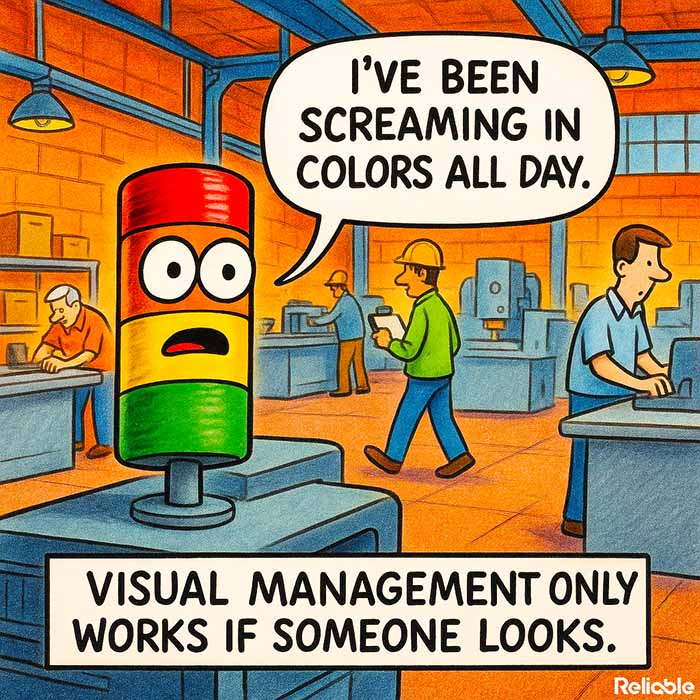

Stack lights flash. Andon boards update. Color-coded floor markings stretch across the shop floor like lanes on a highway. Every visual management best practices manufacturing guide starts with the same premise: make the abnormal visible so people can respond quickly. The trouble is, visibility alone accomplishes nothing if nobody is looking.
Visual signals are only as useful as the human response they trigger. Installing a stack light on every machine is a capital expense. Training people to act when that light changes color is an operational discipline, and the second part is where most programs stall.
Visual Management Best Practices Manufacturing Facilities Actually Follow
The best visual management systems share a few common traits. They’re simple, immediate, and tied to specific actions. A red stack light means “stop and call maintenance.” A yellow border on a gauge means “this reading is approaching the limit; increase your check frequency.” Green means “normal; move on.”
The best visual systems connect a signal to a specific action. If nobody knows what to do when the light turns red, the light is decoration.
That clarity matters because ambiguity kills response time. When a visual indicator could mean three different things depending on context, operators learn to ignore it. The signal becomes background noise within a few weeks.
Effective programs follow a handful of principles.
- One signal, one meaning. Every color, symbol, and position should map to exactly one condition and one expected response.
- Place indicators at the point of decision. A pressure gauge mounted on the mezzanine above a pump does nothing for the operator standing at floor level. Put the signal where the person who needs to act can see it without leaving their station.
- Set escalation timers. If a red condition goes unacknowledged for five minutes, the alert should escalate to a supervisor. Visual systems need a backup loop for the moments when people are busy, distracted, or between shifts.
The escalation timer is the mechanism most plants skip, and its absence is exactly why visual systems decay over time. Without a consequence for ignoring a signal, ignoring the signal becomes the default.
Visual management systems decay the moment ignoring a signal carries no consequence.
A food processing plant in Ohio reduced its average response time to equipment alerts from 23 minutes to under 4 minutes by adding one rule: any red stack light unacknowledged for 3 minutes triggered an automatic page to the shift lead. The technology was simple. The behavioral change was enormous.
Common Failures in Visual Management Programs
Knowing the visual management best practices manufacturing teams should follow is useful. Understanding why those practices break down is more useful.
Information Overload
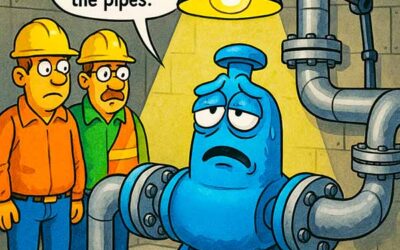
Some plants treat visual management like an all-you-can-eat buffet. Every wall has a board. Every machine has a light. Every aisle has color-coded tape for three different purposes. The result is sensory saturation: operators tune everything out because everything is screaming for attention at once.
The fix is aggressive prioritization. Limit visual indicators to conditions that require immediate human response. Everything else belongs in a CMMS dashboard or shift report, where it can be reviewed at a natural cadence rather than competing for attention on the shop floor.
When every indicator screams for attention, operators stop hearing any of them.
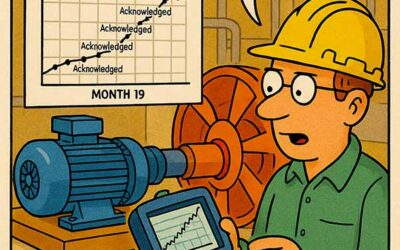
A good rule of thumb: if a visual indicator has been in yellow or red status for more than 48 hours without anyone acting on it, it should either be escalated or removed. Chronic alerts teach people that alerts are meaningless.
Static Boards That Never Update
Whiteboards with last month’s production numbers. Maintenance scheduling boards that haven’t been updated since the last audit. Safety scoreboards showing data from Q2.
Static visual tools lose credibility fast. If the information is stale, operators assume the entire system is stale, including the parts that might actually be current. Update cycles need to match the decision cycle. Daily metrics boards need daily updates. Real-time indicators need real-time data feeds.
- Assign a specific person to update each visual tool on a defined schedule.
- Audit visual tools monthly. Remove any that haven’t been updated or referenced in 30 days.
- Tie board updates to existing routines (shift handoff, morning standup, PM rounds) so the update happens naturally.
The autonomous maintenance model built into TPM programs gets this right: operators own their visual tools and update them as part of their daily routine, which keeps the data fresh and keeps the operator engaged with the information.
Making Visual Management Stick
The difference between a plant where visual management works and a plant where it’s performative comes down to one thing: accountability. Someone owns every signal. Someone responds to every alert. Someone reviews the system regularly and removes what stopped being useful.
Visual management works when someone owns every signal and someone responds to every alert, every time.
That’s a management discipline, and it requires the same kind of ongoing investment as any other reliability practice. The boards, lights, and floor markings are the cheap part. The daily attention they demand from supervisors, operators, and planners is what makes the system valuable, and it’s the first thing that erodes when leadership attention moves elsewhere.
Plants that sustain strong visual management programs treat them like living systems: regularly pruned, frequently updated, and always tied to actions that people are held accountable for completing.