
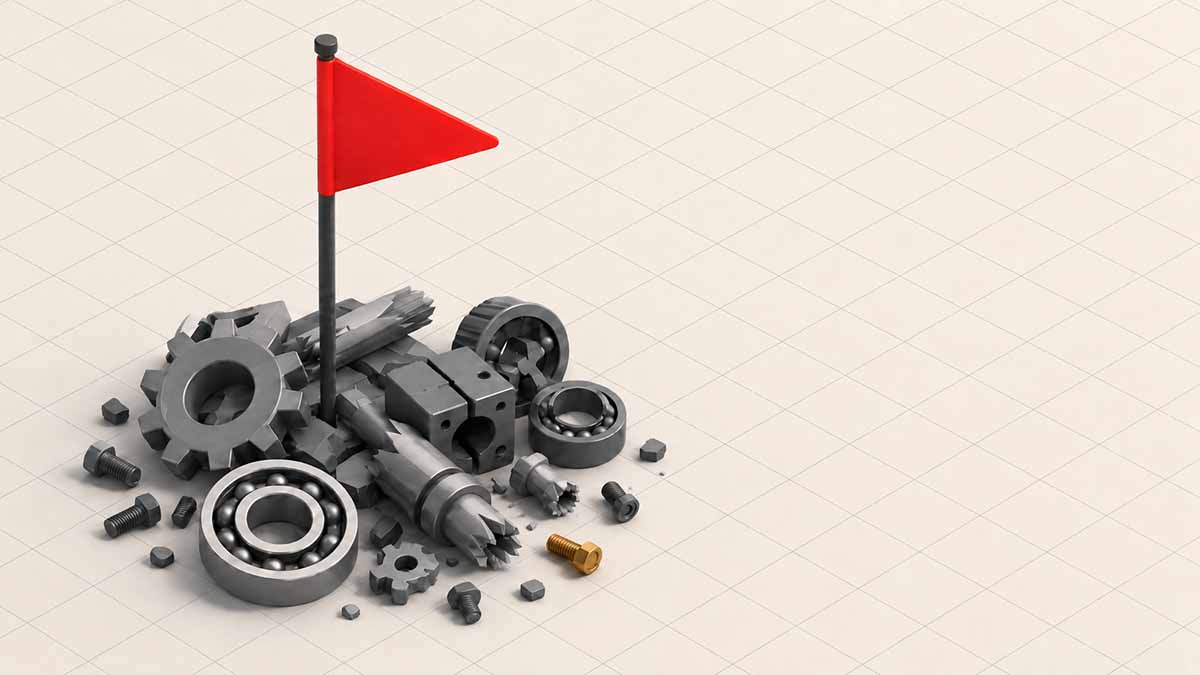

Every executive team in manufacturing claims reliability is a top priority. The slide deck says it. The wall posters say it. The town hall speeches say it. Then you walk the plant floor and see something else entirely.
Real support for reliability shows up in budget decisions, hiring choices, meeting agendas, and what gets celebrated at the end of the quarter. If your leadership team is paying lip service while quietly starving the program, the signs are everywhere. Here are 25 of them.
The Red Flags
- The reliability engineer reports three layers below the plant manager and gets pulled into expediting work every week.
- The annual budget process treats maintenance as a cost center to shrink, never as an investment to protect.
- Capital projects get approved without a single line item for spares, training, or commissioning support.
- The plant celebrates “great recoveries” from breakdowns more loudly than it celebrates avoided failures.
- Production targets get raised every year while maintenance headcount stays flat or shrinks.
- The phrase “we don’t have time for that right now” gets used to kill PM optimization, RCA follow-through, and precision maintenance training.
- Senior leaders can quote last month’s tonnage to the decimal but can’t name the reliability metrics for the plant’s most critical assets.
- Reliability meetings get rescheduled or cancelled whenever production has a bad day.
- The CMMS was purchased five years ago and still hasn’t been fully implemented, and nobody at the top is asking why.
- Outside contractors are used as a permanent substitute for developing internal capability.
- When equipment fails, the first question from leadership is “who screwed up” instead of “what did the system allow to happen.”
- Bonus structures reward this quarter’s output and ignore long-term asset health entirely.
- The storeroom hasn’t been cycle counted in over a year, and stockouts are treated as bad luck instead of a systemic failure.
- Reliability initiatives get launched with fanfare, then quietly die when the champion leaves or gets reassigned.
- Operators aren’t trained to perform basic equipment care, and nobody on the leadership team sees that as a problem.
- The plant manager walks past obvious leaks, vibration, and housekeeping issues without comment.
- Safety and reliability are talked about in the same breath until budget cuts, when reliability gets cut even when the same failures create safety exposure.
- The training budget disappears every Q4 and reappears at half its size every Q1.
- Component substitutions are approved on purchase price alone, without maintenance or reliability review.
- The site has no asset criticality ranking, or has one that hasn’t been updated since 2019.
- Root cause analysis recommendations sit in a spreadsheet for years with no funding and no follow-up.
- Leadership measures schedule compliance but ignores schedule quality, so the team games the metric to look good.
- The corporate office sends a reliability consultant every two years, listens to the report, and changes nothing.
- When a senior maintenance leader retires, the position gets eliminated or absorbed instead of refilled with the right person.
- The word “reliability” appears in every strategic document the company publishes, and not a single executive’s compensation is tied to it.
What Actually Counts as Support
Talk is cheap. Reliability requires upfront discipline, patience, and funding before the payoff is obvious, which is exactly why it gets shortchanged when leadership has to choose between this quarter’s number and next decade’s plant.
The plants that genuinely outperform their peers have leadership teams who fund reliability when it’s inconvenient, defend it when production is pushing back, and measure themselves on it when nobody’s watching. If your leadership team can’t pass that test, the red flags above describe where your plant already is, and where it will stay until something at the top changes.