
A reliability program can detect problems accurately and still fail to change anything, because knowing how to communicate reliability findings is a separate skill from producing them. The analysis may be sound and the recommendation reasonable, yet the response is still a shrug. The finding was heard and then quietly filed away. The cost of that disconnect can show up later as an outage or avoidable risk that nobody links back to the earlier warning.
This is one of the quieter failures in reliability work. The technical side can function as designed while the value never materializes because the findings do not move into a decision process. Closing that gap is a delivery problem as well as a data problem. A technically strong finding creates little maintenance value if its message dies in an inbox.
Why Accurate Findings Still Get Ignored
Findings get ignored for reasons that may have little to do with their technical quality. A strong report aimed at the wrong audience, or buried in jargon, forces a busy decision maker to translate it before acting. Clear language and a visible recommendation reduce that burden.
Timing and framing matter alongside content. A warning delivered as a bare data point, without a clear consequence attached, competes against the urgent demands already filling a manager’s day. It can read as information rather than as a decision that needs making. Framing connects the same data to a choice the listener can evaluate.
A finding that fails to say what to do, and what happens if nobody does it, is easy to nod at and forget.
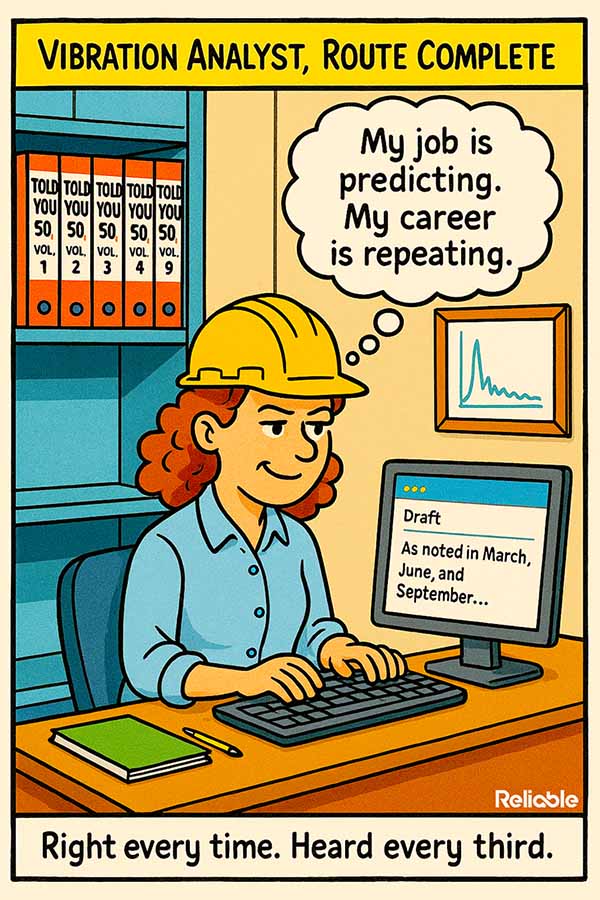
Repetition without escalation can become its own trap. An analyst who notes the same issue in March, June, and September, each time in the same channel and without a defined escalation path, can unintentionally signal that the warning does not require a decision. This is a common thread in why predictive maintenance programs fail.
The frustrating part is that detection may have worked as intended. The program identified a developing condition, yet the equipment still ran to breakdown because the message never crossed from the analyst’s screen into a decision that someone actually owned.
Speaking the Language of the Decision Maker
A finding travels further when it is framed in terms the audience already uses to make decisions. A plant manager often focuses on production, safety, quality, and cost risk; a maintenance manager on labor, work readiness, and schedule; and a finance leader on dollars, timing, and uncertainty.
Translating a vibration trend into those terms is where communication earns its keep. Saying that a bearing shows a developing fault may mean little to a non-specialist; saying the finding affects a critical line, the evidence is worsening, and an intervention or review window is recommended makes the decision clearer. If a time-to-failure estimate or outage cost is used, state the basis and uncertainty instead of presenting it as known.
- Name the asset’s role and the consequences of failure in production, safety, quality, environmental, or cost terms.
- Give a response or review window supported by the evidence, and distinguish it from a predicted time to failure.
- Compare the cost of acting with the cost or consequence scenarios of waiting, using ranges when uncertainty is material.
- State the recommendation plainly, in one sentence a non-specialist can repeat.
Framing findings around the metrics leaders already track sharpens the point further. Tying a recommendation to the maintenance kpis that actually matter helps it register as a business issue rather than as a technical footnote, provided the linkage is real and not forced.
How to Communicate Reliability Findings That Land
Knowing how to communicate reliability findings well often starts with leading from the conclusion. Decision makers usually benefit from seeing the recommendation, consequence, confidence, and required timing first, with the supporting analysis available behind it rather than a slow build toward a buried point.
Brevity respects the audience and can improve the odds of a response. A concise one-page or two-minute summary that states the problem, evidence, consequence, recommendation, confidence, and decision window is often easier to act on than a dense report. Technical detail can remain available for review without blocking the main decision.
The closer the recommendation is to the front of the report, the easier it is for a decision maker to see what requires action.
Channel matters alongside content. A high-risk finding should follow the site escalation process and often deserves a live conversation as well as an entry in the system. Matching the urgency of the message to the urgency of the medium helps signal how quickly it needs attention.
Confidence in the delivery counts, but so does calibrated uncertainty. An analyst should present the recommendation clearly, state the diagnostic confidence and assumptions, and avoid both vague hedging and false precision. Decision makers need to know what is known, what is inferred, and what remains uncertain.
Turning a Finding Into a Recommendation
A finding describes a condition; a recommendation asks for an action. The step between them is where some reports stop short, leaving the reader to decide what should happen next. Supplying a technically justified recommendation makes the requested decision clearer.
A strong recommendation is specific and bounded. It names the requested action, the response or review window, the reason, and the person or role expected to own the next step once the decision is made. It also separates what must happen now from what can be scheduled so the reader faces a clear choice rather than an open-ended concern.
- The single action being requested, stated directly, with confidence and uncertainty communicated separately.
- The deadline, review date, or response window in which the action needs to happen.
- The consequence of delay, expressed in terms the audience already values and supported by the available evidence.
- The role that should own the next step once the decision has been made.
Distinguishing real alarms from noise protects credibility over time. Being clear about diagnostic confidence, and transparent about predictive maintenance false alarms or uncertain diagnoses, helps keep recommendations from being discounted when a finding does not develop exactly as expected.
Building the Credibility That Makes Findings Stick
Communication improves with a calibrated track record behind it. When an analyst’s past recommendations have been technically sound, uncertainty has been stated honestly, and outcomes have been followed through, later findings carry more weight than a single report can earn on its own.
Building that record means closing the loop on both hits and misses. Following a recommendation through to its outcome, checking whether the diagnosis and timing were right, and learning when they were not turns individual findings into a steadily improving basis for trust.
Credibility is built when findings are clear, technically defensible, and followed through, which makes the next warning more likely to be taken seriously.
Relationships carry the message as much as the reports do. An analyst known and trusted by the decision makers gets a hearing that a stranger emailing a chart rarely will, and that access is worth cultivating deliberately over time.
Handled this way, communication stops being an afterthought bolted onto the analysis and becomes part of the reliability work itself. Plants that treat delivery as seriously as detection are better positioned to turn accurate findings into timely maintenance decisions and avoid or mitigate failures. Detection produces information; communication helps turn that information into action.