CMMS vs EAM: What’s the Difference, and Which One Do You Need?
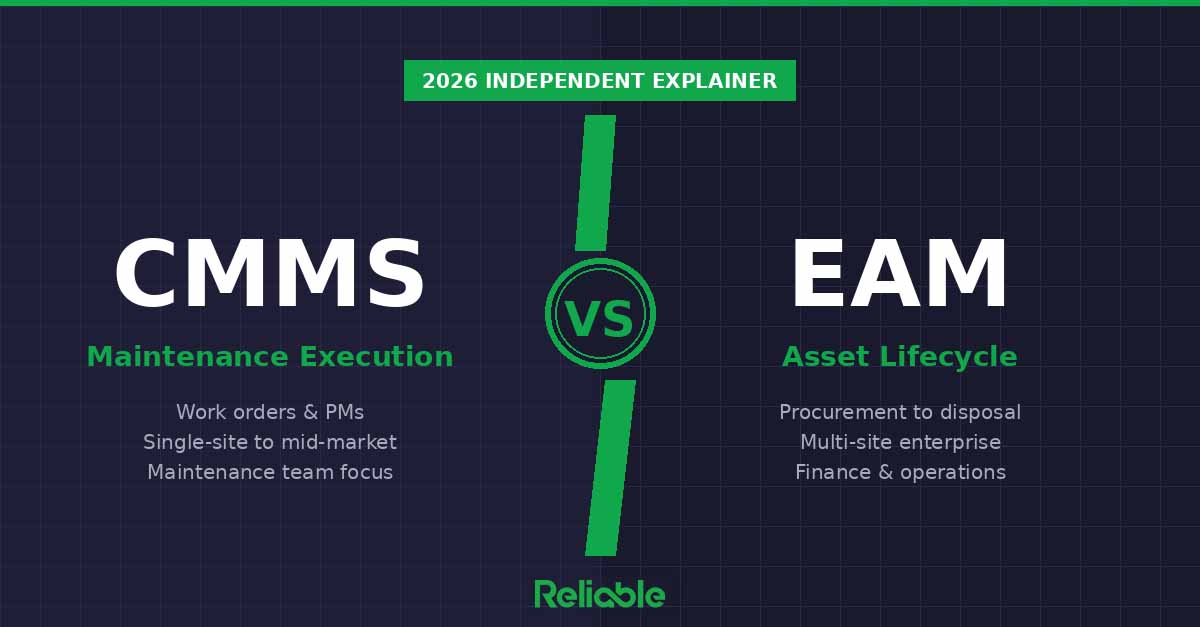
TL;DR: CMMS is software for executing maintenance - work orders, PMs, parts tracking, technician workflows. EAM is software for managing the full lifecycle of assets as financial resources - procurement, depreciation, capital planning, compliance, and disposal in addition to maintenance. Most single-site and mid-market plants need a CMMS. Multi-site enterprises with formal capital planning processes and finance-driven asset accountability need EAM. The categories overlap, and modern CMMS platforms have absorbed capabilities that used to be exclusive to EAM. The right choice depends on your scale, your stakeholders, and how you account for assets - not on which sales rep talked to you most recently.
Why This Question Has No Clear Answer Online
Search "CMMS vs EAM" and you will find a dozen vendor-published articles, every one of which conveniently defines the categories in a way that favors the vendor's own product. IBM defines EAM in a way that makes Maximo the natural choice. MaintainX defines CMMS in a way that makes MaintainX sufficient for almost any operation. SAP defines both categories in a way that makes their integrated platform the obvious answer.
This guide is independent editorial analysis. Reliable Magazine does not sell CMMS or EAM software and has no commercial interest in routing you toward one category or the other. Reliable does not accept payment for rankings. Vendors may sponsor enhanced listings with additional detail, but editorial rankings are independent. Read our editorial policy.
What CMMS Actually Is
CMMS stands for Computerized Maintenance Management System. The category emerged in the 1980s when maintenance teams started moving off paper work orders and into databases. Modern CMMS platforms handle the day-to-day execution of maintenance work:
Work order management - creating, assigning, completing, and tracking maintenance jobs
Preventive maintenance scheduling - calendar-based or meter-based PM triggers and recurring work
Asset tracking - equipment records, maintenance histories, and basic asset hierarchies
Parts and inventory management - spare parts, MRO inventory, and reorder triggers
Technician workflows - mobile work order completion, photo capture, time tracking
Reporting - KPIs like MTBF, MTTR, PM compliance, and labor utilization
The center of gravity for CMMS is the maintenance team. Planners build PM schedules. Technicians execute work orders. Supervisors track completion and performance. Reliability engineers analyze failure patterns. The CMMS exists to make maintenance work faster, more consistent, and more measurable.
What EAM Actually Is
EAM stands for Enterprise Asset Management. The category emerged in the 1990s as large industrial operations needed software that treated physical assets the way ERP systems treated inventory and finances - as strategic resources requiring lifecycle accountability, not just maintenance attention. Modern EAM platforms include all CMMS functionality and add:
Asset lifecycle management - tracking assets from procurement through disposal, including depreciation, transfers between sites, and end-of-life decisions
Capital planning - multi-year forecasting of asset replacement, refurbishment, and capital expenditure
Financial integration - native connectivity to ERP for accounting, depreciation schedules, and asset valuation
Compliance and risk management - formal audit trails, certification tracking, and regulatory reporting at enterprise scale
Multi-site enterprise management - consolidated visibility across dozens or hundreds of sites with role-based access controls
Procurement integration - vendor management, contract tracking, and purchase order workflows tied to asset records
The center of gravity for EAM is the enterprise. Maintenance teams use EAM, but so do finance teams, procurement teams, capital planning teams, compliance officers, and senior operations leaders. The EAM exists to treat physical assets as strategic financial resources across their entire useful life, not just to maintain them. EAM's value is not only financial. Putting maintenance, finance, procurement, and operations leadership in the same asset system is itself a reliability strategy - it prevents the fragmentation that lets asset accountability fall between departments. Reliability as a cross-functional culture, rather than a maintenance task, is easier to sustain when every stakeholder works from the same asset record.
Where the Categories Overlap
The honest answer to "what's the difference" is that the line has gotten blurry. Modern CMMS platforms have absorbed capabilities that used to be exclusive to EAM - multi-site management, deep asset hierarchies, ERP integration, and compliance documentation are all available in mid-market CMMS today. Modern EAM platforms have improved their work order and PM execution to match what CMMS does well.
The result is a continuum rather than a clean division. At one end, simple CMMS platforms aimed at single-site teams of fewer than 50 users. At the other end, full enterprise EAM platforms aimed at global operations with thousands of assets. In the middle, a large gray zone where both categories overlap and the right choice depends on stakeholder needs more than feature checklists.
Head-to-Head: CMMS vs EAM
| Dimension | CMMS | EAM |
|---|---|---|
| Primary user | Maintenance team | Maintenance, finance, procurement, planning |
| Asset focus | Maintenance and reliability | Full lifecycle: procurement to disposal |
| Scale | Single-site to mid-market multi-site | Multi-site enterprise to global |
| Financial integration | Optional, varies by platform | Native, deep ERP connectivity |
| Capital planning | Limited or absent | Multi-year forecasting and budgeting |
| Typical pricing | $20–$85 per user per month | $100+ per user per month, often custom enterprise |
| Implementation cost | Low five figures to mid six figures | Mid six figures to seven figures+ |
| Time-to-value | 2–12 weeks typical | 6–24 months for major rollouts |
| Examples | MaintainX, Limble, UpKeep, Coast | IBM Maximo, SAP EAM, Oracle EAM, Infor EAM |
Which One Do You Actually Need?
Choose CMMS if:
Your maintenance team is the primary user, with limited day-to-day input from finance or procurement
Capital planning happens in spreadsheets or a separate ERP, not in the maintenance system
Asset records don't need to serve as a financial source of truth across departments
Your operation is single-site or a small number of sites with similar workflows
You want to be productive in weeks, not months
Your budget for software is in the low five to mid six figures annually
You are moving off paper, spreadsheets, or a legacy maintenance system
Choose EAM if:
Finance, procurement, and capital planning teams need direct visibility into asset records — not reports forwarded by maintenance
Asset financial accountability is shared across departments, not owned solely by maintenance
Your operation spans multiple sites, or a single complex site with diverse stakeholder needs
You manage thousands of assets across multiple geographies and business units
You have formal capital planning processes that require multi-year asset forecasting
Compliance and audit requirements span multiple regulatory regimes
Your organization can support a 6 to 24 month implementation with significant change management
The Three Questions That Actually Matter
Most CMMS vs EAM debates get tangled in feature comparison. The decision is simpler than that. Three questions cut through the noise:
1. How many sites do you operate?
Single-site operations almost always need CMMS, not EAM. Multi-site operations need to ask the next question.
2. Who is accountable for asset financial performance?
If your maintenance manager is the only person who needs to see asset records, CMMS is sufficient. If your CFO, procurement director, and capital planning team also need direct access - not reports forwarded by maintenance - you probably need EAM.
3. Do you manage assets through their full lifecycle in software, or just maintain them?
If you procure assets through ERP, depreciate them through accounting, and dispose of them through a separate process, CMMS handles the maintenance piece adequately. If you want a single source of truth for the asset from purchase order through final disposal, you need EAM.
If you answered "single site," "maintenance only," and "just maintain them," you need CMMS. If you answered "many sites," "multiple stakeholders," and "full lifecycle," you need EAM. Many operations land cleanly on one side or the other once these questions are answered honestly, though a real gray zone exists for complex mid-market manufacturers where either category can work.
The Honest Middle Ground
Many operations that think they need EAM can be served by a strong mid-market CMMS with good ERP integration - particularly those without formal multi-stakeholder asset accountability. EAM platforms are designed for global enterprise complexity that most plants do not have, and the implementation overhead crushes value if you do not actually use the full lifecycle features. The largest CMMS platforms in 2026 - Limble, Fiix at the enterprise tier, eMaint at the enterprise tier - handle multi-site operations of meaningful scale without requiring a Maximo-class deployment.
On the other hand, operations that try to use CMMS where EAM is genuinely needed end up with maintenance teams in CMMS, finance teams in spreadsheets, and procurement teams in ERP - three sources of truth that disagree about basic facts like how many assets exist and what they're worth. The cost of that fragmentation is usually higher than the cost of an EAM platform, but it is hidden in productivity loss rather than visible as a line item.
The worst mistake is buying based on vendor positioning rather than stakeholder need. Talk to the people who will actually use the system - and the people who will demand reports from it - before you commit to either category.
Frequently Asked Questions
What is the difference between CMMS and EAM software?
CMMS (Computerized Maintenance Management System) focuses on day-to-day maintenance execution: work orders, preventive maintenance scheduling, parts tracking, and technician workflows. EAM (Enterprise Asset Management) encompasses CMMS functionality but extends to full asset lifecycle management — including procurement, depreciation, compliance, capital planning, and end-of-life decisions. CMMS is a tool for maintenance teams. EAM is a platform for organizations that manage assets as strategic financial resources across their entire lifecycle.
Do I need CMMS or EAM for my plant?
Most single-site and mid-market plants need a CMMS. Multi-site enterprises with complex asset portfolios, formal capital planning processes, and finance-driven asset accountability need EAM. The decision depends on three questions: How many sites do you operate? Who is accountable for asset financial performance — maintenance or finance? Do you need to track assets through procurement, depreciation, and disposal, or just maintain them? If maintenance execution is your primary need, choose CMMS. If full lifecycle asset management is your need, choose EAM.
Is EAM more expensive than CMMS?
Yes, generally. EAM platforms are typically priced for enterprise deployments and often start at $100 per user per month or higher, with significant implementation costs that can run into six or seven figures for major rollouts like IBM Maximo or SAP EAM. Mid-market CMMS platforms typically run $20 to $85 per user per month with implementation costs from low five figures to mid six figures. EAM costs more because it includes more functionality and supports larger, more complex deployments — but most operations do not need that depth.
Can a CMMS replace an EAM system?
For true enterprise deployments with thousands of assets across dozens of sites, formal capital planning processes, and finance-driven asset accountability, CMMS typically cannot replace EAM. There is no clean dividing line — the inflection point is usually about stakeholder scope and lifecycle accountability rather than asset count.
What are examples of CMMS and EAM platforms?
Common CMMS platforms include MaintainX, Limble, UpKeep, Coast, Fiix, and eMaint. Common EAM platforms include IBM Maximo, SAP EAM, Oracle EAM, Infor EAM, Hexagon EAM, and AVEVA. Some platforms span both categories — Fiix and eMaint, for example, scale from CMMS use cases into EAM territory at their enterprise tiers. Maximo and SAP EAM are pure EAM platforms designed for large enterprise deployments.
Can I migrate from CMMS to EAM as my organization grows?
Yes, but it is a significant project. Most organizations grow into needing EAM rather than starting there — beginning with a CMMS that fits their current state and migrating to EAM when complexity, multi-site scale, and finance-driven asset accountability outgrow the CMMS. Plan for six to twelve months of migration work, including data transfer, integration reconfiguration, and process redesign. Some CMMS vendors (Fiix, eMaint) make this easier by offering enterprise tiers that bridge into EAM functionality without a full platform replacement.
Related Guides
Sources
Vendor product documentation from MaintainX, Limble, UpKeep, Coast, Fiix, eMaint, IBM Maximo, SAP EAM, Oracle EAM, and Infor EAM
G2 and Capterra category data for CMMS and EAM software (April 2026)
Reliable Magazine independent product demos and editorial analysis
Last updated: April 21, 2026. This explainer is editorial analysis by Reliable Magazine. No vendor paid for inclusion or editorial input.