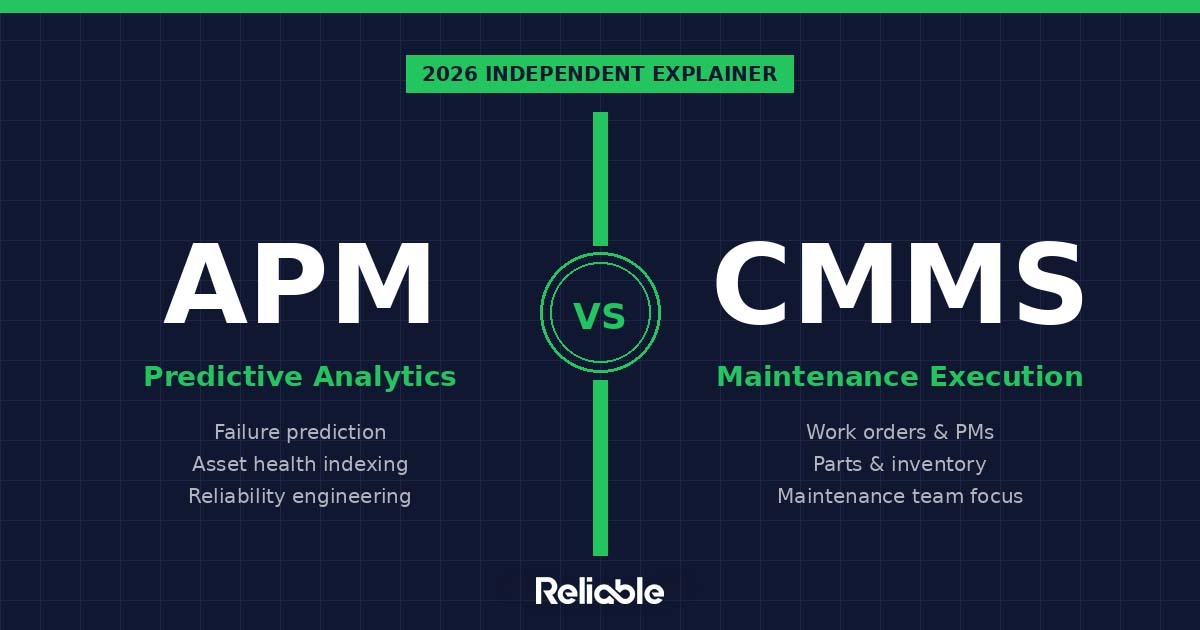

TL;DR: APM and CMMS solve different problems at different layers of the asset reliability stack. APM (Asset Performance Management) is the analytics and predictive intelligence layer – it analyzes condition data, predicts failures, and recommends interventions. CMMS (Computerized Maintenance Management System) is the execution layer – it routes work orders, schedules PMs, manages parts, and documents maintenance history. APM is the brain. CMMS is the hands. They integrate bidirectionally: APM recommendations become CMMS work orders, and CMMS execution data feeds back into APM models. Most mature reliability operations need both, but the right sequencing is CMMS first and APM second. Operations that try to skip the CMMS step typically end up with predictive dashboards that nobody acts on. The right path is CMMS to build maintenance discipline, then condition monitoring to capture data, then APM to analyze it.
The Short Answer
APM tells you what to do. CMMS tracks that it got done.
If you only remember one thing from this explainer, remember the role distinction. APM operates at the analytical layer – it takes condition data from sensors, historians, and IIoT platforms, applies statistical models or AI, and produces predictions and recommendations about what maintenance should be done. CMMS operates at the execution layer – it takes those recommendations (or scheduled PMs, or breakdown calls, or operator requests) and orchestrates the actual maintenance work. APM is analytical; CMMS is operational. Both are needed for serious reliability programs, but they do fundamentally different things.
Why the Confusion Exists
The categories blur for four reasons. First, APM vendors increasingly include CMMS-lite work order modules in their platforms. GE Vernova APM Health, AVEVA APM, and Bentley AssetWise APM all include basic execution capabilities that look like CMMS from the outside. Buyers reading APM vendor marketing sometimes conclude that APM replaces CMMS, which it generally doesn’t for operations with serious maintenance teams.
Second, CMMS vendors increasingly add predictive maintenance and AI capabilities. Limble, MaintainX, and Fiix have all rolled out predictive features in recent years – anomaly detection, condition-based PM triggers, AI-driven recommendations. These features handle simple predictive scenarios but generally don’t match dedicated APM platforms in depth. The marketing positioning makes CMMS look like APM, which it generally isn’t at any serious analytical level.
Third, vendors like Tractian deliberately blur the line by bundling CMMS, sensors, and AI predictive analytics in one platform. This is operationally compelling for the right buyer – single-vendor accountability, integrated workflows, faster time-to-value – but creates category confusion in the broader market because Tractian markets itself as both CMMS and APM simultaneously.
Fourth, EAM platforms like IBM Maximo, SAP S/4HANA, and Hexagon EAM include both APM and CMMS modules as part of broader asset management suites. This is technically integration rather than replacement – the modules are distinct, with different data models and different operational purposes – but the marketing makes the categories look identical because they ship together.
What APM Does
APM operates at the analytical and predictive intelligence layer of the asset reliability stack. The core capabilities are:
- Asset health indexing – aggregating condition data from multiple sources (vibration, temperature, oil analysis, ultrasonic, motor circuit analysis, process data) into composite health scores at the asset and component level
- Failure prediction – applying statistical models, reliability engineering methods, or AI to predict when assets will fail based on current condition and operating context
- Risk-based decision support – quantifying the consequences of failure and the probability of failure to support inspection, maintenance, and replacement decisions
- Reliability-centered maintenance integration – supporting RCM analysis, criticality assessment, failure mode and effects analysis (FMEA), and PM program optimization
- Anomaly detection – identifying deviations from normal operating patterns that may indicate developing failures before traditional condition monitoring thresholds are exceeded
- Lifecycle cost modeling – calculating total cost of ownership across maintenance, replacement, and operational performance to support capital planning
- Maintenance recommendation generation – translating analytical outputs into specific maintenance actions with priority, urgency, and recommended interventions
APM is the system of record for asset reliability intelligence. It owns the analytical view of asset condition that CMMS execution data cannot produce alone. The major APM platforms covered in our APM guide include GE Vernova APM, AVEVA APM, Bentley AssetWise APM, IBM Maximo APM, and emerging AI-driven platforms like Augury, Senseye (Siemens), and AspenTech Mtell.
What CMMS Does
CMMS operates at the maintenance execution layer. The core capabilities are:
- Work order management – request-to-completion workflow for repair work orders, planned maintenance, and inspections with technician assignment and parts allocation
- Preventive maintenance scheduling – calendar-based, meter-based, and condition-based PM triggers with route-based scheduling for maintenance technicians
- Asset management and history – equipment hierarchy, asset records, full maintenance history, repair documentation, and failure analysis
- Parts and inventory management – spare parts inventory, reorder points, parts consumption tracking, and supplier management
- Mobile technician execution – work order completion in the field, photo capture, time tracking, parts checkout, and signature capture
- Maintenance KPIs – MTBF, MTTR, PM compliance, schedule adherence, and maintenance cost per asset
- Compliance documentation – calibration records, inspection logs, regulatory documentation for industries where maintenance is regulated
CMMS is the system of record for maintenance execution. It owns the maintenance history of every asset – every PM completed, every repair performed, every part consumed – that drives operational decisions and feeds reliability analysis. The major CMMS platforms covered in our CMMS guide include MaintainX, Limble, eMaint, Fiix, UpKeep, and Coast.
Side-by-Side Comparison
| Dimension | APM | CMMS |
|---|---|---|
| Primary Function | Predictive analytics | Maintenance execution |
| Primary Question | What will fail and when? | How is maintenance getting done? |
| Layer | Analytical / intelligence | Operational / execution |
| Primary Outputs | Predictions, recommendations, health indices | Work orders, history, KPIs |
| Primary Users | Reliability engineers, planners | Maintenance technicians, supervisors |
| Data Sources | Sensors, historians, IIoT, condition monitoring | Work orders, parts, technician input |
| Time Horizon | Days to months (forward-looking) | Hours to weeks (current and historical) |
| Typical Vendors | GE Vernova, AVEVA, Bentley, Augury, Senseye | MaintainX, Limble, eMaint, Fiix, UpKeep |
| Implementation | 6-24 months (data + models) | 2 weeks to 6 months |
The Overlap Zone (and Where Vendors Confuse Buyers)
Three areas of legitimate overlap between APM and CMMS create most of the buyer confusion.
Work order generation from analytics. APM’s primary output is recommendations, and recommendations frequently translate into work orders. The handshake is real and operationally important. Vendors marketing APM platforms with bundled work order modules sometimes suggest the bundle replaces CMMS. It generally does not. APM-bundled work order modules handle simple cases – when APM recommends an inspection, the bundle creates a work order – but they rarely match dedicated CMMS depth on PM scheduling, parts management, technician execution, or maintenance history. The right architecture is APM generating recommendations that flow into a dedicated CMMS, not APM trying to handle execution itself.
Reliability KPIs. Both systems produce reliability KPIs but at different levels. CMMS produces execution KPIs from work order data – MTBF, MTTR, PM compliance, schedule adherence. APM produces predictive and risk-based KPIs from analytical data – asset health indices, predicted remaining useful life, failure probability, risk-based prioritization. These overlap but don’t substitute for each other. A reliability program needs both. Operations that try to extract APM-level reliability intelligence from CMMS data alone end up with descriptive analytics rather than predictive intelligence.
Asset hierarchy and master data. Both systems track equipment, both maintain asset hierarchies, and both need consistent IDs across the same physical assets. APM tracks assets for analytical purposes – health, criticality, predicted failure modes. CMMS tracks assets for execution purposes – maintenance history, parts allocation, work order routing. The right architecture aligns the asset master between systems through scheduled sync or API integration, with one system designated as the master (typically CMMS, because the maintenance team owns the asset records most rigorously).
How APM and CMMS Integrate
Integration between APM and CMMS happens at three primary handshake points. Each one is operationally important and each one is commonly underestimated during procurement.
The recommendation-to-work-order handshake. When APM identifies a developing failure or maintenance need, the recommendation should generate a CMMS work order with appropriate priority, estimated parts, and estimated labor. Done well, this means a vibration anomaly detected by APM at 2 a.m. becomes a planned work order in CMMS by 6 a.m. – sized, parts-staged, and ready for technician dispatch. Done poorly, the recommendation lives in APM dashboards that maintenance planners check occasionally, the work doesn’t get scheduled, and the asset fails despite the prediction. The integration quality at this handshake is the most consequential factor in whether APM produces operational value or remains a reporting layer.
The execution-data feedback handshake. CMMS work order completion data should flow back into APM models. When a recommended action is completed – a bearing replaced, an alignment performed, a lubricant changed – APM should update its predictions based on the actual maintenance and observed outcome. Without this feedback, APM models drift from operational reality and predictions degrade over time. The feedback loop is what allows APM models to improve through real operational data rather than remain static at deployment baseline.
The asset master handshake. Both systems need to reference the same physical equipment with consistent IDs. The asset master integration aligns the equipment hierarchy so a pump in APM is the same pump in CMMS, including the same component breakdown, the same criticality classification, and the same parent-child relationships. Without alignment, APM analytics and CMMS work orders cannot be correlated, and reliability analysis breaks across system boundaries. The right architecture typically designates CMMS as the asset master and replicates to APM through scheduled sync or API integration.
Modern integrations use middleware platforms (MuleSoft, Boomi, webMethods) or direct API connections. The major APM vendors all support standard CMMS integration patterns, though the integration depth varies considerably. Operations should validate integration quality during procurement rather than assume support – APM platforms with deep native CMMS integrations (GE Vernova APM with IBM Maximo, AVEVA APM with multiple CMMS) generally outperform platforms with generic API support.
When CMMS Alone Is Enough
Most operations starting out need CMMS but not APM. This is more common than buyers realize:
- Operations without significant condition monitoring – APM analyzes condition data, and operations without sensors, historian data, or condition monitoring programs have no data to feed APM
- Operations with reactive maintenance cultures – APM produces predictions, but predictions only create value if the operation acts on them. Reactive operations should fix the maintenance discipline first
- Smaller operations with under approximately 1,000 critical assets, where the APM business case is weakened by limited prediction surface area
- Operations early in their reliability journey – typically the first 12 to 24 months after deploying CMMS, where the maintenance discipline isn’t yet mature enough to act on predictive recommendations
For these operations, CMMS handles maintenance management adequately on its own. PM programs based on calendar or meter triggers, condition-based PMs from sensor inputs where deployed, and reactive work orders from operator requests cover the operational scope. Adding APM at this stage typically produces dashboards that nobody acts on rather than operational improvement.
When You Need APM
APM becomes valuable when several conditions are met simultaneously:
- Condition monitoring is already in place at scale – vibration sensors, oil analysis programs, thermal imaging routes, ultrasonic surveys, motor circuit analysis. APM analyzes data; without data, there’s nothing to analyze
- The operation has CMMS discipline – work orders get completed, PMs get done on schedule, maintenance history is accurate. APM recommendations require execution capability to create value
- The assets are capital-intensive enough to justify prediction – APM business cases work best when individual asset failures cost six or seven figures in lost production, replacement, or safety consequences
- Reliability engineering is a serious function – APM platforms produce analytical outputs that require reliability engineering interpretation. Operations without dedicated reliability resources rarely extract full APM value
Industries where APM typically delivers strong ROI include power generation (turbine reliability), oil and gas (rotating equipment, mechanical integrity), mining (haul truck and shovel availability), chemical and refining (process equipment), and aerospace (engine and component lifecycle). Operations in these industries with mature CMMS deployments typically benefit substantially from APM addition. Operations without these characteristics often find APM premature.
When You Need Both
Most mature reliability operations need both APM and CMMS. The scenarios where both are effectively required:
Capital-intensive operations with predictive maturity. Operations with expensive equipment, established condition monitoring, mature CMMS discipline, and reliability engineering function need both systems. The integration between them – APM recommendations flowing into CMMS work orders, CMMS execution data flowing back into APM models – is what makes serious reliability programs work.
Regulated industries with mechanical integrity programs. Oil and gas, chemical, pharmaceutical, and aerospace operations with mechanical integrity (MI) programs under OSHA PSM, FDA validation, or API standards typically need APM for risk-based inspection methodology and CMMS for execution. The compliance burden of MI programs is difficult to manage with CMMS alone and impossible to satisfy with APM alone.
Operations pursuing reliability-centered maintenance (RCM). RCM methodology requires both analytical capability (FMEA, criticality analysis, P-F curve analysis) that APM provides and execution capability (PM program optimization, work order management) that CMMS provides. Operations seriously implementing RCM typically deploy both.
Mature operations. Most operations that have been running professional reliability programs for more than 5 years have both systems, even if the implementations are imperfect. Operations without both at this scale typically have an undermanaged side – usually APM, because the analytical capability is harder to mature than the execution capability.
If You Only Have Budget for One: Start with CMMS
For most operations building toward both systems, CMMS comes first. The reasoning is straightforward. APM produces predictions and recommendations; without CMMS infrastructure to execute them, the predictions create reports rather than operational value. CMMS is also typically lower cost than APM, with faster implementation timelines (weeks to months versus months to years) and quicker time-to-value.
The right sequence for most operations is:
- Deploy CMMS and build maintenance discipline. Get work orders flowing through the system, get PMs completed on schedule, get the asset hierarchy clean. Run for 12 to 24 months minimum to develop maintenance habits and accurate data.
- Deploy condition monitoring on critical assets. Vibration, temperature, oil analysis, ultrasonic surveys, depending on the asset class. Get the sensors and survey routes producing reliable data flowing into a historian or IIoT platform.
- Add APM to analyze the condition data and produce predictions. Integrate APM recommendations into CMMS work order workflows. Close the feedback loop so CMMS execution data flows back into APM models.
The wrong sequence is implementing APM before CMMS discipline exists, or before condition monitoring is captured at scale. APM platforms deployed against weak CMMS discipline typically produce dashboards that nobody acts on. APM platforms deployed without condition monitoring data underneath produce predictions that have nothing to predict from. Both failure modes are common in vendor-driven APM deployments where the sales cycle outpaces the buyer’s operational maturity.
The exception is condition monitoring service companies. Many operations effectively get APM-as-a-service from third parties – vibration analysis services, oil analysis labs, thermal imaging contractors – who deliver predictions and recommendations to operations with their own CMMS. This is a valid path that doesn’t require deploying APM software directly. For operations that aren’t ready to deploy APM software but need predictive intelligence, contracting condition monitoring services is often the right interim approach.
The Honest Middle Ground
APM and CMMS selection is a category where overbuying on APM is the most common procurement mistake. A few honest assessments worth flagging.
The AI hype creates premature APM deployments. Vendors selling AI-driven APM emphasize the technology rather than the operational prerequisites, and buyers sometimes deploy APM because the AI capabilities sound compelling. Without condition monitoring data underneath and without CMMS discipline to act on recommendations, the AI has nothing to analyze and nothing to drive. Operations that deploy APM in this context typically discover the implementation produces dashboards rather than operational value, and the platform becomes shelfware.
APM-bundled CMMS-lite is rarely enough for serious operations. Vendors selling APM platforms with bundled work order modules sometimes position the bundle as a single-platform replacement for both APM and CMMS. The work order modules are real but generally lack the depth of dedicated CMMS for serious maintenance teams. Operations with maintenance teams of more than approximately 10 technicians typically find APM-bundled work order capabilities inadequate for ongoing operations.
CMMS predictive features rarely substitute for APM. Modern CMMS platforms market AI-driven predictive maintenance features, and the features are increasingly capable for simple use cases. But CMMS predictive capabilities generally don’t match dedicated APM for serious analytical depth — statistical reliability modeling, multi-source data fusion, risk-based decision support. Operations needing serious APM capability typically deploy dedicated platforms regardless of CMMS predictive features.
The Tractian-style bundled approach is right for some operations. Tractian and similar vendors that bundle CMMS, sensors, and AI predictive analytics into integrated platforms work well for specific buyer profiles – operations needing fast time-to-value, lacking integration resources, and with simple-to-moderate maintenance complexity. The bundled approach is wrong for operations with existing CMMS investments, complex integration requirements, or serious analytical needs that exceed the bundle depth. The decision depends on operational starting point and complexity.
Frequently Asked Questions
What is the difference between APM and CMMS?
APM is the analytics and predictive intelligence layer that tells you what will fail, when, and why. APM aggregates condition monitoring data, applies statistical models or AI, produces health indices, predicts failures, and recommends interventions. CMMS is the execution layer that captures how maintenance gets done. CMMS routes work orders, schedules preventive maintenance, manages parts inventory, and documents maintenance history. APM is the brain. CMMS is the hands. APM tells you to do maintenance. CMMS tracks that maintenance got done.
Do I need both APM and CMMS?
Most mature reliability operations need both, but the right sequencing is CMMS first and APM second. CMMS is required for any operation with maintenance teams, work order management, or PM programs. APM becomes valuable when condition monitoring data is already being captured at scale and the operation has the maintenance discipline to act on predictive recommendations. Operations starting out should implement CMMS first, build maintenance discipline for 12 to 24 months, deploy condition monitoring on critical assets, then add APM to analyze the data.
Can APM replace CMMS?
Generally no. APM platforms increasingly include CMMS-lite work order modules, but these handle simple cases and rarely match dedicated CMMS platforms on PM scheduling depth, parts inventory management, technician mobile execution, or maintenance history workflows. Operations with serious maintenance teams almost always deploy a dedicated CMMS or EAM alongside APM rather than relying on APM-bundled execution.
Can CMMS replace APM?
No, though many CMMS platforms now include predictive maintenance features that approximate basic APM functionality. CMMS predictive features handle simple predictive scenarios but generally do not replace dedicated APM platforms for operations requiring statistical reliability modeling, advanced failure mode analysis, multi-source data fusion, or risk-based decision support.
Should I implement APM or CMMS first?
For almost all operations, CMMS comes first. APM produces predictions and recommendations that require maintenance execution capability to act on. Without CMMS infrastructure – work order workflow, technician mobile execution, parts management, asset hierarchy – APM recommendations cannot become work that actually gets done. The right sequence is CMMS first, condition monitoring deployment second, and APM third.
How do APM and CMMS integrate?
Integration happens at three primary handshake points. The recommendation-to-work-order handshake converts APM predictions into CMMS work orders. The execution-data feedback handshake flows CMMS completion data back into APM models. The asset master handshake aligns equipment hierarchy across both systems. Modern integrations use middleware platforms or direct API connections.
What is the difference between APM and predictive maintenance?
APM is the broader category that includes predictive maintenance as one component. Predictive maintenance specifically focuses on predicting equipment failures from condition data. APM includes predictive maintenance plus broader capabilities: asset health indexing, risk-based decision support, reliability-centered maintenance integration, criticality analysis, and lifecycle cost modeling. In vendor marketing the terms are often used interchangeably, but APM is technically the parent category.
Related Guides
- Best CMMS Software 2026: Independent Comparison
- Best Asset Performance Management Software 2026
- CMMS vs EAM: What’s the Difference, and Which One Do You Need?
- MES vs CMMS: What’s the Difference, and Which One Do You Need?
- MES vs ERP: What’s the Difference, and Which One Do You Need?
- How to Calculate OEE: Methodology and Worked Examples
Sources
- GE Vernova APM product documentation – gevernova.com
- AVEVA Asset Performance Management documentation – aveva.com
- Bentley AssetWise APM documentation – bentley.com
- IBM Maximo APM documentation – ibm.com
- Augury product documentation – augury.com
- Senseye (Siemens) product documentation – siemens.com
- AspenTech Mtell product documentation – aspentech.com
- MaintainX product documentation – getmaintainx.com
- Limble CMMS product documentation – limblecmms.com
- eMaint product documentation – emaint.com
- SMRP Best Practices – Society for Maintenance and Reliability Professionals
- ISO 55000 Asset Management standard
- Reliable Magazine independent editorial analysis
Last updated: April 29, 2026. This guide is editorial analysis by Reliable Magazine.