MES vs ERP: What’s the Difference, and Which One Do You Need?
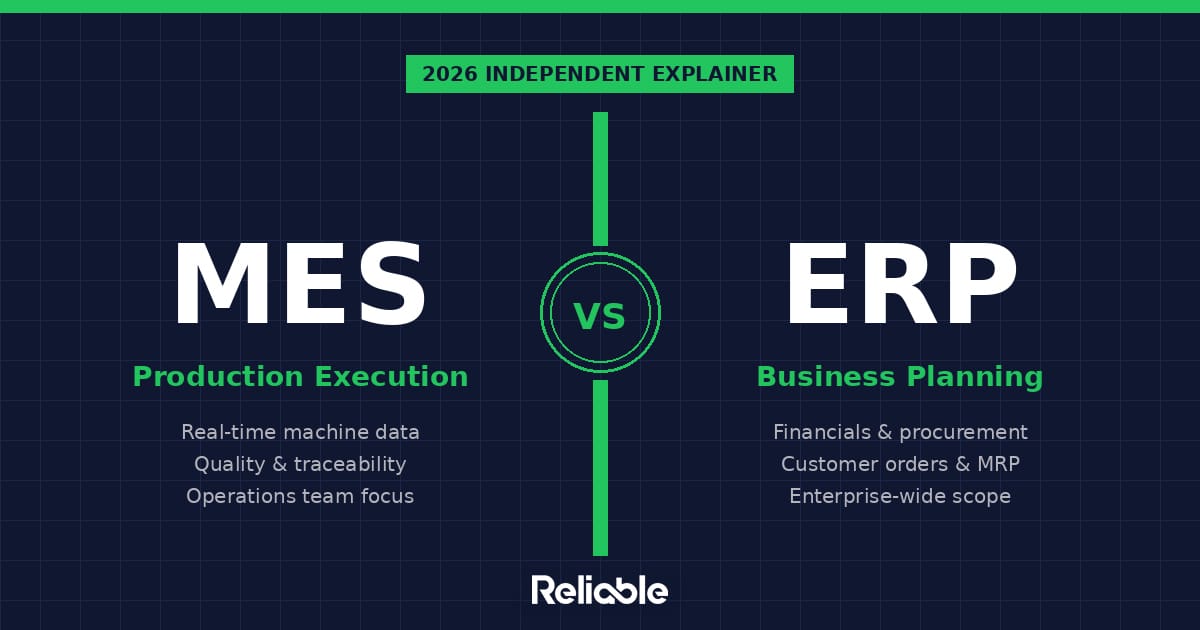
TL;DR: ERP and MES sit at different levels of the manufacturing operations stack and solve different problems. ERP (Enterprise Resource Planning) operates at the business level - financials, procurement, supply chain, customer orders, and material requirements planning - answering what to make, when, and at what cost. MES (Manufacturing Execution System) operates at the shop floor level - real-time machine data, work order execution, quality, traceability, and operator instructions - answering whether what was planned is actually getting made correctly. Most serious manufacturers need both. ERP releases work orders down to MES; MES executes production and reports actuals back to ERP. The ISA-95 standard defines this integration. Choose ERP for business operations, MES for production execution, and integrate them through standard connectors. Trying to use ERP alone for production execution generally fails for any operation with quality requirements, regulatory traceability, or OEE measurement needs.
The Short Answer
ERP tells the plant what to make. MES makes sure it gets made correctly. ERP plans the business; MES executes the production. They are complementary systems that integrate with each other, and most manufacturing operations above the smallest scale need both.
If you only remember one thing from this explainer, remember the time horizon. ERP works in business time - hours, days, weeks, months. MES works in production time - seconds and minutes. That single distinction explains nearly every other difference between the two systems.
Why the Confusion Exists
The categories blur for three reasons. First, ERP vendors include shop floor control modules in their platforms, which look like MES from a marketing perspective but generally fall short in practice for serious production execution. SAP's Production Planning module, Oracle's Manufacturing Cloud, and Microsoft Dynamics 365's Supply Chain Management all include shop floor functionality that some manufacturers attempt to use in place of dedicated MES.
Second, MES vendors increasingly position their platforms as broader manufacturing operations management (MOM) systems that handle capabilities historically owned by ERP - production scheduling, inventory management, labor tracking. The category boundaries are real, but the marketing language obscures them.
Third, the underlying ISA-95 standard that defines where each system sits is well known to manufacturing IT leaders but rarely understood by business stakeholders making the buying decision. Without the framework, ERP and MES can sound like they do the same thing, which leads to procurement decisions based on vendor positioning rather than functional fit.
The ISA-95 Framework: Where Each System Sits
ISA-95 is the international standard for enterprise-control system integration. It defines five levels of manufacturing operations:
Level 0 - The physical process: sensors, motors, valves, the actual equipment
Level 1 - Sensing and manipulation: PLCs, control loops, basic device control
Level 2 - Supervisory control: SCADA, HMI, DCS, batch control
Level 3 - Manufacturing operations management: this is where MES lives
Level 4 - Business planning and logistics: this is where ERP lives
Level 3 (MES) operates on a time horizon of seconds to hours and manages production execution, dispatching, quality, and tracking. Level 4 (ERP) operates on a time horizon of hours to months and manages business operations including financials, procurement, sales orders, and capacity planning. The boundary between Level 3 and Level 4 is where MES and ERP integrate.
This is not academic. The ISA-95 framework is how manufacturing IT architecture is actually designed. When a manufacturer says they have an MES, they mean a Level 3 system. When they say they have an ERP, they mean a Level 4 system. Vendors that blur this line — particularly ERP vendors that claim their shop floor module replaces MES — are usually selling against the framework rather than within it.
What ERP Does
ERP manages business-level operations across the entire enterprise. The core capabilities are:
Financials - general ledger, accounts payable and receivable, fixed assets, financial reporting
Procurement and supply chain - purchase orders, supplier management, inventory across the supply chain, logistics
Customer orders and revenue - sales order management, pricing, customer master, invoicing
Material requirements planning (MRP) - translating customer demand and forecasts into production and procurement plans
Capacity planning - long-range capacity decisions across plants, lines, and equipment
Workforce management - HR, payroll, labor planning at the enterprise level
ERP is the system of record for the business. It owns the master data - customers, suppliers, materials, financials - that the rest of the manufacturing technology stack depends on. The major manufacturing ERP platforms covered in our ERP for manufacturing guide include SAP S/4HANA, Oracle Cloud SCM, Microsoft Dynamics 365, Epicor Kinetic, and Infor LN, among others.
What MES Does
MES manages production execution on the shop floor. The core capabilities are:
Production order execution - releasing work to lines and machines, dispatching, sequencing, and routing in real time
Real-time machine data integration - connecting to PLCs, SCADA, and historians to capture machine state, cycle counts, and equipment events
Quality management - in-process quality checks, statistical process control, non-conformance handling, hold and release
Traceability and genealogy - tracking what materials went into what products, on which equipment, by which operators, at what time
Electronic batch records and work instructions - guiding operators through production steps, capturing electronic signatures, producing audit-ready documentation
OEE and production performance - measuring availability, performance, and quality in real time, with downtime reasons and root cause analysis
Labor and material tracking - capturing actual labor hours and material consumption against work orders
MES is the system of record for production. It owns the data about what actually happened on the shop floor - cycle times, quality events, downtime, scrap, operator activity, machine state - at a level of granularity that ERP cannot match. The major MES platforms covered in our MES platforms guide include Plex (Rockwell), Siemens Opcenter, GE Vernova Proficy, Tulip, Aegis FactoryLogix, and Critical Manufacturing.
Side-by-Side Comparison
| Dimension | ERP | MES |
|---|---|---|
| ISA-95 Level | Level 4 (Business) | Level 3 (Operations) |
| Time Horizon | Hours to months | Seconds to hours |
| Primary Question | What should we make and when? | Are we making it correctly right now? |
| Primary Users | Finance, supply chain, planners | Operators, supervisors, quality |
| Data Source | Business transactions | Machines, sensors, operators |
| Data Granularity | Order and work-order level | Operation, cycle, and unit level |
| Scope | Enterprise-wide | Plant or line-specific |
| Typical Vendors | SAP, Oracle, Microsoft, Epicor | Plex, Siemens Opcenter, Proficy, Tulip |
| Implementation | 12-36 months for enterprise | 3-24 months depending on scope |
The Overlap Zone (and Where Vendors Confuse Buyers)
Three areas of legitimate overlap between MES and ERP create most of the buyer confusion:
Production scheduling. ERP includes basic production scheduling at the master schedule level - typically week-by-week or day-by-day capacity planning. MES handles detailed dispatching at the operation level, sequencing work across machines and operators in real time. Some MES platforms (and dedicated APS systems) handle finite scheduling that ERP cannot. The right architecture in most operations is ERP setting the master schedule, MES executing the detailed schedule, and APS layered in if scheduling complexity warrants it.
Inventory management. ERP owns enterprise inventory - raw materials in the warehouse, finished goods in distribution, work-in-progress at a high level. MES tracks production-floor inventory at the granularity of individual containers, tanks, and staging locations - including in-process material being transformed by production. The right boundary is usually ERP for any inventory that lives outside production, MES for material that is in active production. The handshake between them happens at material issue and goods receipt transactions.
Work order management. ERP releases work orders to the plant. MES executes them. The work order in ERP is a planning document; the work order in MES is an execution document with operations, routing steps, machine assignments, quality checks, and operator instructions. Vendors sometimes describe ERP shop floor modules as "work order management" in a way that suggests MES capabilities, but the depth of execution support is generally different.
How MES and ERP Integrate
The integration is bidirectional and follows the ISA-95 framework. ERP sends production information down to MES, MES sends actuals back up to ERP.
What ERP sends to MES:
Released work orders with header information
Bills of materials (BOMs) and routings
Material master data and item specifications
Customer order references for traceability
Master scheduling information
What MES sends to ERP:
Production confirmations (quantities produced, completed operations)
Material consumption (actual quantities used against BOMs)
Labor hours and machine time
Scrap and rework quantities
Quality holds and release decisions
Inventory movements (goods receipt, material issues)
The integration is typically built using standard middleware - SAP MII for SAP integrations, Oracle MES Integration for Oracle, or generic platforms like MuleSoft, Boomi, and webMethods for cross-vendor scenarios. ISA-95 Part 5 defines B2MML (Business to Manufacturing Markup Language), the standard XML schema for these data exchanges. Modern MES platforms support B2MML out of the box. The integration quality is one of the most important factors in MES selection because poor ERP-MES integration creates duplicate data entry, reporting discrepancies, and operational friction that undermines both systems.
When ERP Alone Is Enough
Some manufacturers operate on ERP alone with manual or semi-automated shop floor controls. This works in specific situations:
Small discrete manufacturers with simple operations, low quality requirements, and no regulatory traceability needs - typically under 50 employees with single-line or job-shop production
Engineer-to-order operations with low volume and high custom content, where each project is essentially unique and traceability is documented at the project level
Distribution and light assembly operations where the manufacturing component is simple kitting or final assembly without complex production execution
For these operations, the ERP shop floor module - SAP Production Planning, Oracle Manufacturing Cloud, Dynamics 365 SCM Production Control, Epicor Kinetic Production Management - handles work order release, basic dispatching, and labor reporting. Adding a dedicated MES would be over-scoped for the operational complexity. Manufacturers in this segment should still validate that the ERP can produce the documentation their customers and regulators require, since some industries demand traceability at a level that ERP shop floor modules cannot provide.
When You Definitely Need Both
Several scenarios make a dedicated MES alongside ERP effectively required rather than optional:
Regulated industries. Pharmaceutical manufacturing under FDA 21 CFR Part 11 requires electronic batch records, electronic signatures, and genealogy that ERP cannot produce alone. Food and beverage manufacturing under FSMA requires lot traceability with a specificity that ERP shop floor modules generally do not deliver. Aerospace requires as-built configuration records and material certifications. Medical device manufacturing requires unique device identification and full genealogy. In all these industries, MES is effectively mandatory.
Operations with quality requirements. Any manufacturer where quality is enforced at the production step level - automotive, electronics, complex discrete manufacturing - needs MES to enforce quality holds, document inspection results, and prevent defective material from advancing through the process. ERP can record quality at the work order level but cannot enforce it at the operation level in real time.
Operations with serious OEE measurement. Real-time OEE measurement requires capturing machine state, cycle data, and downtime reasons at machine level - capabilities that require MES integration to PLCs and SCADA. ERP-based "OEE" calculations from manual data entry are generally not accurate enough to support continuous improvement programs. Our OEE calculation methodology guide covers this in more depth.
Operations with complex traceability. Genealogy and as-built records - knowing which raw material lot, which equipment, which operator, and which process parameters produced which finished good - require MES. ERP can track lot consumption against work orders but cannot reconstruct full genealogy across multi-stage production.
Process operations with regulatory or quality requirements. Process manufacturers (chemicals, pharma, food, refining) typically need MES to manage batch records, recipe execution, and equipment cleaning records. The DCS and historian provide some MES-like capabilities at the control layer but rarely replace a dedicated MES for batch management and electronic batch records.
The Honest Middle Ground
MES and ERP selection is a category where overbuying and underbuying are both common. Manufacturers sometimes deploy enterprise-class MES platforms for operations that would be served well by ERP shop floor modules, ending up with implementations that take years and produce capabilities the operation does not actually use. Other manufacturers try to extend ERP shop floor modules into MES territory, ending up with brittle customizations that fail when production complexity grows.
The right answer is honest assessment of operational complexity, regulatory exposure, and quality requirements. Three diagnostic questions usually reveal the correct architecture:
Does your industry require electronic traceability or batch records? If yes, you need MES. The regulatory requirement effectively forces it.
Do you measure OEE seriously, or want to? If yes, you need real-time machine integration, which means MES.
Do you enforce quality at the operation level? If yes, you need MES to enforce holds and document inspections in production time.
If all three answers are no, ERP shop floor modules are usually adequate. If any answer is yes, plan on deploying both. If you are already running both and considering whether to consolidate to ERP-only, the answer is almost always no - the cost of removing MES capability rarely justifies the savings.
Frequently Asked Questions
What is the difference between MES and ERP?
ERP (Enterprise Resource Planning) manages business-level operations including financials, procurement, supply chain, customer orders, and material requirements planning. ERP operates in business time — hours, days, and weeks — and answers what to make, when, for whom, and at what cost. MES (Manufacturing Execution System) manages production execution on the shop floor including real-time machine data, work order routing, quality control, traceability, and operator instructions. MES operates in production time — seconds and minutes — and ensures that what ERP plans actually gets made correctly. ERP tells the plant what to make. MES makes sure it gets made correctly. They integrate with each other but solve different problems with different data models and different time horizons.
Do I need both MES and ERP?
Most serious manufacturers need both. ERP is required for any operation with financials, procurement, and customer orders, which is essentially every manufacturer above the smallest scale. MES becomes important when production execution requires real-time data, quality enforcement, traceability for regulatory compliance, or accurate OEE measurement. Small manufacturers with simple discrete operations, low quality requirements, and no regulatory traceability needs sometimes operate on ERP alone with manual shop floor controls. Mid-size and large manufacturers, regulated industries (pharmaceutical, food, aerospace), and operations with quality or traceability requirements almost always need both. The exception is some process operations where the DCS and historian effectively perform the MES role at the control layer.
What is the ISA-95 model and how does it relate to MES and ERP?
ISA-95 is the international standard that defines how enterprise systems and control systems integrate in manufacturing operations. The model defines five levels. Level 0 is the physical process (sensors, valves, motors). Level 1 is sensing and manipulation (PLCs, control loops). Level 2 is supervisory control (SCADA, HMI, DCS). Level 3 is manufacturing operations management — this is where MES sits, managing production scheduling, dispatching, execution, and tracking on a time horizon of seconds to hours. Level 4 is business planning and logistics — this is where ERP sits, managing business operations on a time horizon of hours to months. The ISA-95 framework defines the data flows between Level 3 and Level 4 that allow ERP and MES to integrate without duplicating functionality.
Can ERP replace MES?
Generally no, though some ERP systems include MES modules that handle simple production execution scenarios. Major ERP platforms such as SAP S/4HANA Manufacturing, Oracle Manufacturing, and Microsoft Dynamics 365 Supply Chain Management include shop floor control modules that approximate basic MES functionality — work order release, simple dispatching, and labor reporting. These modules work for low-complexity discrete manufacturing but generally do not replace dedicated MES platforms for operations requiring real-time machine integration, quality enforcement, electronic batch records, genealogy and traceability, or OEE measurement. Manufacturers who need these capabilities typically deploy a dedicated MES alongside their ERP rather than relying on ERP shop floor modules.
How do MES and ERP integrate?
MES and ERP integrate bidirectionally across the ISA-95 Level 3 to Level 4 boundary. ERP releases work orders, production schedules, bills of materials, and routings down to MES. MES executes production and reports actuals back to ERP including quantities produced, scrap, labor hours, machine time, and material consumption. Modern MES platforms integrate with major ERP systems through standard connectors — SAP MII, Oracle MES integration, and middleware platforms like MuleSoft and Boomi handle the data exchange. ISA-95 Part 5 defines the standard data structures (B2MML) for these integrations. The integration quality is one of the most important factors in MES selection because poor ERP-MES integration creates duplicate data entry, reporting discrepancies, and operational friction that undermines the value of both systems.
Which industries need MES the most?
Regulated industries need MES most acutely because compliance requirements demand traceability and quality documentation that ERP alone cannot produce. Pharmaceutical manufacturing requires electronic batch records and genealogy under FDA 21 CFR Part 11 — MES is effectively mandatory. Food and beverage manufacturers require lot traceability under FSMA. Aerospace manufacturers require as-built configuration records and material certifications. Medical device manufacturers require unique device identification and genealogy. Beyond regulated industries, automotive, electronics, and complex discrete manufacturers need MES for quality management and OEE measurement. Process industries (chemicals, refining, pulp and paper) often substitute DCS-plus-historian architectures for traditional MES, though dedicated MES platforms are increasingly deployed alongside DCS in process operations.
What is the difference between MES and MOM?
MOM (Manufacturing Operations Management) is the broader category that includes MES along with adjacent capabilities such as quality management, laboratory information management (LIMS), warehouse management for production, and advanced planning and scheduling (APS). MES is the production execution component within MOM. ISA-95 uses MOM as the formal term for Level 3 manufacturing operations management. In practice, the terms are often used interchangeably, with vendors marketing MOM platforms (Siemens Opcenter, Rockwell Plex, AVEVA Manufacturing Operations Management) that include MES functionality plus related capabilities. The distinction matters when evaluating vendors — a true MOM platform handles capabilities that pure MES platforms require integration to deliver.
Related Guides
Sources
ISA-95 standard documentation - International Society of Automation
MESA International - Manufacturing Enterprise Solutions Association reference architecture
SAP S/4HANA Manufacturing documentation - sap.com
Oracle Manufacturing Cloud documentation - oracle.com
Microsoft Dynamics 365 Supply Chain Management documentation - microsoft.com
Siemens Opcenter MES documentation - sw.siemens.com
Rockwell Plex documentation - rockwellautomation.com
FDA 21 CFR Part 11 - Electronic Records and Electronic Signatures
FSMA - Food Safety Modernization Act traceability rules
Reliable Magazine independent editorial analysis
Last updated: April 29, 2026. This guide is editorial analysis by Reliable Magazine.