
Predictive maintenance aims to identify a developing problem or estimate future asset condition. Prescriptive maintenance adds a recommendation about what action to take. That is the useful distinction, but the terminology is not governed by one universal maintenance standard and vendors use it differently. In common use, a prescriptive system combines condition or predictive insight with decision logic, constraints, and business context to recommend one or more responses.
From Predictive to Prescriptive: What Is Prescriptive Maintenance?
It helps to see the progression without turning it into a rigid ladder. Reactive maintenance responds after failure. Preventive maintenance is performed at predetermined intervals or usage limits. Predictive maintenance uses condition and operating data to detect deterioration and, in some applications, forecast future condition or failure risk. Prescriptive maintenance goes further by evaluating possible responses and recommending an action, sometimes with timing, risk, cost, or operational tradeoffs. Instead of only saying that vibration is trending up on pump 4, it may recommend inspection, reduced load, or a planned bearing change within a defined window, with the evidence behind the recommendation.
That extra layer is analytics and decision support, not necessarily a new kind of sensor. A prescriptive application may combine condition data, engineering rules, failure models, maintenance history, optimization, and machine learning. The hardware may be identical to a predictive setup; what changes is the decision logic sitting on top of it, turning a signal or forecast into a suggested action that a planner or other authorized user can accept, modify, or reject.
Predictive maintenance can leave a decision question: what should we do with this information? Prescriptive maintenance is an attempt to answer that question in a repeatable way before the human makes the final call.
How Prescriptive Maintenance Actually Works
Under the hood, systems vary, but a prescriptive recommendation commonly draws on three types of input. First is evidence about current or expected asset condition, such as vibration, temperature, lubricant data, ultrasound, process variables, or model outputs, the kind of input a predictive maintenance strategy may already use. Second is a model or rule set connecting symptoms to failure modes and possible interventions. Third is context such as asset criticality, production constraints, spare availability, crew access, and outage timing.
Combine those inputs and the system can compare options a simple threshold alarm cannot. It might weigh a rising vibration trend against asset criticality, spare availability, forecast uncertainty, and the next planned outage, then recommend scheduling work in that outage if the modeled risk is acceptable. A useful recommendation should expose the assumptions and constraints behind it. The recommendation is only as good as the data, model or rules, and context supporting it, which is why prescriptive maintenance is an operational capability rather than a feature you simply switch on.
Prescriptive analytics does not require every recommendation to come from a trained machine-learning model. Systems can use engineering rules, optimization, statistical or machine-learning models, or combinations of them. What they cannot do reliably is compensate for missing context or poor inputs. A polished APM software interface does not make an unsupported recommendation defensible.
There is a blunt prerequisite hiding in all of this: the data and context have to be trustworthy enough for the decision. Sensors can drift, tags can be mislabeled, and work history can be filled with vague repaired entries. Before a plant relies on prescriptive analytics, it should validate asset identity, instrumentation, operating context, and the maintenance history needed to support the rules or models being used. If a machine-learning model is trained, the training data also needs to be representative and its performance validated on the target application.
A high-confidence recommendation is useful only when that confidence is calibrated and the supporting evidence is traceable. An authoritative-looking score is not a substitute for validation.
A prescriptive system can help a plant apply decision logic more consistently. It does not eliminate engineering judgment, and it should make assumptions and limits visible enough that users know when to challenge the recommendation.
What It Takes to Trust the Recommendation
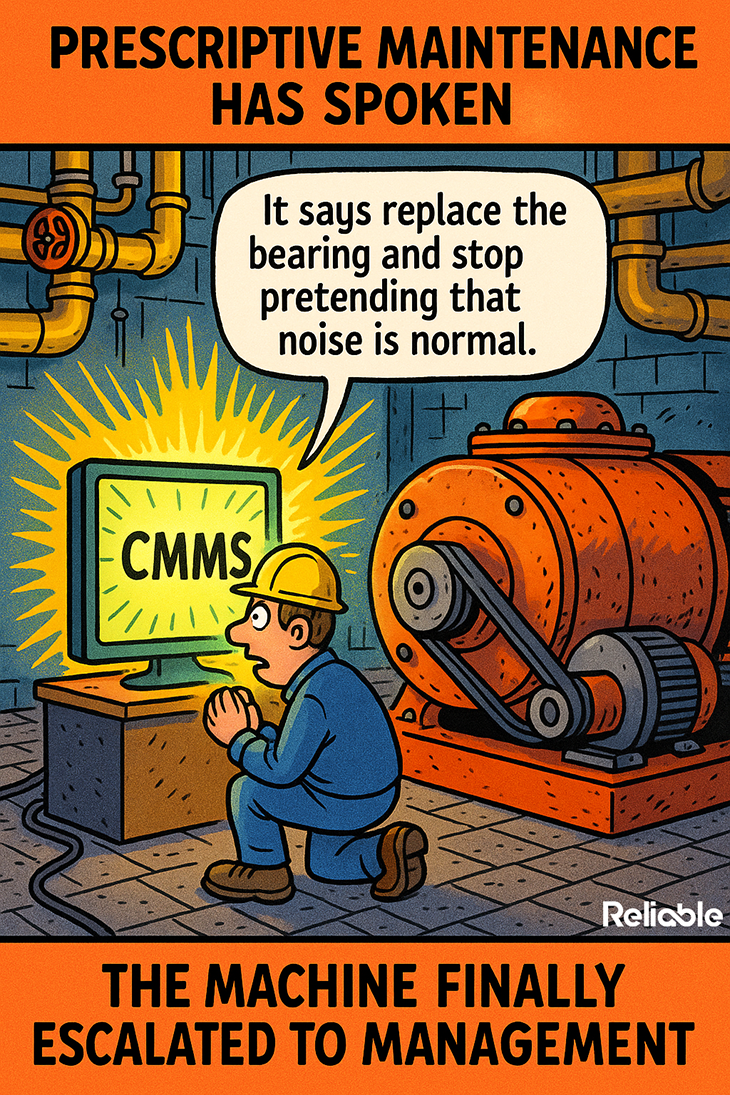
The hardest part of prescriptive maintenance is not only the math; it is technical validation and trust. An experienced technician should not be expected to obey an opaque recommendation simply because it came from software. Strong systems show the evidence, the decision criteria, and confidence or uncertainty where available, so the user can evaluate the recommendation rather than blindly comply or ignore it.
Early deployment is best treated as validation. Use a shadow mode or a bounded pilot, compare recommendations with inspections and actual outcomes, track false positives, false negatives, and missed faults, and review where rules or models fail. Credibility should follow demonstrated performance in the target application, not a vendor claim or a successful demo somewhere else.
Good recommendations build on early failure detection when the goal is to intervene before functional failure. The right timing is not simply late enough to use every remaining hour; it balances risk, production impact, spare and crew availability, and confidence in the prognosis. A recommendation is useful when it creates enough lead time for safe, economical action within the plant’s risk tolerance.
Prescriptive systems will sometimes be wrong. Treat a miss as evidence to investigate the data, model, rule, or context, then correct, retrain, or retune only when the evidence supports the change. Performance can improve through a disciplined feedback loop, but it does not improve automatically. Keep an audit trail so the team can distinguish model error from data-quality, assumption, or execution error.
You do not roll out prescriptive maintenance by installing it. You roll it out by validating it often enough that people know when to trust it, when to verify it, and when to challenge it.
Building Toward Prescriptive Maintenance
Clean data and execution discipline matter, but there is no universal maturity ladder that every plant must follow in sequence. A site may pilot a prescriptive use case while improving preventive work, condition monitoring, and planning in parallel. The practical requirement is that the use case has adequate data, a defensible model or rule set, and a work process capable of acting on the recommendation.
Where that foundation exists, the prescriptive layer can combine technical evidence with operational context and give planners a consistent second opinion. Sensors do not need to be perfect and history is rarely clean; the task is to understand data quality, uncertainty, and model limits. The strongest systems help experts see why a recommendation was made and then learn from the outcome.
What Is Prescriptive Maintenance Worth to Your Program?
Prescriptive maintenance is not the right first move for every plant. A highly reactive site may get little value if it cannot turn recommendations into planned, executable work. Condition monitoring is a common input, but it is not mandatory in every implementation; some systems use maintenance history, process data, engineering rules, or other evidence. Value appears when the data and decision logic are strong enough to support an action and the organization has the capacity to act on it.
Where it pays off, it pays off in decisions. Prescriptive analytics aims to reduce debate over alerts, avoid unnecessary intervention, and prevent known degradation from reaching functional failure. The most defensible definition is the use of analytics and decision logic to turn maintenance and operating data into a specific, traceable recommended action, with human or governed automated approval appropriate to the risk.