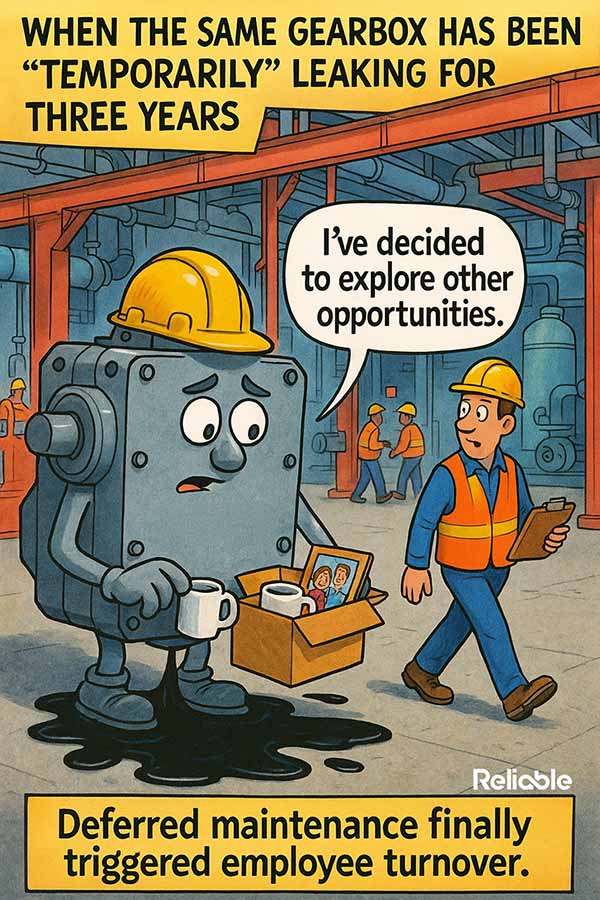

A gearbox that has been leaking for three years is a maintenance decision, even when nobody remembers making it. The risks of temporary equipment repairs grow quietly because a stop-gap can remain in service long after its intended window. Some temporary repairs can be legitimate when they are engineered, authorized, risk-assessed, and monitored. Others, especially conditions involving machine guarding, safety interlocks, hazardous energy, or pressure boundaries, may make continued operation unacceptable unless applicable procedures and engineering controls specifically allow it.
The word temporary is doing a lot of work in that sentence. On the floor, it usually means the first repair anyone had time for, blessed by the fact that the machine kept running afterward. The trouble starts when temporary quietly turns into permanent and the original risk never actually leaves the building.
A temporary repair can be the right risk-control choice when it is engineered and authorized for a defined operating window. The bigger failure is letting that temporary state exist without an owner, operating limits, inspection requirements, an expiration or review date, and a plan for permanent disposition.
Why Temporary Repairs Quietly Become Permanent
A temporary fix succeeds at the one thing everyone can see: the line is moving again. That visible win removes the urgency that would have funded the permanent repair, so the follow-up work order drifts steadily to the bottom of the list.
Meanwhile the plant keeps generating fresh emergencies, and each one can look more urgent than an old leak or workaround. Efforts to reduce reactive maintenance stall when temporary repairs accumulate without permanent disposition, because some of those unresolved defects continue to consume attention or create future failure exposure.
Nothing on a plant floor is as permanent as a temporary repair that kept the line running.
There is also comfort in the familiar. Operators learn to work around the drip pan, the odd noise, and the valve that needs a certain touch, and that fluency makes the abnormal feel normal. The longer a workaround survives, the more invisible it becomes to the people living beside it.
By the time the temporary repair fails for good, the plant has often forgotten the underlying defect entirely. The rushed second repair then recreates the same patch under pressure, and the whole cycle resets with interest added on.
How to Spot the Temporary Fixes You Have Stopped Seeing
Because these repairs hide in plain sight, finding them takes a deliberate look rather than a casual walk-through. A short, focused hunt usually turns up more than a team expects to find.
- Walk the plant specifically for drip pans, makeshift supports, tape or patches, temporary clamps used outside their intended design, and documented bypasses. Verify whether each condition is approved, risk-assessed, and still within its allowed operating window before logging or escalating it as an open defect.
- Search the work order history for jobs closed as temporary, stop-gap, or repair pending parts that never got their follow-up.
- Ask operators which machines require a special trick or workaround to run, since that may point to an undocumented defect, temporary operating condition, or abnormal procedure that deserves review.
Each valid item on that list is a decision to carry a known condition for some period of time. Written down together, they show the size and type of temporary exposure the plant has accepted, whether deliberately or by drift.
The exercise can change the conversation. A single familiar drip pan is easy to overlook, but a consolidated list of temporary conditions makes the exposure visible enough to prioritize, engineer, schedule, or formally disposition.
The Real Risks of Temporary Equipment Repairs
The risks of temporary equipment repairs reach beyond the obvious chance that a stop-gap fails. A leaking seal may lose lubricant and, depending on seal arrangement and pressure, may also allow dirt or water to enter. Either condition can increase wear risk if it is allowed to continue.
The same logic runs through many temporary conditions. A temporary support can alter a load path if it was not engineered for the service. A bypassed or damaged guard, or a jumpered interlock, is a separate safety issue and should not be treated as an ordinary production workaround; applicable safeguarding and hazardous-energy-control requirements still apply. Those conditions can create human exposure as well as component failure risk.
A patch does not pause the damage; it simply moves the bill to a date you did not choose.
Then there is the cost of the emergency itself. A planned repair can be prepared with the correct parts, permits, labor, and downtime window, while a failure may add emergency labor, collateral cleanup, secondary damage, and lost production on top of the original repair.
The quietest risk is learning the wrong lesson. When a temporary repair holds, the organization may conclude that the underlying defect no longer matters. Repeated, high-consequence, or poorly understood temporary repairs should trigger a root cause failure analysis or other cause review proportionate to the risk, rather than simply recreating the same workaround.
Turning Temporary Back Into a Real Plan
The control for a culture of patches is to make temporary an honest, tracked state instead of a quiet dead end. A few plain practices keep the follow-up from vanishing when the line comes back.
- Document every approved temporary repair with an owner, engineering or risk basis, operating limits, inspection interval, review or expiration date, and a linked work order for permanent repair or formal disposition.
- Where practical, identify the temporary condition at the asset and set a review interval, so it cannot age for years without a deliberate decision to repair, renew the temporary authorization, or re-engineer the condition.
- Review open temporary repairs at a cadence matched to their risk, keeping higher-consequence conditions visible to the people responsible for engineering, operations, safety, and funding the permanent fix.
Handled that way, an approved temporary repair does what it was meant to do: manage a condition for a defined period on purpose. Taking the risks of temporary equipment repairs seriously means closing the loop with a permanent repair or a formal engineering disposition instead of letting the stop-gap quietly become the standard state.