
In many plants, the annual outage becomes the place where deferred work waits. A leaking valve, a motor that runs warm, or equipment that needs access for a planned repair can all get pushed toward the same window until the list is overloaded. Learning to reduce shutdown scope creep means keeping that list honest, so the outage carries work that truly benefits from the planned equipment downtime and can be executed safely and ready to work.
Scope creep is the growth of an outage work list beyond the approved baseline or the event’s capacity. It rarely arrives as one big decision. It accumulates through late additions and deferred jobs until the combined plan needs more labor, material, engineering, or time than the shutdown was prepared to provide.
Many maintenance teams know the result. An outage can run long, high-value jobs can compete for the same crews, and work quality can suffer as the restart deadline approaches. Some planned work may then be deferred again, leaving risk in the backlog after startup.
None of this makes outages the villain. A well-run shutdown is one of the most valuable tools a plant has, giving crews safe access to work that cannot reasonably be completed while the equipment is operating. The goal is to protect that value by keeping the scope focused, justified, and executable.
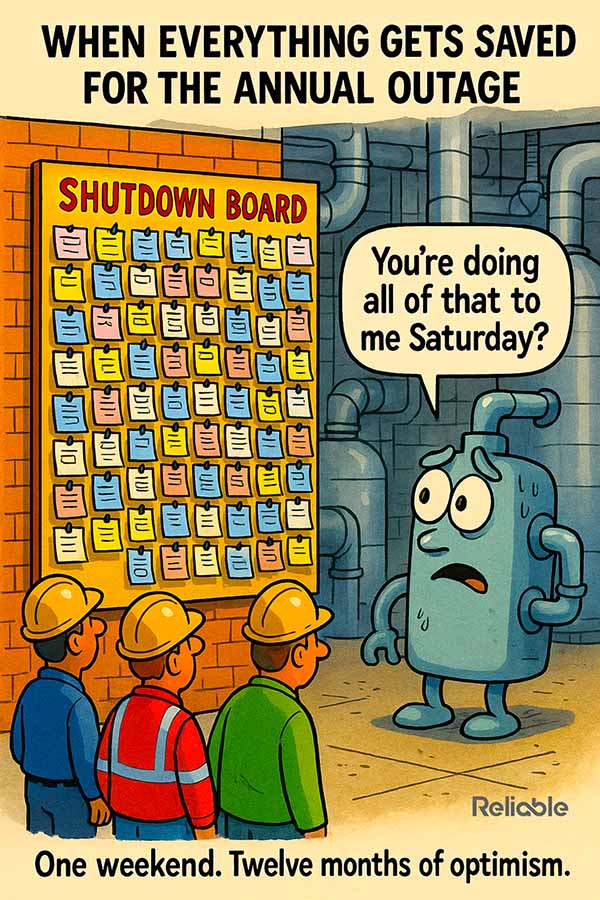
Why Everything Ends Up Saved for the Annual Outage
The outage attracts work for understandable reasons. Some jobs genuinely require equipment to be stopped, isolated, de-energized, opened, or otherwise unavailable for production, and batching compatible work into one window can avoid repeated production impacts. The trouble starts when jobs that can reasonably be completed during routine operation, local downtime, or another planned window are parked there anyway, adding to the deferred maintenance risks already being carried.
Every deferral can look cheap in the moment. Pushing a repair to the outage avoids a production conversation today, but repeated deferrals across the year can fill the shutdown board with work that doesn’t need the event or isn’t sufficiently prepared for it.
An annual outage is not a landfill for every job that nobody wanted to schedule.
There is also a planning gap behind the habit. When routine work has no protected schedule of its own, the outage becomes the only place it reliably happens, so anything that slips during the year lands on the shutdown by sheer default.
Naming this dynamic is the first step. The outage is a tool for work that requires or materially benefits from the planned downtime, access, isolation, or coordinated resources. Treating it as a catch-all for everything postponed is what turns a controlled plan into an overloaded one.
The habit also feeds on optimism. Teams look at the calendar, see months before the shutdown, and assume there will be plenty of room on the board when it finally arrives. That distant window always looks roomier than it turns out to be, and the reckoning only comes when the jobs are counted against real hours and real crews.
What Shutdown Scope Creep Actually Costs
Scope creep looks free while the list is only growing on paper. The bill comes due during and after the outage, in a handful of predictable ways.
- Schedule overrun and rushed work, as too much scope competes for limited hours and quality can suffer under a hard restart deadline.
- Higher cost, when late or excessive scope drives additional contractor labor, overtime, expediting, or schedule extension.
- Startup risk, because every intervention, opened system, modification, and restoration creates another item that must be checked before stable operation is re-established.
- Deferred-again work, where lower-priority jobs that cannot be completed are returned to the backlog and may require a new risk decision.
None of these costs shows up on the deferral decision that created it. Each one lands months later, on a different budget line, which is exactly why the habit is so easy to keep feeding year after year.
The compounding effect is the dangerous part. If routine work keeps rolling into the outage and unfinished work keeps rolling forward, future events can become larger and harder to prepare. The cure is not simply a longer shutdown; it is better scope selection, readiness, and routine work management.
How to Reduce Shutdown Scope Creep Before the Outage
Knowing how to reduce shutdown scope creep starts long before execution, in everyday maintenance planning and in the event scoping process. Challenge every proposed job with several questions: does it require this downtime window, is it required for safety, integrity, compliance, or reliability, and is the work technically ready enough to justify consuming outage capacity?
That challenge sorts the list. Work that needs equipment stopped, isolated, de-energized, opened, or uniquely accessible during the event belongs in the candidate scope. Work that can be done safely and economically during normal operation, a short local stop, or a planned changeover should usually be scheduled there instead.
The outage should carry work that is justified by the event window, not simply everything that is convenient to postpone.
Timing the challenge matters as much as asking it. The scope-freeze date should be set early enough to support the event’s longest credible engineering, material, contractor, permit, and planning lead times. For a small shutdown that may be weeks or months; for a major turnaround it can be much earlier. After freeze, late additions should clear a formal change-control process.
Give the freeze teeth by naming the decision authority or steering group. Post-freeze additions should be accepted or rejected against documented criteria, with schedule, cost, risk, and readiness impacts visible before the scope changes.
Publish the criteria well in advance. When everyone knows what qualifies as event scope, weak candidates can be challenged early, and the formal scope-freeze review becomes confirmation of a prepared list rather than a last-minute collection exercise.
Building the Work List That Earns Its Slot
A controlled outage runs on a work list where every job has earned its place. Building that list is a screening exercise rather than a collection drive.
- Require a stated reason each job needs this event window, and send work that fails the test back to the normal backlog with an owner and realistic plan.
- Attach a realistic duration, labor estimate, parts and material status, permits or isolation needs, engineering requirements, and responsible crew to every accepted job, so the plan reflects work that can actually be made ready.
- Rank accepted work by consequence and risk, while protecting mandatory safety, integrity, and compliance scope, so contingency decisions do not default to whichever job was submitted last.
A list built this way may be shorter, but it is also more executable. It tells leadership what the outage is prepared to deliver and gives the crews a ready work package instead of a wish list that must be triaged during execution.
Protecting the Routine Work From the Shutdown Magnet
The deepest cure for scope creep is to make sure routine work has somewhere else to go. Strong maintenance scheduling during normal operation is what keeps small jobs from drifting toward the outage in the first place.
When preventive tasks, minor repairs, and inspections reliably happen through the normal work-management process, the pressure to save them for the shutdown fades. The outage can then focus on work that requires or materially benefits from the event window.
Every job completed in the right routine window is one less candidate competing for outage capacity.
Short, planned equipment stops help just as much. Many jobs that appear to need the annual outage only need a limited local downtime window, which good scheduling can arrange without taking the entire plant or production area out of service.
Reliability work also helps upstream. Equipment kept in good condition through the year is less likely to arrive at the outage with a large queue of unplanned corrective work, which can reduce pressure on the event scope.
Condition monitoring and early detection can identify developing faults while there is still time to plan the right repair window. Some findings will still belong in the outage, but earlier notice improves engineering, parts, and scope decisions before the event is frozen.
Running the Outage So Scope Stays Controlled
Control does not end when the outage begins. The way a shutdown is run either holds the line on scope or lets it balloon in the final, frantic hours.
- Handle emergent and discovery work through a formal change process, so each new finding is weighed against safety, integrity, schedule, cost, resources, and restart impact before it joins the active plan.
- Track progress against the plan in real time, so a job running long becomes visible early enough to make a real decision about it.
- Protect the restart, keeping a clear line between work that must finish for safe and reliable startup and work that can be formally deferred to a controlled follow-up window.
Discovery work is a normal possibility when equipment is opened or inspected, but it should not become a loophole for avoidable late scope. A good outage has a process and appropriate contingency for genuine findings while still challenging discretionary additions.
Communication ties it all together during the event. A short, frequent check-in that reviews progress, emergent finds, and the hours remaining keeps everyone working from the same plan, so decisions about scope get made openly against the clock instead of by whoever happens to be loudest at the tool.
Making Next Year’s Outage Smaller
A single controlled outage is a win, but the real prize is a downward trend. Each shutdown is a chance to learn why work piled up and to fix the upstream causes before the next one comes around.
That starts with an honest review after startup. Look at work that entered the event late, work that was deferred again, and jobs that could have been executed during routine operation. Trace each item back to the planning, reliability, inspection, or scheduling gap that sent it there.
A well-controlled outage is uneventful for the right reason: the scope was challenged, prepared, and changed only when the risk justified it.
Feed those lessons straight back into the daily system. When the review keeps pointing at the same missed routines or the same unscheduled repairs, the fix lives in the weekly rhythm, and closing that gap shrinks next year’s list at its source.
Share the trend with leadership as well. A simple chart separating frozen-scope hours, approved post-freeze additions, discovery work, and deferred work across several events makes scope control visible and shows where the planning process is improving or slipping.
Handled this way, the annual outage returns to a defensible size. Learning how to reduce shutdown scope creep means doing routine work in the right windows, challenging event scope early, freezing it at a planning-appropriate point, and controlling exceptions so the outage carries only work that earns scarce downtime capacity.