

Some machines deserve an Oscar. Not because they perform well—but because they can perform convincingly even when they’re on the edge of failure.
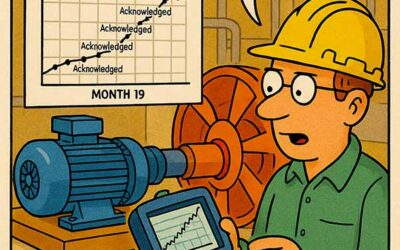
This cartoon captures a not-so-fictional truth: sometimes, your most trusted tools can be misled. Let’s unpack how vibration analysis can be fooled, what causes it, and how to reduce your risk.
False Negatives: The Hidden Cost of Over-Reliance on Vibration Data
Every seasoned reliability engineer has a story: a machine that looked fine on the report but failed catastrophically weeks later. Vibration analysis, while incredibly powerful, is not foolproof. It can and does get tricked—especially by dynamic conditions or incomplete data capture.
Here’s how vibration analysis can be fooled:
- Transient Faults: If imbalance or looseness only appears under specific loads, it might not be present during the measurement window.
- Sensor Placement Errors: Even slight misalignment of accelerometers or poor contact can drastically reduce signal fidelity.
- Resolution Limits: Low-resolution data or insufficient sampling rates can mask early-stage faults.
- Human Interpretation Gaps: Technicians may overlook subtle signs or assume clean trends mean clean machines.
The result? A report that says “normal,” while inside the asset, damage progresses quietly.
Why Your Machines Might “Perform” Better Than They Really Are
Machines don’t fake it on purpose—but operational variables can make them appear healthier than they are.
- Changing Load Conditions: A machine may only show vibration abnormalities under high load or startup torque, not during idle or steady-state operation.
- Temperature Sensitivity: Thermal expansion may temporarily “tighten up” components, masking looseness or misalignment.
- Background Noise Masking Signals: In noisy environments, critical frequencies may be buried under ambient machine or structural noise.
These false signals lull analysts into inaction, especially if no red flags are triggered in the software. That’s why understanding how vibration analysis can be fooled isn’t a hypothetical exercise—it’s a core reliability competency.
Integrating Contextual Clues to Reveal What Vibration Misses
If vibration analysis is the movie, the surrounding data is the script, lighting, and cast. You need more than the plot to understand the story.
Multi-sensor correlation is key:
- Ultrasound can detect faults before they show up in vibration.
- Thermography picks up friction and misalignment heat signatures.
- Oil analysis flags wear particles early in failure progression.
- Operator rounds can identify unusual sounds, smells, or temperature shifts that instruments miss.
The most accurate diagnoses happen when these tools are interpreted together, not in isolation. A seemingly healthy spectrum might contradict a thermal image showing a hot bearing—or a lube report showing metal debris.
Strategies to Reduce the Risk of Being Fooled
It’s not about distrusting your tools—it’s about demanding more from your program. Here’s how to strengthen your analysis:
- Trend, don’t snapshot: Individual readings are unreliable. Focus on trends over time with consistent parameters.
- Automate alerts on subtle changes: Look beyond thresholds. RMS values might stay stable while kurtosis or crest factors climb.
- Inspect anomalies, not just alarms: An unusual reading in context is more valuable than a standard one outside of it.
- Time readings with machine cycles: Capture vibration under representative load, speed, and process conditions.
- Upgrade your resolution: Use enveloping, demodulation, or high-frequency techniques for bearings and gears.
If you want to truly understand how vibration analysis can be fooled, you need to look past the printout and into the operating reality of your plant.
The Cultural Factor: Teaching Teams to Question “Normal”
Predictive maintenance fails not just because of technical blind spots—but cultural ones. If your team is conditioned to accept a clean report as gospel, you’re vulnerable.
Train people to think like skeptics.
- Challenge clean data with “what if we’re missing something?”
- Celebrate near-misses as learning opportunities.
- Teach that tools are fallible, and verification is a virtue.
Machines that “pass” analysis but fail shortly after should not just be replaced—they should be investigated. What allowed the fault to slip through?
Bottom Line: The Best Machines Are Honest, But Data Isn’t Always
Machines don’t lie, but your interpretation of their signals might. Vibration analysis remains one of the most powerful tools in the reliability toolbox—but only when applied with context, precision, and humility.
The cartoon makes us laugh, but the message is serious: when your motor’s acting like a Broadway star, it’s time to look deeper. Don’t let performance overshadow condition. Get smarter about how vibration analysis can be fooled—so your program doesn’t get caught off guard.