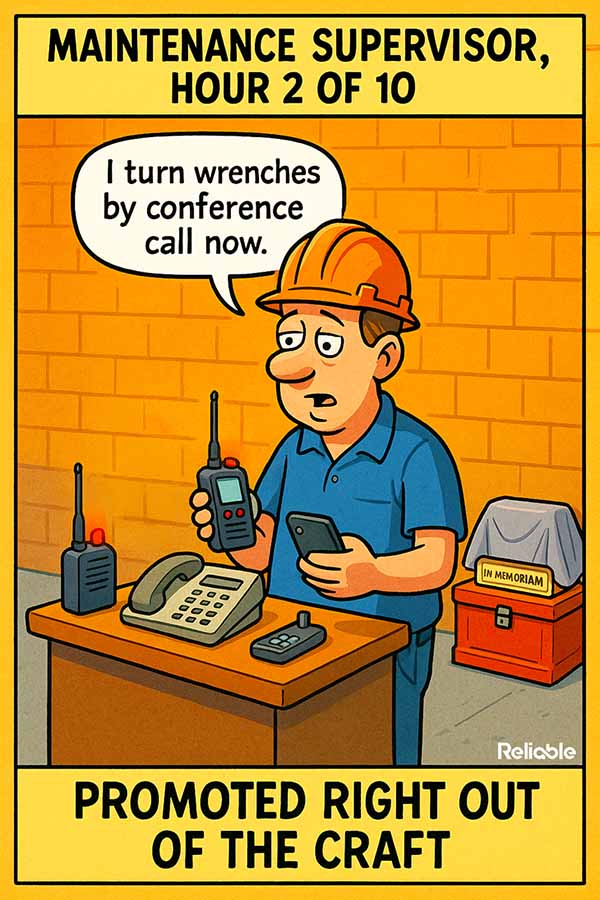

The question of how to develop maintenance supervisors usually surfaces the hard way, a few weeks after a plant hands its sharpest technician a title and a phone. The work that made that person valuable, the hands-on diagnosis and the quiet fixes, gives way to scheduling calls, staffing gaps, and status updates. On paper it looks like a reward, and on the floor it can read like a loss.
Supervision is a separate craft, and treating it as a natural extension of technical skill can set good people up to struggle. A plant that wants strong frontline leaders has to build that capability on purpose, with the same rigor it brings to a reliability program or a maintenance plan. Done well, that development can preserve both leadership capability and technical depth.
How to Develop Maintenance Supervisors Who Still Fix Things
The first tension to resolve is technical identity. A new supervisor may have spent years being the person who recognized abnormal machine behavior or traced an intermittent fault, and that reputation is hard-won. Ask them to surrender technical involvement entirely and the plant risks losing some of their credibility with the crew and some of the technical judgment they bring to decisions.
The better move is to reshape how that expertise gets used rather than retire it. A supervisor still needs enough equipment knowledge to ask good questions and recognize risk, but the value now comes from coaching a diagnosis, reviewing job readiness, and knowing which jobs deserve a second set of eyes before the crew commits to them.
A supervisor who loses touch with the equipment also loses important context for leading the people who maintain it.
Structured shadowing helps here. Pairing a new supervisor with an experienced one for real decisions shows them what the role actually demands, the kind of judgment covered in guidance on how to be a maintenance supervisor rather than in any job description. The lessons that stick are the ones learned while the pressure is real.
That mentoring works best when it is scheduled and protected on the calendar. Once it becomes the first thing dropped on a busy day, the plant is back to hoping supervision develops by osmosis, which rarely produces consistent leaders. A recurring session with a mentor is more reliable than a vague promise of support later.
The Hidden Cost of Promoting Your Best Technician
A promotion from the toolbox carries a quiet transaction. The plant gains a supervisor and reduces the hands-on capacity of the crew, and the second half of that trade often goes unmeasured for months. Leaders celebrate the new title and can overlook the technical capacity that just moved off the tools.
When the promoted technician held specialized skills such as precision alignment, complex diagnostics, or deep knowledge of a critical asset, the gap may not surface immediately. It can appear later as slower troubleshooting, greater dependence on a few remaining experts, or more rework unless the capability is deliberately backfilled.
- The promoted technician is still nearby, so their reduced hands-on availability can feel temporary rather than structural.
- Reactive jobs get absorbed by the rest of the crew, spreading the load until a second departure finally exposes it.
- Skill loss can show up as slower repairs, repeat work, or greater dependence on outside support, but those outcomes can have several causes and should not be traced to a staffing decision without evidence.
- The new supervisor keeps solving problems informally, masking the fact that the plant never truly replaced the craft.
Naming that cost early changes the decision. A plant that plans for backfilling and cross-training before the promotion protects both the new supervisor and the work they leave behind. The goal is a deliberate handoff of knowledge, captured while the expert is still on the team.
Building Planning and Coordination Skills
The daily reality of supervision is coordination: matching available people to ready work and coordinating parts, permits, access, and time windows so that work actually happens. Many technicians have never had to see the whole board at once, and the shift from doing one job well to coordinating many jobs is a real adjustment.
Developing that skill means giving new supervisors ownership of daily execution decisions within the agreed weekly schedule, with support close by. Reviewing the weekly schedule together, then letting them translate it into crew assignments and daily priorities, helps protect wrench time without turning the supervisor into the planner.
A supervisor’s core contribution is coordinated execution: getting safe, ready work completed by the right people while keeping the crew aligned with the schedule and operating priorities.
Coordination also depends on communication upward and sideways. A supervisor who can translate floor conditions into terms an operations manager understands is better positioned to protect the schedule from unnecessary disruption and negotiate when a request would break the agreed plan.
These skills respond well to deliberate practice. Small, repeated reps at planning a shift, assigning ready work, or negotiating an outage window build the confidence that lets a supervisor make sound calls when pressure arrives. Confidence built on repetition holds up better than confidence handed over with a title.
Giving New Supervisors Room to Lead
Authority granted on paper means little without the room to use it. A supervisor who has to escalate every decision learns to stop deciding, and the plant loses the responsiveness the role was meant to add. Growth requires a widening lane, checked often but rarely blocked.
Development includes deliberately expanding the decisions a supervisor owns as they demonstrate judgment. Clear boundaries help everyone: which calls are theirs, which need a manager, and which require an engineer. Ambiguity here breeds either paralysis or overreach, and both are avoidable.
- Day-to-day work assignment and prioritization within an agreed weekly plan.
- First-line coaching and feedback for the technicians on their crew.
- Small purchasing and parts decisions inside a set dollar threshold.
- Direct contact with operations on scheduling and access, without a manager relaying every message.
Room to lead includes room to be wrong on low-stakes calls. A supervisor who is corrected constructively after a reasonable judgment can grow faster than one who is second-guessed into caution. The goal is controlled learning inside clearly defined safety, quality, cost, and technical boundaries.
Measuring Whether the Development Worked
Plants measure equipment relentlessly and often leave leadership development to gut feel. A development effort deserves the same evidence any reliability initiative would demand, with baselines, targets, and a regular look at the trend.
Useful signals are already available in the data plants collect. Schedule compliance on the supervisor’s crew, rework rates, safety participation, and technician retention can all inform the discussion, but none is a pure measure of leadership. Work mix, planning quality, staffing, operations support, and other factors can move the same metrics. Those signals are best interpreted alongside direct observation, crew feedback, and the capabilities expected on the path toward maintenance manager.
A plant that cannot describe how its supervisors are improving is promoting them without a reliable development feedback loop.
Those signals, combined with observation and feedback, guide the next round of coaching. A supervisor strong on coordination but shaky on difficult conversations needs targeted support, and the evidence helps show where the help should go. Development becomes a loop rather than a single event.
Treating supervisor development as a measured, ongoing program rather than a one-time promotion helps keep a plant from repeating the same avoidable mistake with every new leader it names. The craft on the floor and the leadership above it can grow together when the plant plans for both.