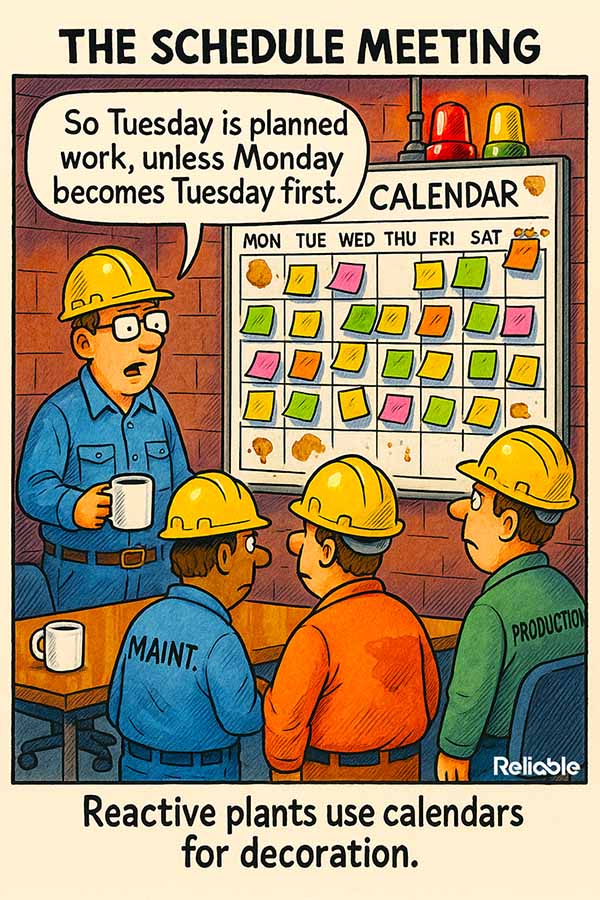

In a reactive plant, the weekly schedule is a document everyone privately expects to be rewritten by Tuesday. Jobs get bumped, priorities reshuffle, and the plan loses meaning. A useful weekly maintenance schedule is not one that can never change; it is a stable baseline that gives the crew a realistic work goal and makes justified break-ins visible.
A weekly schedule sets the maintenance work a crew intends to accomplish during the week. Depending on the site’s process, the exact day, sequence, and craft assignment may be finalized in the daily schedule rather than locked a week in advance. The weekly schedule should therefore be firm enough to guide capacity and coordination without pretending that genuine urgent work will never occur.
How to Build a Weekly Maintenance Schedule That Holds
A durable weekly schedule rests on a pool of work that is genuinely ready to execute. Ready means the scope and priority are clear; labor and craft requirements are estimated; required materials, tools, permits, safety controls, access, and coordination have been identified; and no known prerequisite makes the job impossible to start. It does not mean every job needs the same level of documentation or that every part must physically sit beside the asset days in advance.
Good maintenance scheduling depends on that ready pool. Committing work that still has unresolved scope, material, access, or safety prerequisites creates avoidable carryover and schedule breaks. Planning should remove those barriers before the job is treated as executable.
A weekly schedule is only as executable as the work behind it. Unready work should not be counted as a firm commitment unless its missing prerequisites will be resolved before execution.
So the first step happens before the weekly schedule is built. Planning develops enough executable work for the scheduler or supervisor to choose from, with estimates and constraints visible. Without that pool, the scheduling process becomes a negotiation over jobs that may not actually be ready.
The ready pool should be large enough to give the scheduler choices when equipment access, labor, or priorities change. Many organizations aim for multiple weeks of ready work, but the right amount depends on job duration, labor flexibility, material lead times, outage patterns, and the stability of the operating plan.
Loading the Week Against Real Capacity
With ready work in hand, build the weekly schedule against known available labor. Start with the crew capacity after planned leave, training, meetings, outages, and other known commitments, then apply the site’s chosen loading rule consistently.
- Start from available hours: use realistic crew capacity after planned leave, training, meetings, and other known commitments.
- Set the loading rule: if the site reserves capacity for expected break-in work, base it on history and make the allowance explicit; if the site uses full weekly loading, treat the schedule as a work goal and manage justified break-ins openly.
- Fill with ready work: draw from the ranked ready backlog to the target load and keep enough alternate work available to respond when access or conditions change.
There is no universal rule that a weekly schedule should be loaded to only seventy or eighty percent. A widely used planning-and-scheduling approach loads one hundred percent of available crew hours as a weekly work goal and allows appropriate urgent work to break the schedule; other sites reserve a defined capacity based on historical demand. Whatever method is used, chronic emergency demand should be measured rather than hidden by routine underloading. The objective is a credible workload and better wrench time, not perfect schedule compliance at any cost.
Loading against real capacity turns the schedule into a useful workload goal. Comparing what was scheduled with what was actually completed, plus the reasons for break-ins or carryover, gives the organization feedback on planning quality, execution barriers, and reactive demand.
Getting Operations to Commit the Equipment
A maintenance schedule is only part of the plan. Work that requires an outage, operating change, permit, access window, or production support must be coordinated with the people who control those conditions.
That coordination should happen before the week begins. Operations and maintenance need agreement on the equipment or access windows required for scheduled work, while the exact daily sequence can still be adjusted within the agreed weekly plan as conditions change.
A weekly schedule built without realistic equipment-access and operating constraints is incomplete. Work is not truly executable until the conditions needed to perform it are understood and coordinated.
When that coordination is missing, the reasons why production planning meetings fail tend to show up quickly. The schedule is built around assumptions that operations never accepted, and work carries over because the required equipment or access window was never actually available.
Getting the commitment does not require a long meeting. It requires the right few people in a room who can actually speak for their areas, a ready schedule to react to, and the discipline to leave with clear decisions rather than a fresh list of things to discuss later.
Freezing the Schedule and Protecting It
A weekly schedule loses value if it is rewritten after every new request. Once the baseline is committed, changes should follow defined priority and escalation rules so the plant can distinguish a justified break-in from ordinary schedule churn.
- Freeze the baseline: preserve the original weekly schedule and change it only when defined priority or risk rules justify a break-in; do not rewrite the original plan after the fact to make compliance look better.
- Triage new requests: route work that does not justify a break-in into the backlog for future scheduling rather than automatically inserting it into the current week.
- Log every break-in: record what displaced scheduled work and why, so recurring causes of schedule loss become visible.
That log is valuable because a bad week can feel random while repeated break-in codes can reveal patterns: recurring equipment problems, weak priority discipline, material or access constraints, or an operating plan that changes too late for maintenance to respond.
Protection is a daily habit rather than a one-time rule. A brief maintenance-and-operations check can manage true changes without turning the weekly baseline into a new schedule every morning.
Making the Weekly Schedule a Habit
The first good schedule is an event. The tenth one is a habit, and the habit is where the real gains live, because a plant that reliably plans its week slowly stops being surprised by it.
Each week provides feedback for the next one. Schedule compliance, carryover, break-in reasons, estimate accuracy, and the depth of ready work all show where the process is improving and where the next constraint sits.
A weekly schedule is a work goal, not a prediction. Its credibility grows when the plant protects the baseline and explains every justified break-in instead of quietly rewriting the plan.
So the practical sequence is straightforward: get enough work ready, load the week against known capacity using a defined rule, coordinate equipment access, freeze the baseline, and manage break-ins through clear priority rules.
None of those steps is difficult on its own. The discipline is doing them in the same order every week and using the variance from plan as feedback instead of treating any change as either failure or permission to abandon the schedule.