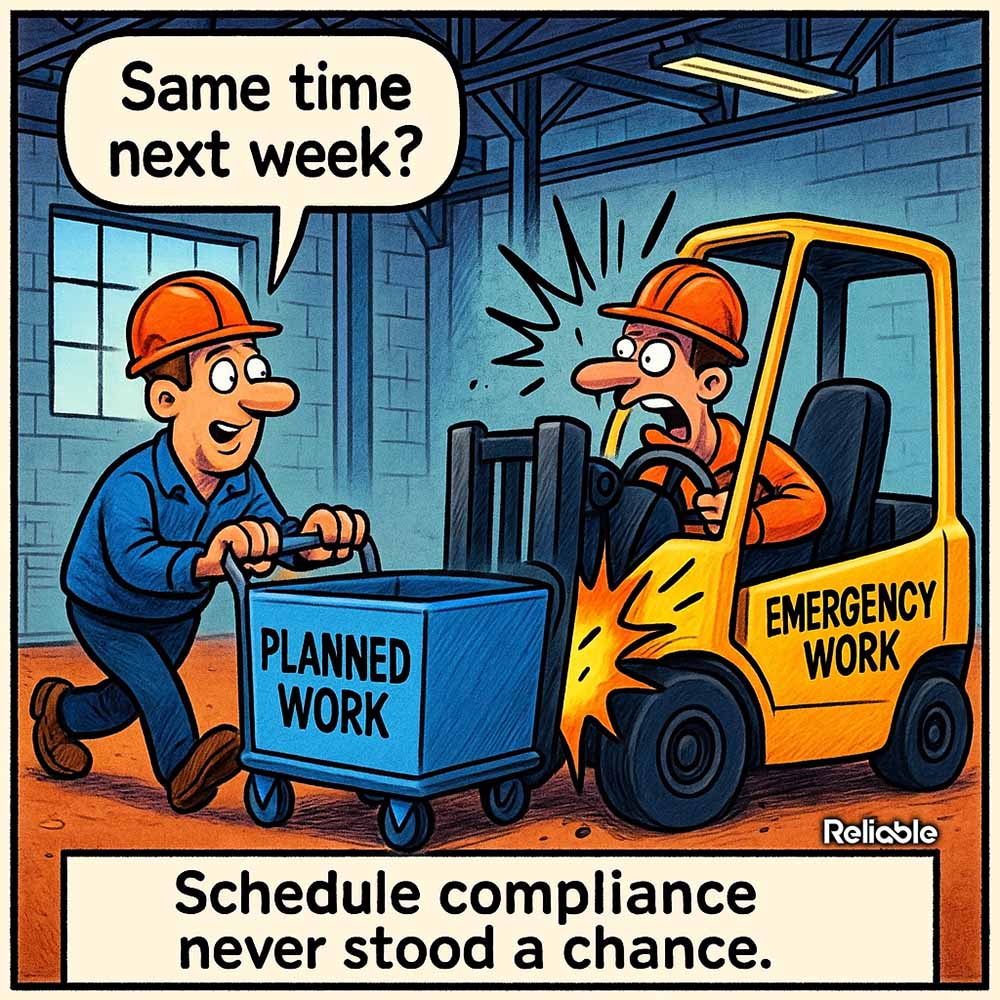

Planned work and emergency work are not strict opposites. Planned describes whether a job went through a formal preparation process before execution; emergency describes urgency or priority. A true emergency may still receive abbreviated planning before tools come out, and corrective work discovered after a failure can sometimes be planned and scheduled if the asset can remain in a safe condition. The daily conflict is better understood as committed scheduled work versus work that must break into that schedule.
Do not collapse that picture into a single planned-versus-reactive number. Useful measures include planned work percentage, unplanned work, reactive or break-in work, emergency work, and schedule compliance. More planned work and less break-in work can be signs of stronger work management, but no single ratio proves that the plant is reliable, safe, or low-cost.
Why Emergency and Break-In Work Displace the Schedule
Emergency work wins when the consequence of waiting is greater than the cost of breaking the schedule. That is appropriate. The problem begins when weak priority discipline lets routine or poorly screened requests enter the same fast lane and displace work that was already planned and coordinated.
When genuinely urgent work repeatedly displaces planned jobs, risk-reducing work may be deferred and backlog can grow. That can create a feedback loop, especially when the same failure modes keep generating break-ins. Breaking that loop is a central part of efforts to reduce reactive maintenance in the first place.
Repeated break-ins consume planned capacity and leave other work unfinished. Treat the pattern as data to investigate, not as a fixed law that every deferred hour creates a future failure.
A plant can work hard and still lose control of the work mix. Crews may stay busy from clock-in to clock-out while preventive, condition-based, corrective, and improvement jobs are repeatedly displaced by break-ins. High activity does not tell you whether the work being completed is reducing risk or simply restoring operation.
The loud job should beat the quiet one when the incoming risk truly requires it. The work-management problem is allowing vague urgency, requester pressure, or weak priority definitions to break the schedule when the job could safely wait.
The dynamic can also improve in the other direction. Better defect elimination, clearer priority rules, stronger planning, and disciplined execution can reduce break-ins and release more capacity for scheduled work. The effect should be measured rather than assumed.
Protecting Planned Work From the Daily Fire
Protecting planned work does not mean ignoring real emergencies. It means defining emergency and urgent work clearly, screening break-in requests consistently, and giving the weekly schedule enough protection that routine requests cannot displace it by default.
- Set a capacity rule: either reserve explicit break-in capacity based on actual history or fully load the weekly schedule as a work goal and allow justified break-ins. Do not treat one loading percentage as universal best practice.
- Gatekeep priority: require a quick risk or priority check before unscheduled work displaces the committed schedule.
- Protect planned work: do not bump a scheduled job unless the incoming work has a higher defined priority or risk, and record the reason when it does.
These controls protect capacity, but planned work only improves reliability when the work itself addresses valid failure modes, defects, or required risk controls. A planned corrective job that removes a known defect may help improve mean time between failures; routine planned work does not automatically increase MTBF.
- Planned work percentage: track labor hours completed on formally planned jobs versus total maintenance labor hours so planning performance is visible.
- Reactive or break-in work: track labor hours spent on work that was not on the frozen weekly schedule, with emergency and urgent priorities identified separately where possible.
- Schedule break-ins and repeat sources: record what displaced planned work, why it qualified, and which assets or request types repeatedly consume the week.
It also helps to make the trade visible when it happens. When a supervisor records that a planned job was displaced for a specific priority and reason, the organization gains data to improve asset reliability, priority rules, staffing, access, and planning instead of arguing from memory.
None of these controls hold without management support. If every requester can label work urgent or supervisors are rewarded only for the problem immediately in front of them, the weekly schedule will keep losing to work that should have entered the normal backlog.
Turning the Ratio Around for Good
The long game is to make formally planned work the norm and genuine break-ins the exception. That supports efforts to improve maintenance schedule compliance, but the metrics are not the same: planned work measures preparation, reactive work measures schedule break-ins, and schedule compliance measures execution of the frozen schedule.
Progress is usually gradual. If the organization reduces recurring failures and screens break-ins more consistently, more scheduled work can be completed, which in turn creates more opportunity for planned corrective and preventive work. Trend the measures together and use the break-in reasons to test whether the cycle is actually improving.
Trend direction matters more than a generic planned-work target pulled from another plant. A site moving toward more planned work and fewer emergency or break-in hours may also see less overtime, rush freight, and schedule churn, but those outcomes should be verified with its own data rather than attributed to the ratio alone.
Schedule compliance improves when unnecessary break-ins are controlled, but true emergencies still take precedence. Protect the baseline and learn from every justified break.
So the practical path is to define priority classes, choose a transparent capacity rule, protect planned work from lower-priority interruptions, and attack the assets or processes that repeatedly generate genuine break-ins.
Over time, better planning and clearer break-in rules make the workload more predictable. Planned work gets a fair chance to execute, true emergencies remain visible, and schedule compliance becomes a useful measure of the work system instead of a score maintained by rewriting the plan.