
It is easy to assume that once a plant is wired with sensors, networked controls, and dashboards updating in real time, improvement takes care of itself. In practice, sensors and analytics create information; improvement occurs when that information changes a process, control strategy, maintenance decision, or operating practice. Some responses can be automated, but the improvement system still needs defined objectives, validation, and accountability. A dashboard nobody uses is not an improvement system.
What Continuous Improvement in Smart Factories Really Automates
Smart manufacturing can automate far more than data collection. Modern systems can sense, analyze, optimize, and, in bounded applications, adjust controls automatically. What they do especially well is make timely, granular operating data available at scale. If assets, products, and events are correctly identified and integrated, a connected plant can show which stops recur, when they occur, under what operating conditions, and how long they last. The advantage is faster, more detailed evidence, not guaranteed accuracy or insight.
Visibility is not the same as sustained improvement. A recurring jam may be detected automatically, and a control system may even correct some conditions on its own. But eliminating a recurring loss often requires someone to define the problem, test causes, assess tradeoffs, approve a change, and verify that the countermeasure worked without creating a new risk. Smart-factory technology can shorten both detection and response time, but it does not remove the need for governance and learning.
A connected plant can detect faults outside staffed hours, compare current performance with historical baselines quickly, and surface slow trends that are difficult to see manually, provided the sensing and analytics are designed for those tasks. An unconnected plant can still improve through observation and disciplined problem solving; it simply has less automated data available. The question is not whether instrumentation is useful. It is which decisions the information will support and what level of automation is appropriate.
Smart manufacturing does not eliminate judgment. It can improve the quality and speed of the information used to make, automate, or review decisions.
The Data Is Not the Improvement
A common risk in connected plants is information overload. Thousands of tags, hundreds of alerts, and dashboards several layers deep can bury the signal in noise. More data is not automatically more insight. Effective programs define which measures and alerts support a specific objective, decision, or response and keep lower-value data available without putting all of it in front of operators all the time.
This is where a risk-based asset condition monitoring program earns its place. Condition monitoring is not automatically selective; the scope has to be designed around asset criticality, credible failure modes, detectable condition indicators, and the actions the plant can take. Continuous improvement benefits from the same discipline: focus routine attention on measures tied to an outcome and keep the rest available for diagnosis when needed.
Feeding trustworthy monitoring data into a well-designed predictive maintenance strategy can help convert instrumentation into earlier, better maintenance decisions. The data earns its keep when it changes a decision, triggers a useful automated response, or improves a model that affects action. Until then it is stored evidence, not improvement.
Pruning requires discipline because it means deliberately not putting every available signal in front of people. Every recurring alert should have an intended owner, response, escalation path, or an explicit reason for being informational only. If an accurate alert never changes a decision, its operational value may be low. Fewer actionable alerts are often better than uncontrolled alarm volume that promotes alarm fatigue. A good monitoring setup is judged not only by what it detects, but also by whether alerts are timely, prioritized, understandable, and actionable.
A plant is not improving simply because it can measure more. Improvement shows up when selected information leads to verified changes in performance, risk, quality, cost, or reliability.
Where the Gains Actually Come From
Real improvement in a connected plant usually comes from a loop, not one source. Sensors and models make observations possible; people or automated control logic interpret or act on them; the result is then measured. Smart-manufacturing research treats data and analytics as decision support and, increasingly, as a basis for autonomous functions, while also recognizing the value of human-generated knowledge. Plants therefore need both technical capability and people who can understand trends, question anomalies, and validate changes.
Organizational habits around data can matter as much as sensor resolution. A short daily review of a few meaningful measures may deliver more value than a large dashboard no one owns, provided those measures drive decisions. Even where models or controls act automatically, people still define objectives, approve many changes, investigate exceptions, and decide whether a result is acceptable. Continuous improvement is the feedback loop between evidence, action, and verification, not the dashboard itself.
The system can surface a signal. Someone, or a governed automated response, still has to turn that signal into an action that improves the process.
Continuous Improvement in Smart Factories Without Losing the Plot
Healthy connected plants match automation with clear ownership. Operators can add context that sensors and models may not capture, while models can reveal patterns people miss. In autonomous maintenance routines, trained operators typically perform defined basic care, inspection, cleaning, lubrication, tightening, and abnormality detection within site rules; problems outside that scope are escalated. The point is not to hand everyone unrestricted authority, but to make information, responsibility, and response paths clear.
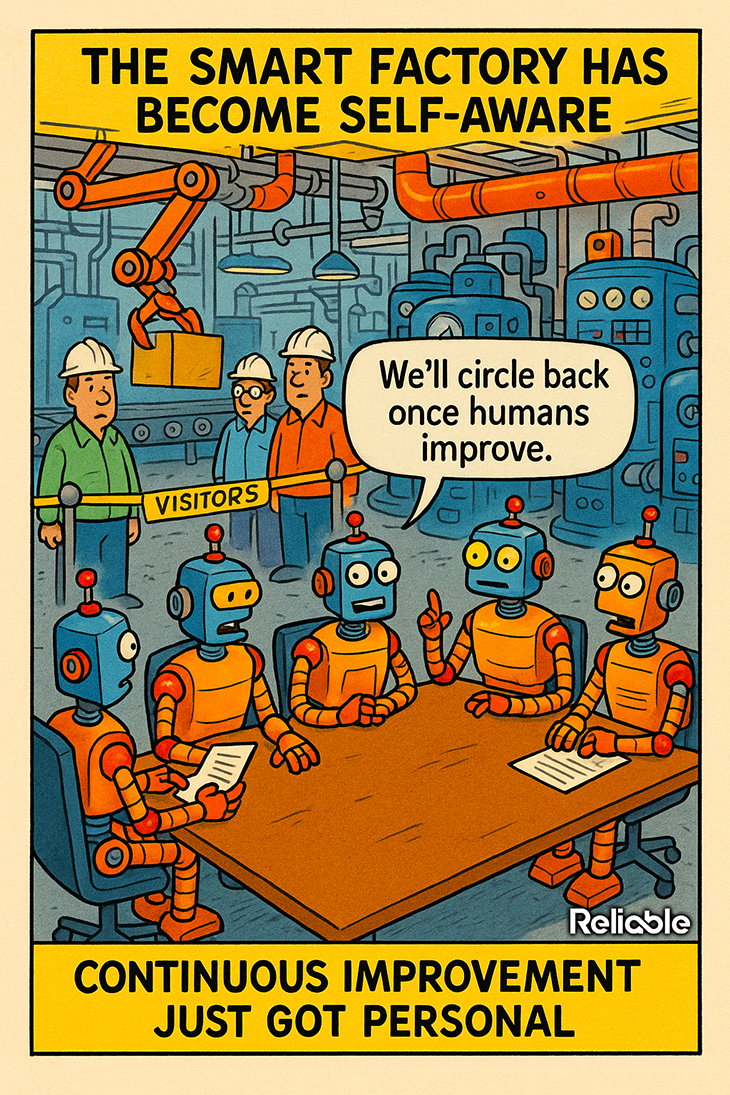
The goal is not to remove people from continuous improvement. More manufacturing decisions will be automated, and some systems already optimize bounded processes with little intervention. People still remain accountable for objectives, safety, tradeoffs, exceptions, and whether a change should be standardized. The strongest smart factories pair sensing, analytics, and automation with disciplined human ownership instead of treating either side as sufficient on its own.