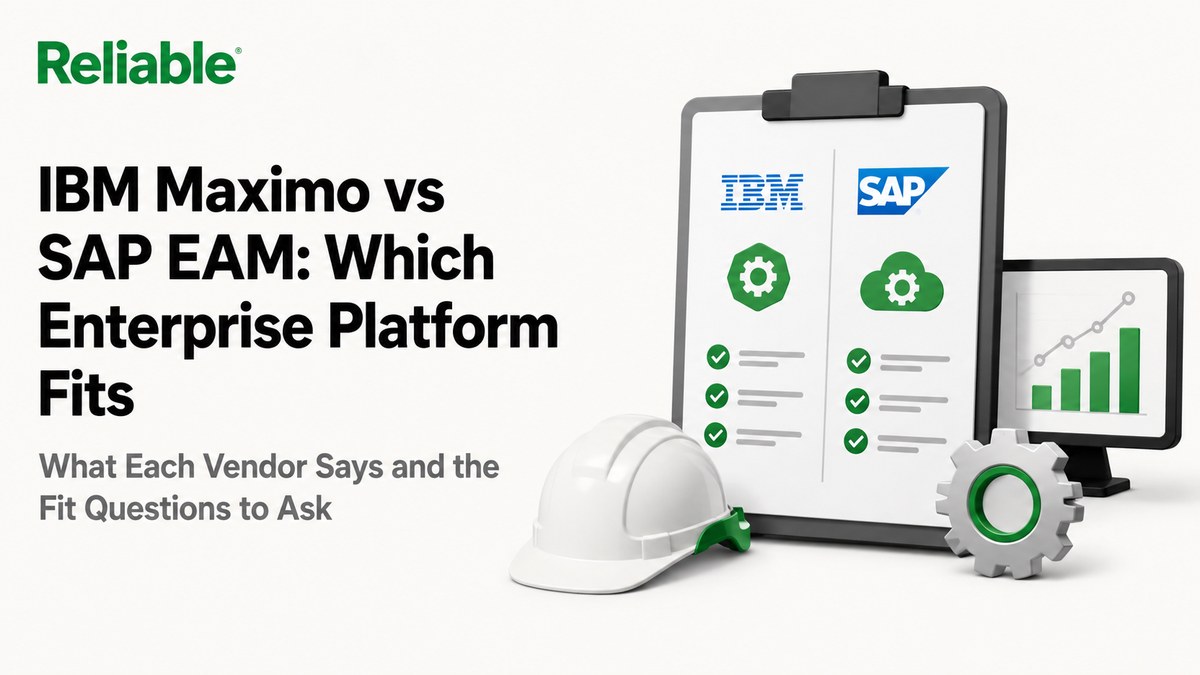

The Short Version: IBM Maximo Application Suite and SAP’s enterprise asset management business area are two enterprise-scale options. IBM publishes Maximo Manage as one application inside that suite, and SAP also publishes asset management capabilities inside SAP Cloud ERP, so a fair comparison starts by reading what each vendor actually publishes.
On the public pages, both vendors describe managing the full lifecycle of physical assets and both describe AI or analytics applied to maintenance and reliability. A structural difference is visible in how each is packaged: IBM presents Maximo Application Suite as a suite licensed through a credit model called AppPoints, while SAP presents enterprise asset management as a business area within supply chain management and also offers asset management capabilities inside SAP Cloud ERP.
This guide from Reliable Magazine does not name a winner. It sets out what IBM says, what SAP says, where the public pages differ, and the fit questions a plant can put to each vendor before committing.
Independence and scope
Reliable Magazine does not sell CMMS or EAM software, consulting, or certification. This guide is independent editorial analysis. It is not an IBM or SAP publication.
All IBM and SAP product claims in this guide are drawn from public vendor pages, listed in full under Sources. The fit questions and examples are editorial synthesis. Where a page uses promotional language, that language is attributed to the vendor rather than presented as an independent finding.
Vendor customer stories, analyst “Leader” badges, and conference claims are not treated as independent proof of anything, and none are used as evidence here.
What each name refers to
IBM Maximo Application Suite and SAP’s EAM business area are not single interchangeable products. IBM publishes Maximo Manage as one application inside the suite. SAP publishes EAM as a business area within supply chain management, and separately documents asset management inside SAP Cloud ERP.
On the IBM side, the public pages describe:
- IBM Maximo Application Suite (MAS), the umbrella product that brings the individual applications together.
- Maximo Manage, one application within the suite. IBM’s documentation states that IBM Maximo Asset Management is now called Maximo Manage.
- Other applications in the suite, which IBM names across its pages, including IBM Maximo Health, IBM Maximo Predict, and IBM Maximo Monitor.
On the SAP side, the public pages describe:
- SAP Enterprise Asset Management (EAM), which SAP’s FAQ frames as a business area within supply chain management.
- SAP intelligent asset management software, which SAP’s EAM product page organizes into a set of named areas.
- SAP Cloud ERP asset management, a separate page describing asset management capabilities delivered within SAP Cloud ERP.
These are documented on different pages and carry different names, so this guide keeps them separate throughout.
What IBM says Maximo is
IBM’s Maximo Application Suite product page describes the suite as a unified asset and facilities management solution that brings maintenance, inspections, and reliability together in one place for critical equipment and infrastructure, using AI to help improve asset uptime, performance, and value.
IBM says the suite is built for operations, maintenance, and facility teams, and that it helps address downtime, aging assets, workforce constraints, and fragmented data.
IBM groups the suite around AI in asset lifecycle management, enterprise asset management (EAM), asset performance management (APM), and asset investment planning (AIP). IBM says Maximo delivers embedded AI across maintenance, field execution, reliability, and planning. IBM describes Maximo APM as using AI, analytics, and sensor data to detect issues early and support condition-based maintenance.
On packaging and licensing, IBM’s pages state that the suite comes in two options: client-managed software or software as a service (SaaS). The suite is purchased using a credit-based licensing and usage model called AppPoints, which IBM describes as a single entitlement to add functionality and users.
IBM’s documentation adds architecture detail. It states that Maximo Application Suite is an integrated suite of applications built on a Red Hat OpenShift environment to provide multi-cloud portability, including support for hybrid cloud or on-premises deployments. IBM describes Red Hat OpenShift as a platform-as-a-service system built around containers that uses Kubernetes orchestration. The documentation also states that Maximo Manage is one of many applications included within the suite, alongside applications such as IBM Maximo Health, IBM Maximo Predict, and IBM Maximo Monitor.
IBM’s documentation states that, after an upgrade to Maximo Manage, user licenses are managed in Maximo Application Suite through AppPoints, and that the same AppPoints can be applied to any application in the suite. The user entitlements named on that page are Limited, Base, Premium, and Self-Service.
IBM’s documentation for Maximo Application Suite as a Service describes it as a cloud-based product that combines suite functions on Red Hat OpenShift on Amazon Web Services, with editions named Essentials, Standard, and Premium.
On the pricing page, IBM repeats the two packages and the AppPoints model, and describes AppPoints as credits or units of value by which the suite can be licensed, with each application and user type requiring a specific number of AppPoints. The pricing page lists components including Maximo Manage, Health, Reliability Strategies, and Mobile. IBM’s FAQ on that page says a customer only needs to install the components it wants to deploy, because of AppPoints.
IBM’s FAQ on the pricing page also states that the suite includes supporting software required to install, implement, and use it, including IBM Cloud Pak for Data, OpenShift, DB2, and WAS Liberty, with no additional purchase required when those programs are used within the suite. That is IBM’s statement about what the entitlement covers, quoted here as IBM’s claim rather than as a cost finding this guide independently verified.
IBM publishes starting package prices and AppPoint figures, but a customer-specific total requires a quote. This guide does not reproduce those figures.
What SAP says EAM is
SAP’s enterprise asset management product page presents enterprise asset management software for managing the entire lifecycle of physical assets. SAP groups its intelligent asset management software into areas the page names: asset operations and planning; maintenance scheduling; maintenance execution; risk estimation and evaluation; reliability methodologies based on FMEA and reliability-centered maintenance; AI-based predictive maintenance; a collaboration platform for asset stakeholders; workforce scheduling and dispatching; analytics; mobile field service; work order management; and mobile asset management.
SAP’s FAQ on that page describes how ERP and EAM relate. It says ERP helps manage and integrate core parts of a business, including finance, HR, manufacturing, supply chain, services, and procurement, among others. It says EAM is a business area within supply chain management that incorporates the management and intelligent maintenance of physical assets throughout the entire asset lifecycle.
SAP’s FAQ also distinguishes a CMMS from an EAM system. It describes a CMMS as software that automates maintenance and operations management and focuses on asset uptime. It describes an EAM system as managing the lifecycle of physical assets, including capital planning, procurement, installation, performance, maintenance, compliance, risk management, and asset disposal. SAP’s FAQ defines asset collaboration as sharing asset data and workflow processes across asset owners, operators, manufacturers, and service providers.
SAP’s current What is EAM page describes EAM as the practice of managing physical assets so they are available, reliable, and safe to use over time. It says EAM software brings together data about assets, maintenance work, inspections, spare parts, and people, and that this makes it easier for maintenance, operations, finance, and planning teams to coordinate their work.
The “What is EAM” page lists common EAM capabilities: asset lifecycle tracking; maintenance management covering preventive, corrective, and condition-based work; inspection and compliance; workforce and resource coordination; performance monitoring and analytics; and integration with finance, supply chain, HR, and GIS. The CMMS-versus-EAM table on that page is SAP’s own comparison, and any row used here is attributed to SAP rather than presented as an industry standard. The guide does not use the benefit percentages on SAP’s page or their underlying third-party sources.
SAP’s Cloud ERP asset management page presents standardized maintenance processes for asset utilization. The capabilities named on that page include technical asset management for onboarding assets and maintaining master data; asset lifecycle management with measurement points; asset hierarchies based on time segments using functional locations and equipment; reusable maintenance task lists; demand monitoring; maintenance planning with preventive and predictive plans; screening of requests; reactive maintenance; maintenance order planning; order scheduling and dispatching; job management; malfunction recording; offline task completion; asset breakdown analysis; and maintenance cost analysis. These are capabilities SAP lists for Cloud ERP asset management, and they are not evidence that every SAP customer has each one deployed.
Where the public pages actually differ
Read side by side, the pages diverge in three ways that a plant can observe directly.
Suite versus ERP-stack framing. IBM presents Maximo Application Suite as a suite. Maximo Manage is one application within Maximo Application Suite, alongside applications such as Health, Predict, and Monitor. SAP presents enterprise asset management as a business area within supply chain management, and separately documents asset management capabilities inside SAP Cloud ERP. A plant reading IBM’s pages sees a suite of asset applications. A plant reading SAP’s pages sees asset management positioned within a broader business and ERP context.
How the commercial pages read. IBM’s public pages put the AppPoints credit model at the center: two packages, credits per application and user type, and entitlements named Limited, Base, Premium, and Self-Service. IBM publishes starting package prices and AppPoint figures, but a customer-specific total requires a quote. SAP’s pages within this guide’s scope center on capability descriptions and business-area framing, and they do not present pricing, so no SAP price is quoted here. The difference to note is what each vendor foregrounds on its public pages, not a price comparison, which the available pages do not support.
Deployment claims on the pages. IBM’s documentation is explicit about architecture: the suite is built on Red Hat OpenShift, described as a container-based platform-as-a-service using Kubernetes orchestration, with multi-cloud portability that IBM says includes hybrid cloud or on-premises deployments, plus a Maximo Application Suite as a Service option on OpenShift on AWS with Essentials, Standard, and Premium editions. SAP’s pages in scope describe SAP Cloud ERP asset management in cloud terms and describe intelligent asset management areas, without laying out a container or orchestration architecture the way IBM’s documentation does. The asymmetry is in what each vendor chooses to document, and it does not by itself favor either product.
None of these differences settles which platform a given plant should buy. They describe how the two vendors package and present their offerings on the public record.
Fit questions a plant can ask
The differences above translate into questions a plant can put directly to each vendor. These are grounded in the public pages, not in any assumed industry average.
- Does the plant already run SAP for finance, HR, procurement, or supply chain, and does it want asset management to live inside that ERP stack? SAP frames EAM as a business area within supply chain management and lists asset management capabilities within SAP Cloud ERP.
- Does the plant want to add reliability and performance applications such as Health, Predict, and Monitor incrementally under one entitlement? IBM’s AppPoints model lets a customer add applications and users under a single entitlement and, per IBM’s FAQ, install only the components it wants to deploy.
- What deployment does the plant require? IBM’s documentation describes hybrid cloud and on-premises options built on OpenShift, as well as a SaaS option on AWS. A plant with on-premises requirements can ask each vendor to state its supported deployment models in writing.
- How does the plant want reliability methods represented? SAP names reliability methodologies based on FMEA and reliability-centered maintenance, and lists AI-based predictive maintenance. IBM lists Maximo Reliability Strategies and describes APM condition-based maintenance.
- Who are the stakeholders beyond the maintenance team? SAP’s current What is EAM page discusses maintenance, operations, finance, and planning teams. SAP’s CMMS/EAM table on that page names EAM core users as maintenance, finance, HR, and procurement. A plant with heavy cross-functional needs can ask how each product supports those roles.
- How will licensing be counted, and what will it total? IBM publishes starting package prices and AppPoint figures, but a customer-specific total requires a quote. A plant can ask IBM for a complete, dated quote in AppPoints and dollars, and ask SAP for its equivalent commercial terms.
One worked example
The two plants below are illustrative examples. Neither is a real company, and neither outcome is a purchase recommendation.
Example plant one: Meridian Foods Packaging (example only, not a real company). Meridian already runs SAP across finance, HR, and procurement, and its operations leaders want asset management to sit inside the environment their teams already use. Reading the public pages, Meridian’s questions center on SAP: How does enterprise asset management as a business area within supply chain management connect to the finance and procurement modules already in place? Which of the SAP Cloud ERP asset management capabilities, such as asset hierarchies using functional locations and equipment, reusable maintenance task lists, and maintenance cost analysis, match how Meridian tracks work today? What would SAP’s commercial terms look like for extending into asset management? Meridian would take those questions to SAP and gather a written scope and quote.
Example plant two: Cascade Regional Water (example only, not a real utility). Cascade manages distributed infrastructure and wants embedded reliability and predictive capability, with some systems that may need to run on-premises. Reading the public pages, Cascade’s questions center on IBM Maximo: Which combination of Maximo Manage, Health, Monitor, and Predict does it actually need, including any application prerequisites, and how would those be counted in AppPoints across its user types? Given IBM’s statement that a customer installs only the components it wants to deploy, what does a phased rollout look like? Which deployment model fits its on-premises requirement, given IBM’s documentation of hybrid and on-premises options on OpenShift alongside the SaaS option on AWS? Cascade would take those questions to IBM and gather a written scope and quote.
Both example plants would then compare the vendors’ written scopes, deployment answers, and commercial terms against their own requirements. This guide does not declare a purchase winner for either one.
Honest limitations
All IBM and SAP product claims in this guide are drawn from public vendor pages; the fit questions and examples are editorial synthesis. Those vendor pages are positioning and marketing material, not independent benchmarks, and they describe what each product claims rather than verified installations.
Product names, packaging, and page content change over time. A plant should confirm the current pages before making any decision, and treat any figure here as accurate to the pages as read for this draft.
Pricing is only partially public. IBM publishes starting package prices and AppPoint figures, but a customer-specific total requires a quote. The SAP pages in scope do not present pricing. This guide does not reproduce IBM’s figures and does not attempt a price comparison.
Reliable Magazine did not run any independent test, trial, or side-by-side benchmark of the two platforms. Vendor customer stories, analyst “Leader” badges, and conference claims were excluded and are not evidence in this guide. Readers evaluating either product should request written, dated scopes and quotes from the vendors directly.
FAQs
Is SAP EAM the same as SAP Cloud ERP asset management?
They are documented on different SAP pages under different names. SAP’s FAQ frames enterprise asset management as a business area within supply chain management, while SAP Cloud ERP asset management is a separate page describing asset management capabilities delivered within SAP Cloud ERP. A plant evaluating SAP should confirm with SAP which offering a given quote refers to.
What is Maximo Manage, and how does it relate to Maximo Application Suite?
IBM’s documentation states that IBM Maximo Asset Management is now called Maximo Manage, and that Maximo Manage is one of many applications included within Maximo Application Suite, alongside applications such as Health, Predict, and Monitor.
How does IBM license Maximo Application Suite?
IBM’s public pages state that the suite is available as client-managed software or as SaaS, and is purchased using a credit-based model called AppPoints, where each application and user type requires a specific number of AppPoints and the same AppPoints can be applied to any application in the suite.
Does IBM publish a simple list price for Maximo?
IBM publishes starting package prices and AppPoint figures, but a customer-specific total requires a quote.
How does SAP distinguish a CMMS from an EAM system?
SAP’s FAQ describes a CMMS as software that automates maintenance and operations management and focuses on asset uptime, and describes an EAM system as managing the full asset lifecycle, including capital planning, procurement, installation, performance, maintenance, compliance, risk management, and asset disposal. That is SAP’s framing on its own page, not an independent standard.
Which platform is better for my plant?
This guide does not name a winner. The better fit depends on a plant’s existing systems, deployment requirements, stakeholder mix, and commercial terms. The fit questions above are designed to be asked of each vendor directly, with written scopes and quotes compared against the plant’s own requirements.
Related Guides
- CMMS vs EAM
- How to Calculate Asset Criticality
- How to Start a PdM Program
- How to Perform RCM
- How to Perform FMEA
- How to Calculate MTBF and MTTR
- Preventive Maintenance
- Maintenance and Reliability Glossary
Sources
- IBM Maximo Application Suite product page
- IBM Maximo pricing page
- IBM Documentation, Maximo Manage overview
- IBM Documentation, Maximo Application Suite as a Service overview
- SAP Enterprise Asset Management product page
- SAP What is EAM page
- SAP Cloud ERP asset management page
Last updated: August 18, 2026. This guide is editorial analysis by Reliable Magazine.