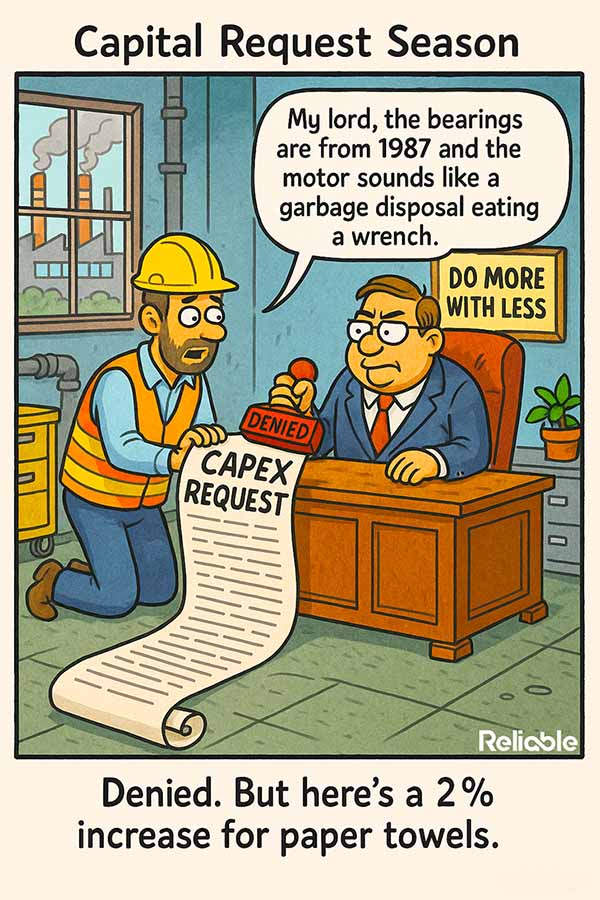

Finance didn’t deny your request because the bearings are fine. They denied it because your request didn’t give them a reason to say yes.
The request didn’t give them a reason to say yes. Fix the request.
The Language Gap Nobody Talks About
Maintenance thinks in failure modes, wear rates, vibration signatures, and MTBF. Finance thinks in IRR, payback period, risk exposure, and capital efficiency. Both are legitimate. They don’t translate automatically.
When you write “motor is showing signs of bearing wear and elevated temperature readings,” a finance manager reads: “maintenance guy wants money for a motor.” When you write “this asset has failed three times in 18 months at an average cost of $47,000 per event, and the next failure has a 70% probability of occurring before Q3,” a finance manager reads: “we have a $141,000 liability sitting on the floor.”
Same motor. Completely different conversation.
Most CAPEX requests describe the problem in terms the requester understands. The approval decision gets made by someone who understands something else entirely.
What Finance Is Actually Looking For
When a capital request hits a CFO’s desk, they’re running a mental filter with roughly four questions. Does this protect revenue? Does this reduce cost? What’s the risk if we don’t fund it? And how fast do we get the money back?
Your request needs to answer all four. Most maintenance requests answer none of them directly, leaving finance to guess, and they’ll guess conservatively every time.
Here’s what that looks like in practice:
- Revenue protection: “This line produces $2.3M per month. A single unplanned failure took it down for 11 days in March 2023. The replacement motor eliminates that exposure.”
- Cost reduction: “Planned replacement at $38,000 versus reactive replacement plus lost production at an average of $112,000 per event, based on our last two failures.”
- Downside risk: “Bearings are original to a 1987 installation. The manufacturer discontinued this motor series in 2019. Lead time on a reactive replacement is 14 to 18 weeks.”
- Payback: “At current failure frequency, payback on the capital investment is 8 months.”
That’s the whole case. You don’t need 12 pages of vibration trend data in the executive summary (put it in the appendix, where it belongs).
The Numbers Finance Needs to See
Three reactive failures on a single motor. Total spend: $344,000. The planned replacement costs $38,000 installed. Finance can do that math. Your job is to put it in front of them before the denial stamp comes out.
Reactive vs. planned replacement cost, single critical motor asset
| Event | Cost | Type |
| Failure 1 (Apr 2022) | $112,000 | Reactive |
| Failure 2 (Nov 2022) | $98,000 | Reactive |
| Failure 3 (Mar 2023) | $134,000 | Reactive |
| Total reactive spend | $344,000 | |
| Planned replacement | $38,000 | Planned |
Reactive cost includes parts, emergency labor, contractor fees, and lost production. Planned cost is total installed: equipment, freight, labor, and commissioning.
Put a table like this on page one of your request. Label it clearly. Let the gap do the talking.
Finance doesn’t distrust maintenance. They distrust requests that make them do the math themselves. Do it for them.
How to Structure the Request Itself
Most CAPEX requests bury the business case in appendices and lead with technical specs. Flip it.
Page one: the business case
Lead with the cost history. Three sentences on the asset, then the numbers. Total spend on reactive failures over the past 24 months. Cost of the proposed replacement. Projected payback period. If there’s a parts availability problem (discontinued motor series, 14-week lead time), say so here, because that’s a supply chain risk that finance understands viscerally.
Page two: the technical justification
This is where the vibration data, thermographic images, and condition monitoring trends go. Finance may never read it. That’s fine. It needs to be there so the request looks credible and so engineering can sign off. But leading with it is why requests get skimmed and denied.
Page three: the ask
One clear number. Total installed cost, not just equipment cost. Finance hates surprises during project execution, and a request that omits freight, installation labor, and commissioning looks naive at best.
Two or three sentences on timing. Why now, specifically. If you’re requesting mid-cycle, explain why waiting for the next budget round is more expensive than funding it today.
The Mistakes That Kill Requests Before They’re Read
Here’s where most submissions fall apart:
- No cost history. Saying a motor “has been problematic” carries zero weight. Three failure events with dates and dollar amounts carries a lot.
- Vague risk language. “Risk of catastrophic failure” means nothing. “14-week lead time on a discontinued motor with a 70% probability of failure before Q3, on a line producing $2.3M per month” means something.
- Asking for too much at once. A $600,000 blanket equipment request for six assets will get picked apart or deferred entirely. Individual requests with individual business cases move faster.
- No alternative analysis. Show the repair-vs.-replace math. If you’ve already considered patching it and ruled it out, say why. It signals that you’ve done the thinking and aren’t just defaulting to new equipment.
- Submitting at the wrong time. Capital committees usually have budget cycles. Requests that arrive two weeks before Q4 close, with no prior conversation, rarely get approved. The approval starts in the hallway, not the submission portal.
The Conversation Before the Request
Here’s something most maintenance engineers won’t do: talk to finance before submitting anything.
One 20-minute conversation with your CFO or controller before the formal request goes in will tell you exactly what they’re worried about this quarter, what the capital committee is prioritizing, and what format they actually want to see. It also means your request lands with a finance manager who’s already heard the story, rather than someone reading it cold.
The technician who knows how to talk money will always get more approved than the one who knows more about the equipment. Both skills matter. Only one gets funded.
What to Do With the Denial
If the request comes back denied, ask for the specific objection. Not “why was this denied” but “what would need to change for this to be approved.” There’s almost always a number, a format, or a timing issue that’s fixable.
Denials are often deferred, not dead. The request that gets approved in Q2 is usually the one that was denied in Q4, resubmitted with better cost data and a shorter payback calculation.
Keep the file. Update it when the next failure happens. By the third event, the math makes the argument for you.
The bearings are still from 1987. The motor still sounds like a garbage disposal eating a wrench. But now you know how to get someone to care about it.