

Metrics drive strategy. They influence budgets, dictate performance reviews, and shape leaders’ perspectives on success. In reliability and maintenance, a single metric can either elevate a program or sink it. But here’s the hard truth: world-class maintenance metrics, when stripped of context, are not just incomplete. They’re misleading.
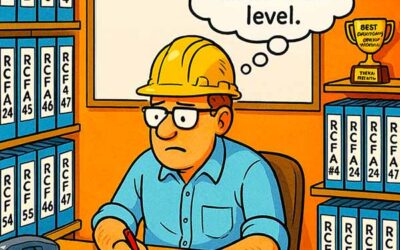
The cartoon tells the story better than a spreadsheet ever could: a proud award for 2% of RAV sits on the wall while the shop floor is buried in broken parts. The message? Numbers alone don’t tell the truth. Metrics without context can easily become dangerous myths.
The Mirage of World-Class Maintenance Metrics
For decades, the industry has been fascinated with benchmarks. The 2% of replacement asset value (RAV) maintenance spend is one of the most quoted “world-class” targets. It suggests that if you keep maintenance costs under that threshold, you’ve achieved excellence.
On paper, this feels right. It provides executives with a clear target, a means to compare plants, and a badge of honor for those who meet the mark. But metrics like 2% of RAV are a mirage when taken at face value. Many plants achieve this by starving themselves of preventive maintenance, deferring corrective actions, or cutting training.
The costs don’t disappear; they simply migrate. Instead of being captured in the maintenance budget, they surface as capital costs for equipment replacements, production losses from unplanned downtime, and higher energy consumption from poorly maintained assets. The number looks lean, but the organization is bleeding money elsewhere.
World-class maintenance metrics must serve as navigation aids, not finish lines. Without context, they are vanity numbers—pretty, but hollow.
Context Turns Numbers into Narrative
The power of a metric lies in the story it tells. Consider two plants, both reporting maintenance spend at 2% of RAV. Plant A enjoys stable equipment, strong uptime, and predictable production. Plant B is drowning in failures, overtime labor, and a depleted spares room.
The numbers are identical, but the realities are worlds apart.
That’s why context transforms a metric into insight. When you evaluate world-class maintenance metrics, you must ask:
- What trade-offs were made to achieve the number?
- Do we see improved reliability, or simply delayed failures?
- How does the metric connect to business value and performance?
Context adds the missing variables: asset age, production demand, criticality, environment, and operating culture. Without it, the metric is just math, detached from meaning.
Using World-Class Maintenance Metrics the Right Way
If benchmarks like 2% of RAV aren’t inherently bad, how do we make them useful? The answer is to treat them as guardrails, not gospel. Here’s how to reframe them:
1. Pair Metrics with Outcomes
Lagging cost indicators, such as the percentage of RAV, must be balanced with performance measures, including overall equipment effectiveness (OEE), mean time between failures (MTBF), and schedule compliance. When costs are low but failures are high, the alarm bells should ring.
2. Focus on Total Cost of Ownership (TCO)
The goal of maintenance is not to minimize cost but to optimize it across the entire asset life cycle. Replacing assets early or losing production capacity dwarfs the “savings” from cutting preventive care. World-class maintenance metrics are only meaningful when they reduce TCO.
3. Customize by Industry and Asset Criticality
A pharmaceutical plant will never have the same targets as a mining operation. Even within a facility, a production-critical turbine deserves a different strategy than a non-critical conveyor. Contextualizing world-class maintenance metrics by industry, asset type, and operating conditions ensures they guide the right behaviors.
4. Incorporate Reliability-Centered Thinking
Reliability-centered maintenance (RCM) shifts the focus from cost alone to function, risk, and consequence of failure. By embedding RCM into the use of world-class maintenance metrics, leaders ensure that metrics drive reliability outcomes instead of shortsighted cost cuts.
The Cultural Trap Behind Vanity Metrics
Why do organizations keep falling for empty numbers? The answer lies in culture. Metrics are often used as shortcuts to communicate success to leadership, boards, or shareholders. A “2% of RAV” report looks neat in a slide deck; it simplifies a messy reality.
But when maintenance teams are incentivized to chase the metric instead of the mission, the culture shifts in dangerous ways:
- Deferred maintenance becomes a badge of honor rather than a warning sign.
- Capital replacements are normalized as if they’re unavoidable, rather than preventable.
- Short-term wins overshadow long-term sustainability, creating a reliability debt that compounds over time.
The cartoon’s pile of broken parts is the real cost of a culture obsessed with vanity metrics. What looks “world-class” in a report feels catastrophic on the shop floor.
Toward Metrics That Drive Real Reliability
So how do we fix it? We must reclaim metrics as tools for truth, not trophies for appearances. That requires three cultural shifts:
- Transparency Over Appearances
Leaders must demand not just numbers but the stories behind them. A world-class maintenance metric without context should invite scrutiny, not celebration. - Integration Across Functions
Finance, operations, and maintenance must align on the meaning of the metric. Cost alone is misleading; only by tying it to uptime, quality, and safety does it reveal real value. - Continuous Improvement Mindset
Benchmarks like 2% of RAV should be starting points, not finish lines. The ultimate goal is to improve asset reliability, extend their life, and reduce total costs year after year.
Metrics Without Context Lie – But With Context They Lead
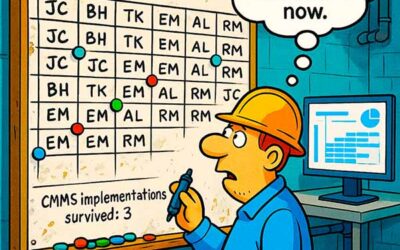
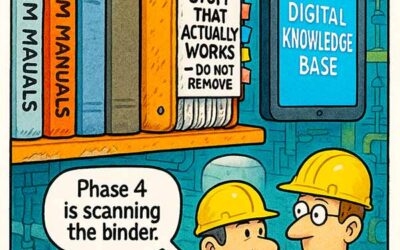
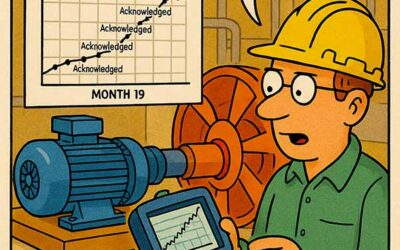
The cartoon captures a truth that spreadsheets often conceal: metrics without context are misleading. A maintenance program boasting a 2% RAV but standing knee-deep in failed parts is not world-class; it’s world-class denial.
World-class maintenance metrics are not inherently bad. But they must be contextualized by outcomes, industry realities, and reliability goals. When treated as gospel, they mislead. When treated as tools, they enlighten.
The challenge for leaders is to resist the comfort of simple numbers and embrace the complexity of truth. Because in reliability, it’s not the metric that matters, it’s what the metric means.