
A bearing fails on a conveyor drive. The crew replaces it, logs the work order, and moves on. Six weeks later, the same bearing fails again. Same location, same symptoms, same emergency scramble.
Sound familiar? It should. Repeat failures account for a staggering portion of unplanned downtime in most industrial facilities. One study from the Society for Maintenance and Reliability Professionals found that up to 40% of equipment failures in some plants are repeats of previous incidents.
The system rewards speed over depth, and maintenance teams know it. Get the line running again. That’s the mandate. Root cause? We’ll get to it later. Except later never comes.
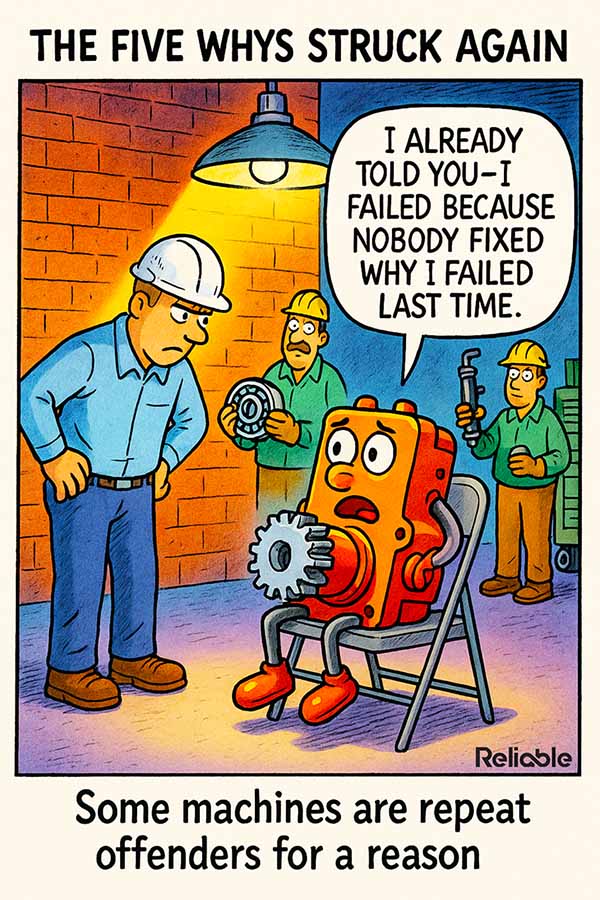
The Five Whys Problem
Most reliability engineers know the Five Whys technique. Ask “why” five times in succession to drill past symptoms and reach the true root cause. It’s elegant in theory. In practice, it’s rarely done well.
The first why is easy. The bearing failed. Why? It overheated. The second why takes a little more thought. Why did it overheat? Lubrication was insufficient. By the third why, things get uncomfortable. Why was lubrication insufficient? The PM schedule called for quarterly greasing, but this bearing needed monthly attention.
Most plants can do the analysis just fine. The follow-through is where everything falls apart. Recommendations get made, then they collect dust.
Here’s where most teams stop. They adjust the PM frequency and call it solved. But the real question, the fourth and fifth why, goes unasked. Why was the PM schedule wrong in the first place? Who set it, and based on what data? Why doesn’t the organization have a process for validating PM intervals against actual equipment performance?
That’s the gap. The first few whys address the technical failure. The deeper whys expose the systemic failure. And systemic failures are the ones that create repeat events.
Why Root Cause Analysis Efforts Stall
There are predictable reasons RCA programs lose momentum, and none of them are mysterious.
- Time pressure: Production demands pull technicians and engineers away from analysis before it’s complete. A partial RCA is worse than none because it creates the illusion that the problem has been addressed.
- Lack of ownership: When nobody is specifically accountable for implementing RCA recommendations, those recommendations die in a shared folder somewhere. Accountability has to be assigned by name, with a deadline.
- Cultural resistance: Asking “why” five times often leads to answers that implicate management decisions, budget constraints, or organizational priorities. That’s uncomfortable territory, and many teams learn to stop asking before they get there.
- No feedback loop: Even when corrective actions are implemented, few plants track whether those actions actually prevented recurrence. Without that feedback, there’s no way to know if the RCA was effective.
The net result is a maintenance organization that’s perpetually reactive. Technicians become experts at the repair, not the prevention. They can swap that bearing in their sleep. They just can’t explain why they keep having to.
Closing the Loop
Effective root cause analysis requires three things that have nothing to do with analytical technique.
First, protected time. The analysis can’t happen in the margins of a shift. It needs dedicated hours, ideally within 48 hours of the failure while evidence is fresh and memories are clear.
A repeat failure is an organizational signal that something upstream is broken and nobody has been given the authority or the time to fix it.
Second, implementation tracking. Every RCA should produce a short list of corrective actions with assigned owners and due dates. Those actions need to be tracked with the same rigor as production KPIs. A recommendation without a tracking mechanism is just a suggestion.
Third, recurrence auditing. After a corrective action is implemented, someone needs to check whether the failure actually stopped. This doesn’t require sophisticated software. A simple spreadsheet tracking failure codes by asset over time will reveal whether your fixes are sticking.
Building the Habit
The plants that do this well treat RCA like a muscle, not a project. They run brief analyses on every significant failure, not just the catastrophic ones. They keep a running log of open recommendations and review it weekly.
- Start with your top 10 repeat failures by frequency or cost. Focus RCA efforts there first.
- Assign one person (not a committee) to own each corrective action.
- Review open RCA items in your weekly maintenance meeting. If it’s not on the agenda, it won’t happen.
Some organizations use formal tools like fault tree analysis or fishbone diagrams. Those are fine. But the tool matters less than the discipline. A Five Whys analysis scribbled on a whiteboard and followed through to completion beats a polished fishbone diagram that sits in a filing cabinet.
The tool matters less than the discipline. A rough analysis that drives action beats a polished report that drives nothing.
The goal is breaking the cycle of repeat failures that drain your budget, exhaust your team, and erode confidence in the maintenance program.
The Real Cost of Skipping It
Consider the math. If a single repeat failure costs $15,000 per event in parts, labor, and lost production, and it happens four times a year, that’s $60,000 annually on one failure mode. A proper RCA with implemented corrective actions might cost $2,000 in labor hours. The return on that investment is 30:1.
Multiply that across a dozen chronic failure modes, and you’re looking at hundreds of thousands of dollars in avoidable costs. That’s not theoretical. It’s money your plant is spending right now on problems it has already diagnosed (or could diagnose) but hasn’t bothered to fix.
- Track the cost of repeat failures separately in your CMMS. Make the number visible to leadership.
- Present RCA wins in dollar terms, not technical terms. “We eliminated a $60,000 annual failure” gets more traction than “we corrected a lubrication deficiency.”
Root cause analysis isn’t glamorous work. It doesn’t involve new technology or expensive consultants. It requires patience, honesty, and follow-through. Those three things are free, and they’re the only things standing between your plant and a dramatically lower failure rate.