Preventing slips and falls in industrial environments requires engineering discipline, consistent inspections, and controls that address the underlying causes rather than just the symptoms. Plants that consistently maintain low injury rates treat surface traction the same way they treat lubrication, cleanliness, alignment tolerances, or electrical insulation integrity: measurable, inspectable, and improvable.
These high-performing operations build structured industrial slip-and-fall prevention strategies grounded in recognized best practices, quantitative benchmarks, and solutions tailored to real operating conditions.
What differentiates these facilities is not the amount of effort they expend, but the precision with which they define acceptable conditions. They eliminate guesswork through documented friction expectations, controlled measurement methods, standardized access geometry verification, drainage improvements, and surface-engineering upgrades designed to perform in harsh industrial environments.
Why Industrial Slip and Fall Prevention Strategies Define Leading Performers
Plants working at an elite safety level use clear, measurable thresholds to evaluate their walking-working surfaces. Rather than relying on generic “keep surfaces dry” directives, they create specific inspection criteria aligned with recognized standards:
- OSHA 1910 Subpart D establishes walking-working surface design requirements, including slope, riser uniformity, load capacity, and lighting minimums.
- ANSI A1264.2 and ANSI B101.1/B101.3 provide voluntary methodologies for slip resistance testing, including dynamic coefficient of friction (DCOF) measurement techniques.
These standards do not prescribe mandatory friction coefficients, but they do offer useful benchmarks. For example, ANSI B101.3 recommends a minimum wet DCOF of 0.42 for level walkways. High-performing facilities frequently adopt this value, or a more conservative threshold, as part of their internal criteria.
Elite organizations recognize that poor drainage and surface contamination account for the majority of slip incidents in industry. Multiple NIOSH investigations indicate that contaminants, moisture, or inadequate drainage cause 60–70% of slip events. This informs their strategy: remove the environmental contributors, and the majority of incident potential disappears with them.
Engineering Modifications That Remove Slip Contributors Before They Form
Leading operations do not wait for near misses to reveal their weaknesses. They engineer hazards out of the system by upgrading surfaces, improving drainage pathways, correcting access geometry, and selecting traction-enhancing materials designed to withstand chemical exposure and thermal cycling.
Surface Engineering and Material Selection That Maintain Traction
Industrial surfaces degrade under UV exposure, chemical washdowns, repeated freeze-thaw cycles, and mechanical abrasion. Plants with mature industrial slip and fall prevention strategies regularly assess:
- Epoxy and aggregate coatings, which typically require re-evaluation every 12–24 months, depending on UV intensity and chemical compatibility.
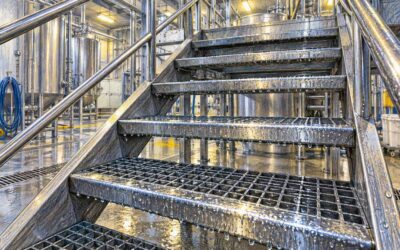
- Serrated vs. plain grating, where serrated styles provide superior traction under wet conditions.
- Anti-slip treads or clip-on systems for metal grating, especially in areas prone to mist, washdowns, or freezing.
One efficient upgrade used by many safety-focused plants is clip-on anti-slip solutions for metal grating. They provide immediate traction improvements without surface prep or downtime. For example, Titan Safety Anti Slip Clips offer fast installation and durable grip suitable for industrial environments.

Drainage Optimization and Moisture Control
Slip risk skyrockets when surfaces cannot shed water effectively. Corrections focus on factors with the most significant engineering impact:
- Slope adjustments – OSHA 1910.22 recommends a minimum slope of 1:48 to promote drainage.
- Grating style selection, where serrated bearing bars and appropriate cross-rod spacing significantly improve dewatering.
- Redirection of process condensate, overhead drip points, and washdown flow paths.
- Insulated or protected grating to delay icing in marginal temperatures.
Changing grating orientation alone has a limited effect; slope and grating type dominate drainage behavior.
Access Geometry and Lighting Standards
Elite plants enforce precise access-system geometry by referencing OSHA’s specific requirements:
- Stair riser uniformity: ±0.25 inches per OSHA 1910.25
- Handrail load capacity: Must withstand 200 lbs. applied in any direction (OSHA 1910.29(f)(1)(i))
- Minimum illumination: 5 foot-candles for walking-working surfaces per OSHA 1910.22
These quantifiable requirements eliminate ambiguity and ensure repeatable compliance across maintenance crews.
Predictive Inspections Grounded in Measurable, Defensible Criteria
Average plants conduct visual inspections. Elite plants perform predictive inspections tied to thresholds, measurement methods, and documented engineering criteria.
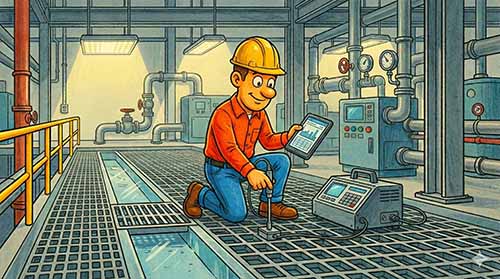
They understand that friction measurement isn’t a simple field test; tribometers react differently to contaminants, footwear, temperature, and surface wetness. As such, these tools are used to set baseline performance, not to forecast real-time slip risk.
A Numbered Framework for Technically Defensible Fall-Prevention Rounds
- Measure baseline slip resistance using calibrated tribometers (e.g., BOT-3000E, English XL) under controlled test conditions. These measurements establish reference values, recognizing that actual traction varies with contaminants and footwear.
- Document contamination contributors, including process residues, humidity spikes, hydraulic mist, coolant overspray, and condensate patterns, not just the visible symptoms.
- Verify access-system geometry against OSHA specifications: stair uniformity, handrail load capacity, lighting minimums, landing transitions, and platform edge conditions.
- Assess protective surface systems such as coatings, aggregate finishes, and removable traction devices for adhesion loss, wear concentration, and chemical degradation.
- Integrate findings into maintenance workflows where deviations automatically generate corrective work orders, prioritized by risk.
This approach transforms inspection rounds into a structured condition-monitoring system.
Field-Ready Controls That Enhance Traction Without Disrupting Work
Frontline adoption ultimately determines whether safety improvements succeed. Plants with low TRIRs (often <1.0) rely on controls that integrate into existing workflows rather than forcing operators to compensate for surface conditions.
Practical Controls Used by High-Performing Facilities
- Clip-on anti-slip grating attachments (e.g., Titan Safety Anti Slip Clips) for rapid deployment on wet or icy grating.
- Abrasive stair nosings designed for both metal and concrete substrates.
- Cold-resistant coatings that maintain grip during freeze-thaw cycling.
- Moisture-absorbing transition mats where indoor and outdoor pathways meet.
- Lighting upgrades to reduce shadows that conceal wet or contaminated patches.
Heat tracing for walkways, while technically feasible, is rarely practical. It is primarily used in extreme-cold conditions, such as arctic facilities or offshore platforms, due to high energy costs, electrical classification constraints, and maintenance requirements. Most plants achieve far better traction improvements through passive measures like drainage enhancements and appropriate grating selection.
Training Focused on Environmental Pattern Recognition
Effective fall-prevention training emphasizes environmental precursors rather than generic reminders. Teams learn to recognize:
- Shifts in temperature gradients that move dew point or freezing conditions across walkways
- Condensate formation tied to process changes
- Residue buildup from production cycles
- Washdown patterns that create recurring wet zones
- Reduced visibility that masks surface contamination
This creates a workforce capable of anticipating hazards based on operating context.
Closing Perspective
Plants that consistently prevent slip incidents do so by design, not chance. Their industrial slip-and-fall prevention strategies combine engineering standards, quantifiable thresholds, calibrated measurement techniques, drainage improvements, surface upgrades, and frontline controls designed for harsh industrial environments.
These organizations understand the hierarchy of contributors – contaminants, drainage failures, inadequate surface engineering, poor lighting, and geometric inconsistencies – and systematically eliminate them. Sometimes the most effective improvements are also the simplest, such as upgrading grating with reliable anti-slip attachments.
The goal is not perfection. It’s predictability. And predictable surfaces create predictable work, with fewer incidents and stronger operational performance.
Sources:
OSHA 1910 Subpart D – Walking-Working Surfaces
OSHA 1910.22, 1910.25, 1910.29 – Surface, stair, and handrail requirements
ANSI A1264.2; ANSI B101.1/B101.3 – Slip Resistance Test Methods
NIOSH Slip/Trip/Fall Prevention Studies