
When Values Hit the Storeroom
Every reliability program starts with good intentions: precision, ownership, continuous improvement.
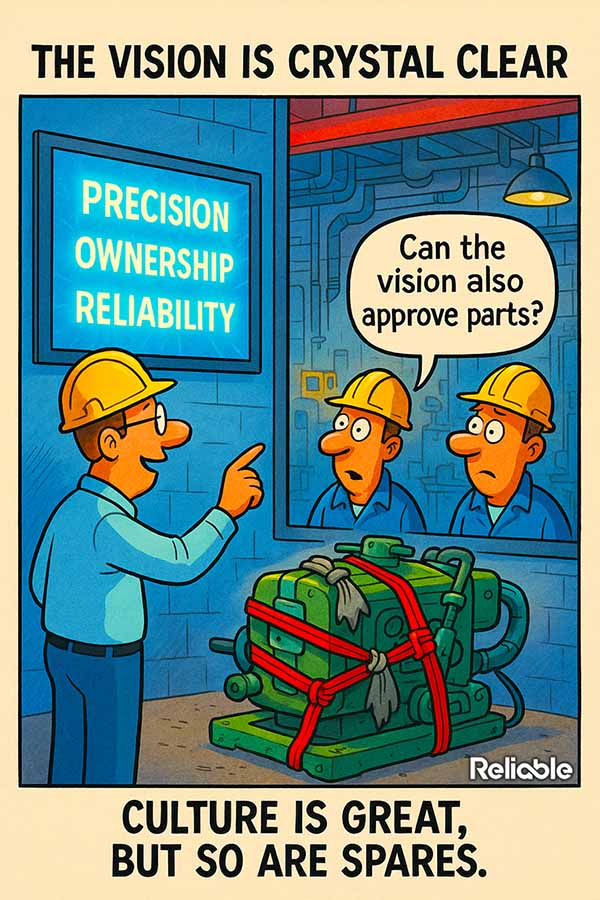
The values get printed on posters, embedded in onboarding presentations, and recited at kickoff meetings with genuine enthusiasm.
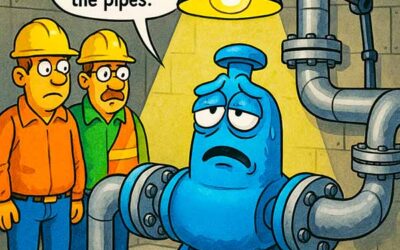
Then a critical pump seal fails at 3 AM on a Thursday, and the storeroom doesn’t have a replacement. The maintenance tech improvises. Production limps along.
Someone places an emergency order with overnight shipping that costs four times the normal price. And the vision statement watches from the break room wall, unable to help.
This disconnect between reliability aspirations and material support is more common than most organizations want to acknowledge.
You can have the best trained technicians and the most sophisticated condition monitoring program in the industry. If the parts aren’t there when they’re needed, none of it matters.
The tension between culture and resources plays out in maintenance departments every day, and it usually comes down to one thing: how the organization actually allocates its money.
The Spare Parts Paradox
Spare parts inventory occupies an awkward position in most organizations. Finance sees it as tied-up capital. Accounting wants it minimized.
Lean initiatives target it for reduction. From a balance sheet perspective, a storeroom full of parts looks like waste.
From a reliability perspective, that same storeroom is insurance. Every critical spare sitting on a shelf represents a failure scenario that won’t turn into an extended outage.
The cost of stocking a $400 mechanical seal is trivial compared to the cost of a 16-hour production shutdown waiting for one to arrive.
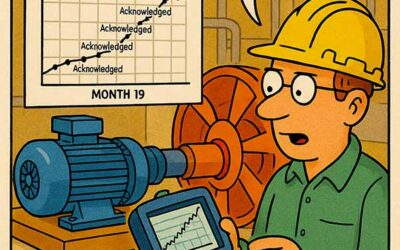
The numbers bear this out. A 2022 study by the Association for Asset Management Professionals found that stockout-related downtime costs manufacturing facilities an average of $50,000 to $250,000 per incident.
- Critical spare stockouts can cost 10 to 50 times the value of the missing part in lost production
- Emergency shipping premiums typically run 3 to 5 times standard freight costs
- Improvised repairs made without proper parts often introduce secondary failures that compound the original problem
- Extended outages caused by parts shortages erode operator confidence in the reliability program itself
The paradox is real: reducing spare parts inventory saves money on paper while creating exposure to costs that are far larger but harder to predict.
Organizations that optimize storeroom investment purely on financial metrics often end up spending more in emergency procurement than they saved through inventory reduction.
Culture Without Resources Is Just Aspiration
Here’s where the vision statement problem gets interesting. Many organizations invest heavily in reliability culture while simultaneously underfunding the material resources that make reliability possible.
Training programs, certifications, team-building events, motivational campaigns: the soft side gets funded. The storeroom doesn’t.
A technician who’s been through precision maintenance training knows exactly how to install a bearing correctly. That knowledge becomes academic if the bearing isn’t in stock and the requisition process takes two weeks.
A technician who’s been through precision maintenance training knows exactly how to install a bearing correctly. That knowledge becomes academic if the bearing isn’t in stock.
The cultural damage from this mismatch is significant. When skilled workers consistently lack the materials to do their jobs properly, they stop believing in the program.
They revert to whatever gets the machine running fastest, which usually means improvised fixes with whatever’s on hand. The culture of precision and ownership gives way to a culture of making do.
And once that shift happens, it’s remarkably hard to reverse. Rebuilding trust with a maintenance team that’s been denied the resources to practice what they were taught takes years.
You can’t retrain someone into believing in a program that’s already let them down. The credibility has to be rebuilt through action, which means funded storerooms and approved requisitions.
Bridging the Gap Between Vision and Storeroom
The solution requires maintenance and finance to speak the same language. Reliability teams need to make the business case for spare parts investment in terms that financial decision-makers understand.
Risk, cost avoidance, and return on investment: that’s the vocabulary that unlocks budgets.
Criticality-Based Stocking
Start by identifying which assets are truly critical to production. For those assets, determine the parts most likely to fail and the consequences of not having them available.
This analysis produces a defensible, data-driven stocking list that even skeptical finance teams can support.
Too many storeroom decisions are based on what was ordered last time or what the vendor happens to have on the truck. A criticality-based approach replaces that inertia with intent.
- Rank assets by criticality using production impact, safety risk, and environmental consequence
- Map failure modes to specific parts for each critical asset using maintenance history and manufacturer data
- Calculate the cost of downtime per hour for each critical system to establish the true value of having spares on hand
- Review and update the critical spares list annually based on actual failure data
The goal is to move spare parts decisions from gut feel to evidence. When you can show that a $2,000 inventory investment protects against a $150,000 downtime risk, the conversation changes.
Making the Financial Case
Maintenance leaders often struggle to get spare parts budgets approved because they frame the request as a cost rather than an investment. The language matters.
Track every instance where a stockout caused extended downtime, emergency procurement costs, or improvised repairs. Quantify those events in dollars.
After 12 months of data collection, you’ll have a compelling cost-avoidance case that frames storeroom investment as risk mitigation.
When you can show that a $2,000 inventory investment protects against a $150,000 downtime risk, the budget conversation changes completely.
Some organizations have found success with a “reliability escrow” approach: setting aside a dedicated fund for critical spares that’s treated as operational insurance rather than maintenance expense.
- Document every stockout event with associated costs (downtime, expediting, secondary damage)
- Present spare parts budgets as risk mitigation investments with calculated ROI
- Propose a dedicated critical spares fund separate from the general maintenance budget
This reframes the investment in terms that finance departments are already comfortable with. Insurance is a concept every executive understands.
Values and Valve Seats
A strong reliability culture is genuinely valuable. It shapes how people think about their work, how they approach problems, and how they treat equipment.
But culture alone can’t keep a plant running. At some point, what matters is whether the right part is on the shelf.
Vision statements set direction. Budgets determine whether you can actually get there.
The most effective reliability programs treat culture and resources as inseparable. They invest in training and spare parts.
They build ownership and stock storerooms. They write vision statements and fund the purchase orders that make those visions achievable.
Because in the end, precision and ownership are only as practical as the parts and tools that make them possible. The values on the wall matter. So do the valve seats in the storeroom.