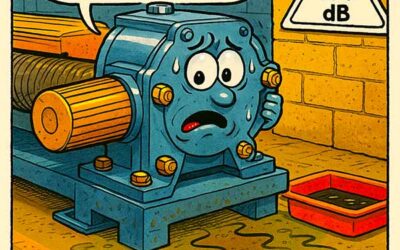
When you first implement condition monitoring, it’s easy to be impressed by the flood of information streaming in from sensors. Thousands of data points pour in every second, promising deep insight into machine health. But as this cartoon humorously captures, a talkative bearing boasting, “I have 47,000 data points to share about my morning!” sometimes that enthusiasm turns into noise.
The core challenge isn’t about collecting data; it’s about understanding it. Plants that don’t control their data inputs or analysis strategy quickly find themselves drowning in irrelevant numbers, false alarms, and diagnostic confusion. True reliability comes from vibration sensor data analysis that filters chaos into precise, actionable knowledge.
Condition monitoring should enable more intelligent decisions, not bury maintenance teams under an avalanche of unfiltered metrics. The key is precision: understanding which parameters matter, why they matter, and how to interpret their behavior over time.
Why Vibration Sensor Data Analysis Can Overload Maintenance Teams
Modern vibration sensors are extremely sensitive, capable of capturing micro-level variations that are often insignificant to real-world operations. This can overwhelm maintenance teams with gigabytes of unnecessary data, producing more alerts than insights.
This data flood usually comes from two sources: over-sampling and lack of context. When sampling frequencies are set too high or baseline conditions aren’t defined, the sensor captures normal machine variability as anomalies. The result is “alarm fatigue,” where reliability engineers begin to tune out warnings entirely.
A well-designed vibration sensor data analysis plan begins by aligning data collection frequency and sensor placement with the machine’s criticality. Not every motor needs high-frequency sampling. Focus high-resolution analysis on assets that are bottlenecks to production or that have high replacement costs.
The value of data isn’t in its volume; it’s in its validity.
The best programs find balance: enough sensitivity to detect emerging faults, but not so much that the data becomes meaningless noise.
Separating the Signal from the Noise in Sensor Data
Filtering is the heart of vibration sensor data analysis. Without proper filtering, your system becomes a mirror of the plant floor, reflecting every bump, hum, and environmental vibration.
Advanced filtering techniques, such as envelope analysis, band-pass filters, and time-domain averaging, allow reliability engineers to isolate fault frequencies related to bearings, gears, or imbalance. For instance, a high-frequency envelope filter can reveal bearing defects that standard time waveform data might hide.
Machine learning has expanded this capability further. Modern platforms can train algorithms to recognize specific fault patterns, automatically suppressing irrelevant data. Combined with FFT (Fast Fourier Transform) analysis, these systems detect subtle shifts in amplitude and frequency that humans might miss.
It’s also vital to correlate vibration data with other predictive technologies. Pairing your vibration data with oil analysis, temperature, and ultrasound creates a multidimensional view of asset condition—each layer verifying and contextualizing the others.
When properly filtered and cross-referenced, vibration data transitions from a stream of random motion into a strategic diagnostic signal.
Turning Vibration Sensor Data Analysis Into Predictive Power
Collecting vibration data is only half the story. The true power of vibration sensor data analysis lies in trend interpretation, detecting small, consistent changes that point toward degradation.
Rather than focusing solely on one-time spikes, analyze how vibration trends evolve. Are amplitudes increasing gradually at a specific frequency band? Is the fault frequency correlating with machine load or temperature? These trends often forecast failure weeks before a catastrophic event.
Trends tell the story that single data points can’t – because reliability lives in the patterns, not the peaks.
Predictive accuracy improves when vibration data is integrated with CMMS or EAM systems. This connection allows condition alerts to automatically trigger work orders, creating a closed-loop process that links data to action. Reliability teams can then prioritize maintenance tasks based on condition severity and potential production impact.
For example, identifying a bearing defect early might allow scheduling a replacement during planned downtime, saving thousands in unplanned stoppage costs. Over time, this continuous monitoring builds a living history of each asset’s health, improving both diagnostics and asset lifecycle planning.
Building a Sustainable Framework for Sensor-Driven Reliability
The ultimate goal of vibration sensor data analysis isn’t just fault detection—it’s continuous improvement. To reach this level, plants need to move beyond reactive data interpretation toward an integrated reliability framework.
Start with data governance. Establish standards for how sensors are installed, calibrated, and maintained. Define what constitutes a meaningful alert versus a nuisance signal. Without governance, even the best sensors can produce inconsistent, unreliable information.
Next, focus on visualization. Dashboards should tell a story—not just display numbers. Highlight trends, correlations, and deviations that are meaningful to decision-makers. Use automated reports to translate technical data into reliability KPIs such as MTBF (Mean Time Between Failures) or risk-based maintenance intervals.
Finally, close the feedback loop. After every maintenance action, compare new vibration data to pre-repair baselines. Did the vibration levels normalize? Did frequencies associated with failure modes disappear? This post-action validation transforms raw data into institutional learning.
As plants evolve their digital maturity, these practices create a “living reliability model” where vibration analytics, human expertise, and maintenance execution operate in harmony.
Conclusion: Don’t Just Collect Data, Understand It
Condition monitoring was never meant to be a numbers game. A sensor that captures 47,000 data points a morning isn’t providing clarity; it’s giving clutter unless properly managed.
The art and science of vibration sensor data analysis lie in making sense of that flood: knowing what to measure, how to interpret it, and when to act. When mastered, this discipline turns a noisy signal into a strategic advantage, helping you anticipate failures, extend asset life, and ensure uptime across the plant.
The most reliable plants aren’t those with the most data; they’re the ones that know exactly which data matters.